


The Impact of Device Settings, Use Patterns, and Flavorings on Carbonyl Emissions from Electronic Cigarettes
- PMID: 32764435
- PMCID: PMC7460324
- DOI: 10.3390/ijerph17165650
The Impact of Device Settings, Use Patterns, and Flavorings on Carbonyl Emissions from Electronic Cigarettes
Abstract
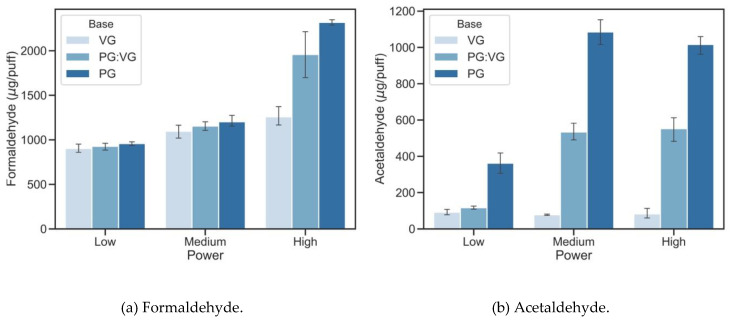
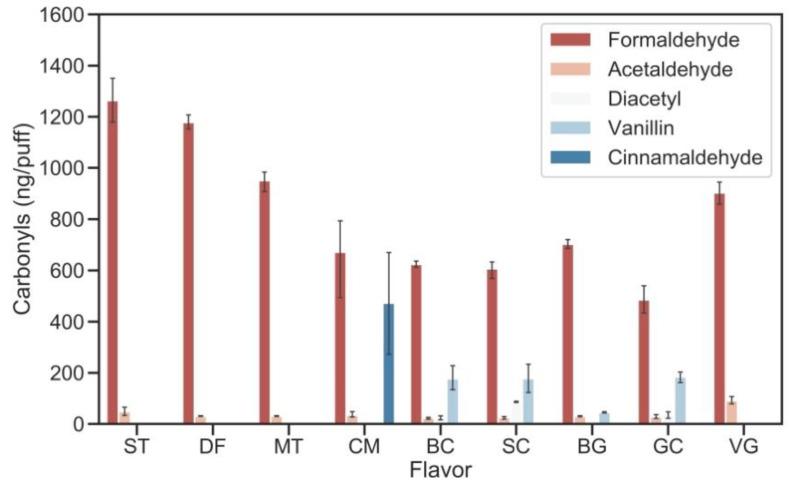
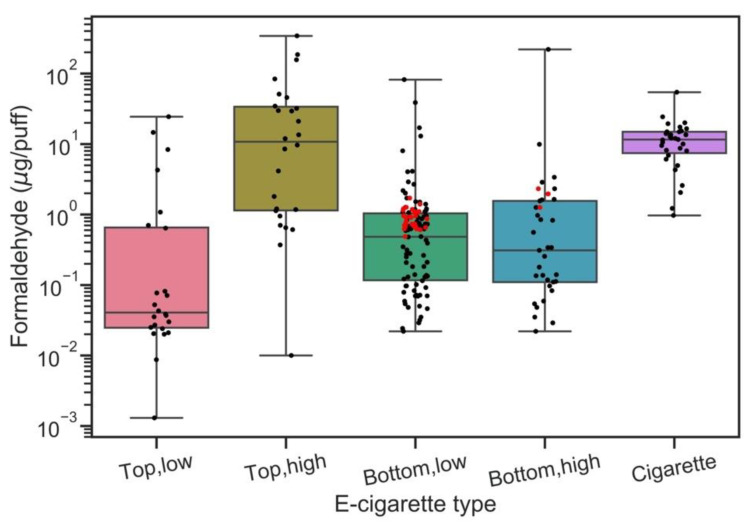
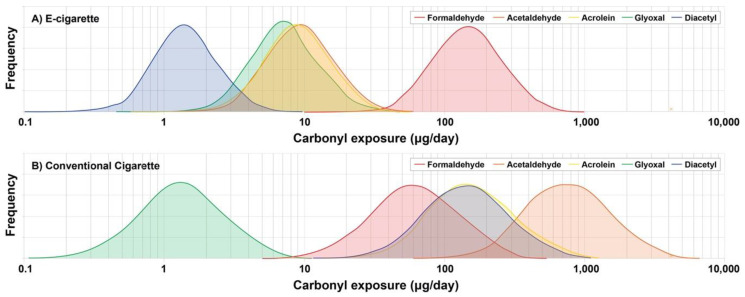
Health impacts of electronic cigarette (e-cigarette) vaping are associated with the harmful chemicals emitted from e-cigarettes such as carbonyls. However, the levels of various carbonyl compounds under real-world vaping conditions have been understudied. This study evaluated the levels of carbonyl compounds (e.g., formaldehyde, acetaldehyde, glyoxal, and diacetyl, etc.) under various device settings (i.e., power output), vaping topographies, and e-liquid compositions (i.e., base liquid, flavor types). The results showed that e-vapor carbonyl levels were the highest under higher power outputs. The propylene glycol (PG)-based e-liquids generated higher formaldehyde and acetaldehyde than vegetable glycerin (VG)-based e-liquids. In addition, fruit flavored e-liquids (i.e., strawberry and dragon fruit) generated higher formaldehyde emissions than mint/menthol and creamy/sweet flavored e-liquids. While single-top coils formed 3.5-fold more formaldehyde per puff than conventional cigarette smoking, bottom coils generated 10-10,000 times less formaldehyde per puff. In general, increases in puff volume and longer puff durations generated significantly higher amounts of formaldehyde. While e-cigarettes emitted much lower levels of carbonyl compounds compared to conventional cigarettes, the presence of several toxic carbonyl compounds in e-cigarette vapor may still pose potential health risks for users without smoking history, including youth. Therefore, the public health administrations need to consider the vaping conditions which generated higher carbonyls, such as higher power output with PG e-liquid, when developing e-cigarette product standards.
Keywords: carbonyl; e-liquid; electronic cigarette; flavoring; power; vaping topography.
Conflict of interest statement
The authors declare no conflict of interest.
Figures
References
-
- Flora J.W., Meruva N., Huang C.B., Wilkinson C.T., Ballentine R., Smith D.C., Werley M.S., McKinney W.J. Characterization of potential impurities and degradation products in electronic cigarette formulations and aerosols. Regul. Toxicol. Pharmacol. 2016;74:1–11. doi: 10.1016/j.yrtph.2015.11.009. - DOI - PubMed
-
- Goniewicz M.L., Knysak J., Gawron M., Kosmider L., Sobczak A., Kurek J., Prokopowicz A., Jablonska-Czapla M., Rosik-Dulewska C., Havel C. Levels of selected carcinogens and toxicants in vapour from electronic cigarettes. Tob. Control. 2014;23:133–139. doi: 10.1136/tobaccocontrol-2012-050859. - DOI - PMC - PubMed
-
- Uchiyama S., Ohta K., Inaba Y., Kunugita N. Determination of carbonyl compounds generated from the E-cigarette using coupled silica cartridges impregnated with hydroquinone and 2, 4-dinitrophenylhydrazine, followed by high-performance liquid chromatography. Anal. Sci. 2013;29:1219–1222. doi: 10.2116/analsci.29.1219. - DOI - PubMed
-
- US EPA Integrated Risk Information System (IRIS) [(accessed on 20 June 2020)]; Available online: https://www.epa.gov/iris.
Publication types
MeSH terms
Substances
Grants and funding
LinkOut - more resources
Full Text Sources
Medical
