. 2020 Aug 6;10(1):13210.
doi: 10.1038/s41598-020-70093-z.

A FACS-based approach to obtain viable eosinophils from human adipose tissue

Affiliations

A FACS-based approach to obtain viable eosinophils from human adipose tissue

James D Hernandez et al. Sci Rep. .

Erratum in

Abstract

Eosinophils have been widely investigated in asthma and allergic diseases. More recently, new insights into the biology of these cells has illustrated eosinophils contribute to homeostatic functions in health such as regulation of adipose tissue glucose metabolism. Human translational studies are limited by the difficulty of obtaining cells taken directly from their tissue environment, relying instead on eosinophils isolated from peripheral blood. Isolation techniques for tissue-derived eosinophils can result in unwanted cell or ribonuclease activation, leading to poor cell viability or RNA quality, which may impair analysis of effector activities of these cells. Here we demonstrate a technique to obtain eosinophils from human adipose tissue samples for the purpose of downstream molecular analysis. From as little as 2 g of intact human adipose tissue, greater than 104 eosinophils were purified by fluorescence-activated cell sorting (FACS) protocol resulting in ≥ 99% purity and ≥ 95% viable eosinophils. We demonstrated that the isolated eosinophils could undergo epigenetic analysis to determine differences in DNA methylation in various settings. Here we focused on comparing eosinophils isolated from human peripheral blood vs human adipose tissue. Our results open the door to future mechanistic investigations to better understand the role of tissue resident eosinophils in different context.


Conflict of interest statement

The authors declare no competing interests.

Figures

Figure 1
Figure 1
Immunohistochemistry of eosinophils in human adipose tissue. Immunohistochemical staining (brown cells) with antibody to eosinophil peroxidase specifically stains eosinophils within adipose tissue. (a) Subcutaneous fat, scale bar = 50 µM (SC-Fat), (b) Visceral fat (OM-Fat), scale bar = 50 µM, (c) Visceral fat (OM-Fat), scale bar = 20 µM. Dotted rectangular and arrow point to eosinophil, (d) Visceral fat (OM-Fat), enlarged rectangular area depicted in (c) on further enlargement identifies eosinophil.
Figure 2
Figure 2
FACS gating scheme for eosinophil sorted from human blood, SC-Fat, and OM-Fat. (A) Samples underwent gating to remove doublets and dead cells (not shown), followed by gating on forward (FSC) and side scatter (SSC). Leukocytes were identified as CD45 (ubiquitous leukocyte marker), SSC hi to gate for granulocytes. Next, CD16-Siglec-8+ cells were selected, followed by CD14-Siglec8+ cells to provide maximal separation of populations with these fluorochrome conjugated antibodies. The eosinophils (EOS) population was identified as CD45+CD14CD16CD66b+Siglec-8+and were sorted to ≥ 99% purity. (B) Representative Hema 3 stained cytospins of sorted populations show eosinophils at 20× and 60× magnification.
Figure 3
Figure 3
Eosinophils can be sorted similarly from adipose tissue and differentiated from mast cells in the same tissue. (a) Similar to the gating strategy in Fig. 2, eosinophils (EOS) were identified as CD45+CD14CD16CD66b+Siglec-8+ from two subjects. (b) To identify the adipose Siglec-8+CD66b negative population seen in (a), we added CD117 to the cocktail and adjusted the gating strategy. Mast cells are CD45+CD14CD16CD66bSiglec-8+CD117+and Eosinophils are CD45+CD14CD16CD66b+Siglec-8+CD117 in this gating strategy. (c) As shown by Hema 3 staining of pre-sort SVF and post-sort SVF cytopspins, both eosinophils and mast cells are present in the SVF fraction they can be sorted to 99% purity with this gating strategy.
Figure 4
Figure 4
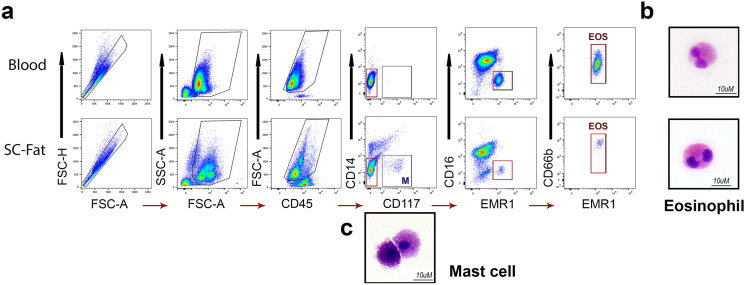
Eosinophils isolated with EMR1 gating strategy. (a) To isolate eosinophils by an alternative labelling and gating strategy we replaced Siglec-8 with EMR1. Blood and adipose tissue were completed side by side for comparison. Eosinophils were CD45+CD14CD16CD117EMR1+CD66b+ and mast cells were readily defined by CD45+CD14CD117+. (b) Representative images of > 99% pure sorted eosinophils and mast cells are shown by Hema 3 staining.
Figure 5
Figure 5
Heatmaps of statistically significant differentially methylated regions (DMRs) identified from eosinophils isolated from different sources using WGBS data. a,b DMRs from eosinophils isolated from peripheral blood (Blood) versus adipose tissue (AT) in subject 1 (a) or subject 2 (b).

References

    1. O'Neill LAJ, Kishton RJ, Rathmell J. A guide to immunometabolism for immunologists. Nat. Rev. Immunol. 2016;16:553–565. doi: 10.1038/nri.2016.70. - DOI - PMC - PubMed
    1. Rothenberg ME, Hogan SP. The eosinophil. Annu. Rev. Immunol. 2006;24:147–174. doi: 10.1146/annurev.immunol.24.021605.090720. - DOI - PubMed
    1. Kariyawasam HH, Robinson DS. The eosinophil: The cell and its weapons, the cytokines, its locations. Semin. Respir. Crit. Care Med. 2006;27:117–127. doi: 10.1055/s-2006-939514. - DOI - PubMed
    1. Weller PF, Spencer LA. Functions of tissue-resident eosinophils. Nat. Rev. Immunol. 2017;17:746–760. doi: 10.1038/nri.2017.95. - DOI - PMC - PubMed
    1. Jacobsen EA, Helmers RA, Lee JJ, Lee NA. The expanding role(s) of eosinophils in health and disease. Blood. 2012;120:3882–3890. doi: 10.1182/blood-2012-06-330845. - DOI - PMC - PubMed

Publication types