Review
. 2020 Jun 25:20:380-385.
doi: 10.1016/j.jor.2020.06.015. eCollection 2020 Jul-Aug.

Triaging Spine Surgery and Treatment during the COVID-19 Pandemic

Affiliations
Review

Triaging Spine Surgery and Treatment during the COVID-19 Pandemic

James M Rizkalla et al. J Orthop. .

Erratum in

Abstract

Objective: To utilize evidence-based medicine to help determine guidelines for spinal surgery during the Covid-19 era.

Methods: A literature review was performed of peer-reviewed articles focused on indications for common procedures in spine surgery. Based on these indications, we sub-categorized these procedures into elective, urgent and emergent categories. Case examples provided.

Results: Indications for spinal surgery were reviewed based on current literature and categorized. This manuscript presents a decision-making algorithm to help provide a guideline for determining the appropriateness of proceeding with spinal surgery during this COVID-19 time period.

Conclusions: Spinal surgery during the COVID-19 pandemic is an intricate challenging decision-making process, involving clinical, sociologic and economic factors.

Keywords: COVID-19; Coronavirus; Infectious disease; Pandemic; Spinal surgery; Spine.


Figures

Fig. 1
Fig. 1
Decision-making algorithm for determining urgency of spinal surgery during the COVID-19 Pandemic.
Fig. 2
Fig. 2
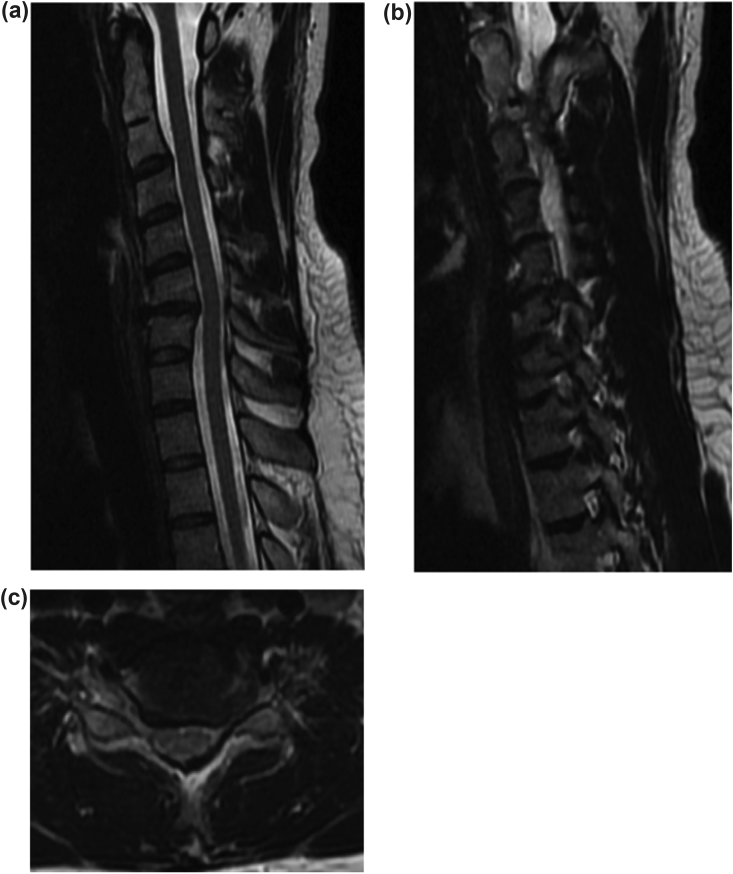
T2 weighted sagittal MRI of the cervical spine revealing degenerative changes and disc space narrowing at C6/7 with moderate disc osteophyte complexes contributing to a moderate degree of central canal stenosis b) Sagittal MRI cut through Entry zone of the left cervical foramen with severe left neuroforaminal stenosis c) Axial MRI cut through the C6– C7 Disc space revealing left sided foraminal stenosis.
Fig. 3
Fig. 3
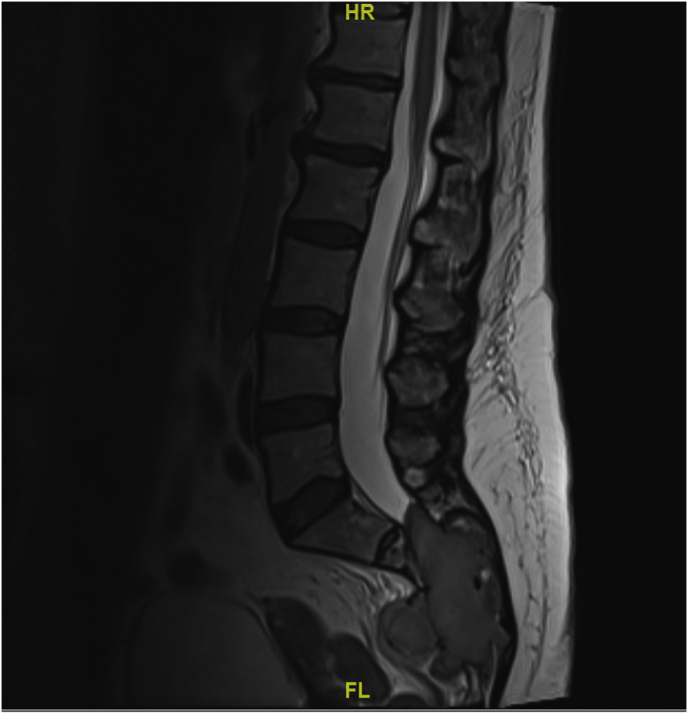
T2 weighted sagittal MRI of the lumbar spine revealing a large multilobulated destructive mass of the sacrum measuring approximately 8.1 cm in craniocaudal dimension and 8.7 x 3.2 cm transverse dimensions with presacral extension. Obliteration of the spinal canal at the involved levels with significant mass affect contouring the thecal sac S1-2.
Fig. 4
Fig. 4
CT scan shows large expansile lytic destructive mass of the sacrum with lobular extension into the presacral soft tissues.
Fig. 5
Fig. 5
Three month follow-up AP radiograph of the pelvis revealing post operative decompression and lumbopelvic posterior instrumentation from L4-S1.

References

    1. Sun P., Lu X., Xu C. Understanding of COVID-19 based on current evidence. J Med Virol. 2020 doi: 10.1002/jmv.25722. Epub ahead of print. - DOI - PMC - PubMed
    1. Ji W., Wang W., Zhao X. Homologous recombination within the spike glycoprotein of the newly identified coronavirus may boost cross‐species transmission from snake to human. J Med Virol. 2020 doi: 10.1002/jmv.25682. Epub ahead of print. - DOI - PMC - PubMed
    1. Zhu N., Zhang D., Wang W. A novel coronavirus from patients with pneumonia in China. N Engl J Med. 2019 doi: 10.1056/NEJMoa2001017. Epub ahead of print 2020. - DOI - PMC - PubMed
    1. Benvenuto D., Giovanetti M., Ciccozzi A. The 2019-new coronavirus epidemic: evidence for virus evolution. J Med Virol. 2020 doi: 10.1002/jmv.25688. Epub ahead of print. - DOI - PMC - PubMed
    1. Zhou P., Lou Yang X., Wang X.G. A pneumonia outbreak associated with a new coronavirus of probable bat origin. Nature. 2020 doi: 10.1038/s41586-020-2012-7. Epub ahead of print. - DOI - PMC - PubMed

LinkOut - more resources