Review
. 2020 Jul 17:11:1092.
doi: 10.3389/fpls.2020.01092. eCollection 2020.

Detection of Plant Viruses and Disease Management: Relevance of Genetic Diversity and Evolution

Affiliations
Review

Detection of Plant Viruses and Disease Management: Relevance of Genetic Diversity and Evolution

Luis Rubio et al. Front Plant Sci. .

Abstract

Plant viruses cause considerable economic losses and are a threat for sustainable agriculture. The frequent emergence of new viral diseases is mainly due to international trade, climate change, and the ability of viruses for rapid evolution. Disease control is based on two strategies: i) immunization (genetic resistance obtained by plant breeding, plant transformation, cross-protection, or others), and ii) prophylaxis to restrain virus dispersion (using quarantine, certification, removal of infected plants, control of natural vectors, or other procedures). Disease management relies strongly on a fast and accurate identification of the causal agent. For known viruses, diagnosis consists in assigning a virus infecting a plant sample to a group of viruses sharing common characteristics, which is usually referred to as species. However, the specificity of diagnosis can also reach higher taxonomic levels, as genus or family, or lower levels, as strain or variant. Diagnostic procedures must be optimized for accuracy by detecting the maximum number of members within the group (sensitivity as the true positive rate) and distinguishing them from outgroup viruses (specificity as the true negative rate). This requires information on the genetic relationships within-group and with members of other groups. The influence of the genetic diversity of virus populations in diagnosis and disease management is well documented, but information on how to integrate the genetic diversity in the detection methods is still scarce. Here we review the techniques used for plant virus diagnosis and disease control, including characteristics such as accuracy, detection level, multiplexing, quantification, portability, and designability. The effect of genetic diversity and evolution of plant viruses in the design and performance of some detection and disease control techniques are also discussed. High-throughput or next-generation sequencing provides broad-spectrum and accurate identification of viruses enabling multiplex detection, quantification, and the discovery of new viruses. Likely, this technique will be the future standard in diagnostics as its cost will be dropping and becoming more affordable.

Keywords: PCR; diagnosis; hybridization; loop-mediated isothermal amplification; multiplexing; next-generation sequencing; sensitivity; specificity.


Figures

Figure 1
Figure 1
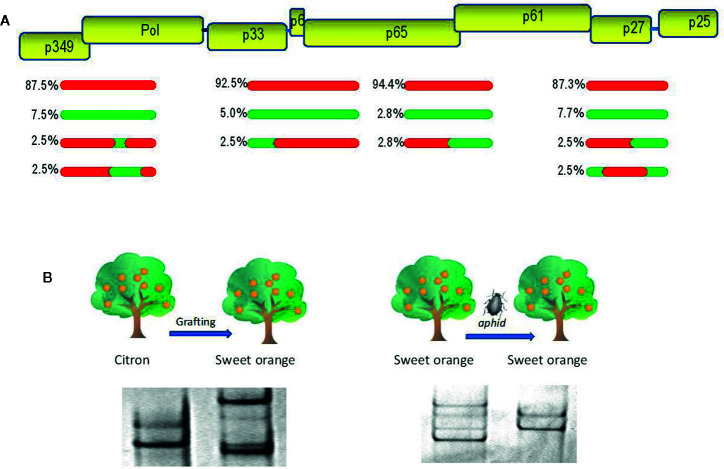
Evolutionary analysis of citrus tristeza virus (CTV). (A) A population of recombinants within the CTV isolate SY568-B6 (Vives et al., 2005). Above is a partial representation of the genomic map of CTV with boxes corresponding to genes. Red and green lines indicate sequence types with about 90% nucleotide identity between them. The relative frequency of each sequence type is indicated. (B) Genetic variation of the CTV isolate T317 after host change (Rubio et al., 2000) and the CTV isolate 408F after a transmission event by the aphid Aphis gossypii (d’Urso et al., 2000). Genetic variants are showed as electrophoretic bands after single-strand conformation polymorphism (SSCP) analysis.
Figure 2
Figure 2
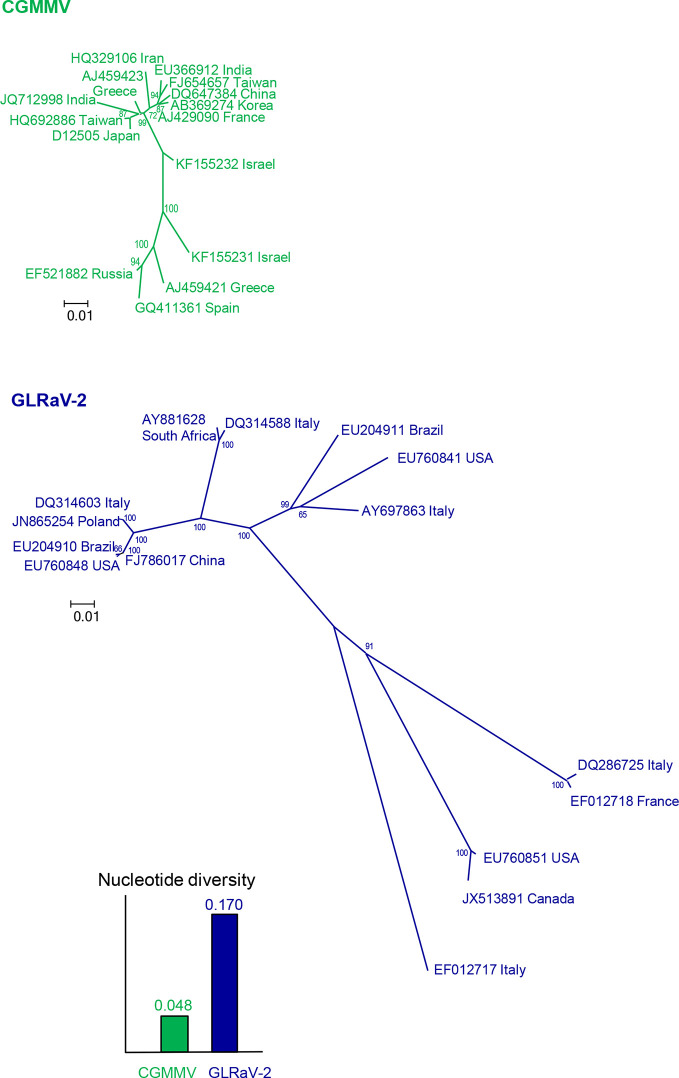
Nucleotide diversities and unrooted neighbor-joining trees of the coat protein gene of 15 isolates of cucumber green mottle mosaic virus (CGMMV) and grapevine leafroll-associated virus 2 (GLRaV-2). Branch lengths are proportional to the genetic distances and bootstrap values ≥ 65% are indicated.
Figure 3
Figure 3
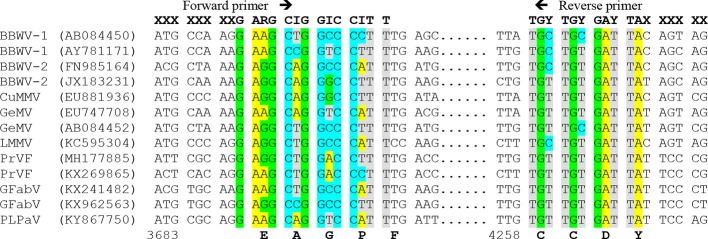
Multiple nucleotide alignment of RNA 1 of different members of the genus Fabavirus, showing a hypothetical design of degenerated primers based on conserved nucleotide positions. On top are hypothetical primers with degenerate sites: R=A+G, Y= C+T and I (inosine)= A+C+G+T, and X= less restricted nucleotides. Virus species of the genus Fabavirus are Broad bean wilt virus 1 (BBWV-1), BBWV-2, Cucurbit mild mosaic virus (CuMMV), Gentian mosaic virus (GeMV), Lamium mild mosaic virus (LMMV), Prunus virus F (PrVF), Grapevine fabavirus (GFabV) and the tentative member peach leaf pitting-associated virus (PLPaV). GenBank accession numbers are between parentheses. Below are the nucleotide positions for GenBank accession AY781171 and the conserved amino acids.
Figure 4
Figure 4
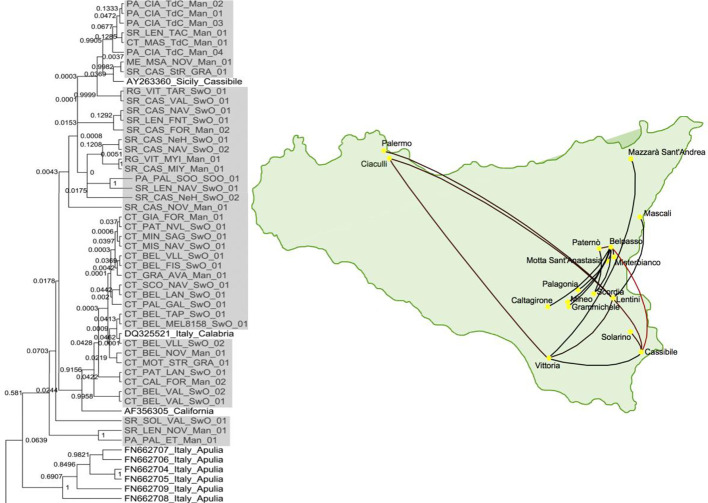
Phylogenetic tree of citrus tristeza virus (CTV) isolates collected from the first outbreak of CTV in Sicily, Italy and a map showing the migration paths within Sicily (Davino et al., 2013).
Figure 5
Figure 5
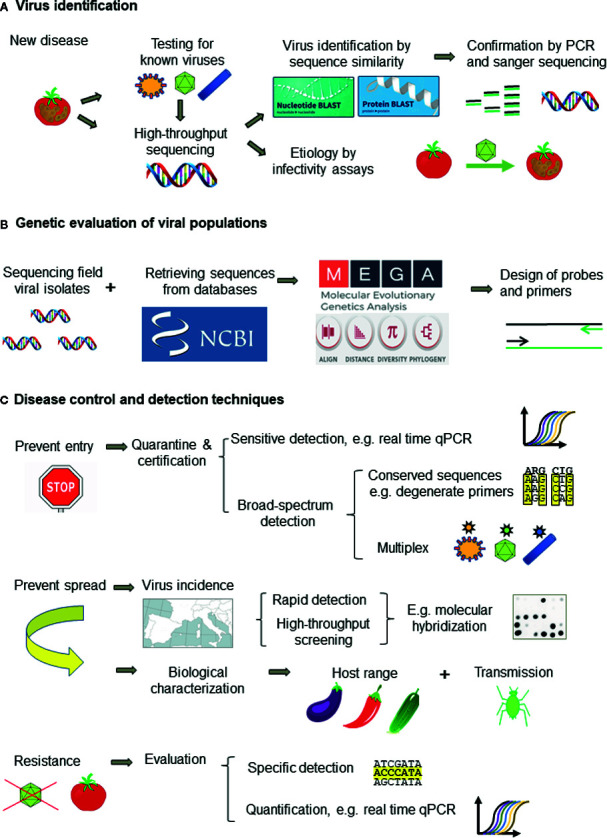
Workflow for tackling plant viral diseases showing: (A) the approach for plant virus identification, (B) genetic evaluation of virus populations for designing detection techniques, and (C) the appropriate detection techniques for disease management.

References

    1. Abrahamian P. E., Seblani R., Sobh H., Abou–Jawdah Y. (2013). Detection and quantitation of two cucurbit criniviruses in mixed infection by real-time RT-PCR. J. Virol. Methods 193, 320–326. 10.1016/j.jviromet.2013.06.004 - DOI - PubMed
    1. Acosta-Leal R., Rush C. (2007). Mutations associated with resistance–breaking isolates of Beet necrotic yellow vein virus and their allelic discrimination using TaqMan technology. Phytopathology 97, 325–330. 10.1094/PHYTO-97-3-0325 - DOI - PubMed
    1. Acosta-Leal R., Duffy S., Xiong Z., Hammond R., Elena S. F. (2011). Advances in plant virus evolution: translating evolutionary insights into better disease management. Phytopathology 101, 1136–1148. 10.1094/PHYTO-01-11-0017 - DOI - PubMed
    1. Adams M. J., Antoniw J. F. (2004). Codon usage bias amongst plant viruses. Arch. Virol. 149, 113–135. 10.1007/s00705-003-0186-6 - DOI - PubMed
    1. Agudelo-Romero P., Carbonell P., Pérez-Amador M. A., Elena S. F. (2008). Virus adaptation by manipulation of host’s gene expression. PloS One 3, e2397. 10.1371/journal.pone.0002397 - DOI - PMC - PubMed