


Correlation Between Serum Levels of 25-Hydroxyvitamin D and Severity of Community-Acquired Pneumonia in Hospitalized Patients Assessed by Pneumonia Severity Index: An Observational Descriptive Study
- PMID: 32765992
- PMCID: PMC7398711
- DOI: 10.7759/cureus.8947
Correlation Between Serum Levels of 25-Hydroxyvitamin D and Severity of Community-Acquired Pneumonia in Hospitalized Patients Assessed by Pneumonia Severity Index: An Observational Descriptive Study
Abstract
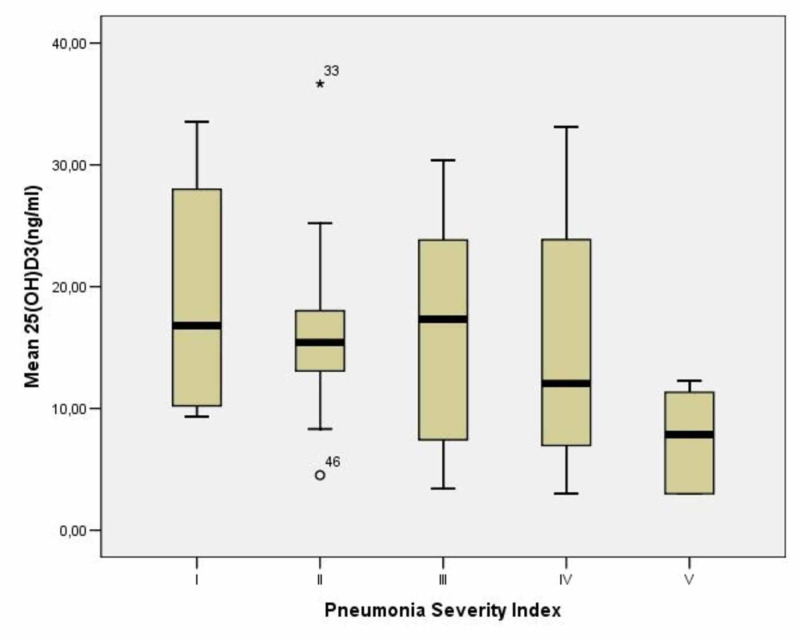
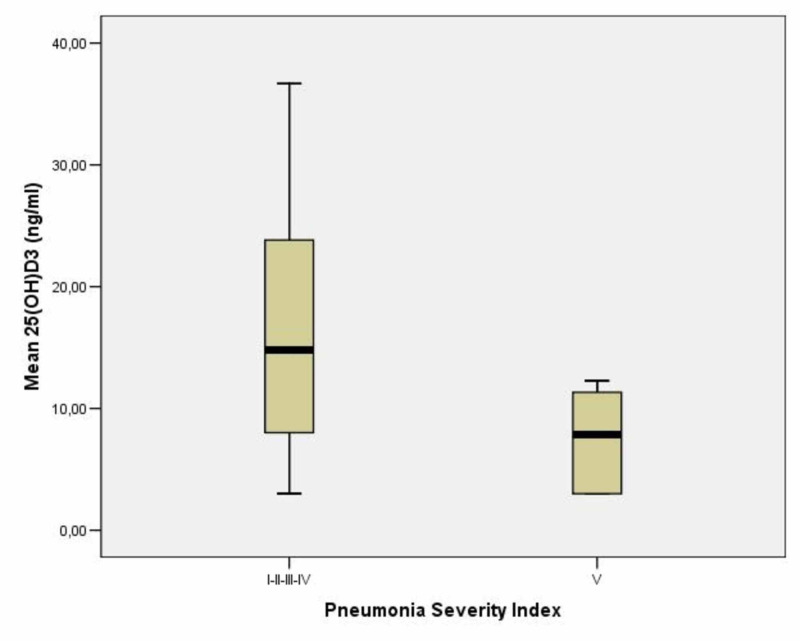
Introduction Pneumonia severity index (PSI) is a prognostic index used for estimating the possibility of death due to community-acquired pneumonia. Vitamin D is a fat-soluble vitamin, essential for calcium and phosphate homeostasis. Vitamin D also has antimicrobial properties and according to recent studies, its deficiency may be correlated to an increased frequency of respiratory infections. The serum concentration of 25-hydroxyvitamin D (25(OH)D) is the best vitamin D status index reflecting vitamin D produced in the skin and offered from food and dietary supplements. Methods The study involved patients, who fulfilled the criteria of community-acquired pneumonia. The exclusion criteria were: patients <18 years old, severely immunocompromised patients, patients with tuberculosis, patients with malabsorption disorders, nursing home residents, patients with a history of malignancy, chronic renal or liver disease, patients with congestive health failure or cerebrovascular disease, and patients receiving vitamin D as a supplement. The following parameters, recorded on admission, were evaluated: age, sex, co-morbidity, residence in a nursing home, duration of symptoms, clinical symptoms, confusion, blood gas analysis, chest radiograph (pleural effusion), and laboratory parameters. The patients were classified in risk classes according to the PSI. Blood samples were collected within the first 48 hours of hospitalization. The serum levels of 25-hydroxyvitamin D were determined by electrochemiluminescence binding assay in Roche Cobas 601 immunoassay analyzer and mean serum levels of 25-hydroxyvitamin D in each risk class were calculated. For statistical analysis, the statistical program SPSS for Windows version 17.0 (Statistical Package for the Social Sciences, SPSS Inc., Chicago, IL) was used. Results A total of 46 patients, 28 males and 18 females, with a mean age of 71.5±17.57 years, hospitalized with community-acquired pneumonia, were included. Sixteen patients (35%) had a severe deficiency, with 25(OH)D levels <10 ng/ml, 17 patients (37%) had moderate deficiency with 25(OH)D levels between 10-20 ng/ml, and 13 patients (28%) had insufficiency with 25(OH)D levels between 20-29 ng/ml. According to the PSI, four (8.7%) patients with a mean age of 53.75±15.43 years were classified as risk class I, 10 (21.7%) patients with a mean age of 54.7±14.82 years as class II, 10 (21.7%) patients with a mean age of 68.41±3.96 years as class III, 17 (37%) patients with a mean age of 84.82±9.73 years as class IV, and five (10.9%) patients with a mean age of 80.2±9.41 years as class V. The mean levels of 25(OH)D were 19.11±11.24 ng/ml in class I, 16.81±8.94 ng/ml in class II, 16.65±9.18 ng/ml in class III, 14.76±10.22 ng/ml in class IV, and 7.49±4.41 ng/ml in class V. There was a positive correlation between low levels of 25(OH)D and the pneumonia severity and statistically significant difference between the mean levels of 25(OH)D in class V (7.49±4.41 ng/ml) compared to overall mean levels in classes I, II, III and IV (16.15±9.49 ng/ml), with p<0.05. Conclusions According to our results, there was a positive association between low levels of 25-hydroxyvitamin D and community-acquired pneumonia severity assessed by PSI. The determination of 25-hydroxyvitamin-D status, mostly in patients >60 years old, may prevent severe community-acquired pneumonia.
Keywords: community-acquired pneumonia; elderly; nutrition; pneumonia severity index; vitamin d.
Copyright © 2020, Georgakopoulou et al.
Conflict of interest statement
The authors have declared that no competing interests exist.
Figures
References
-
- Institute of Medicine. Washington, DC: The National Academies Press; 2011. Dietary Reference Intakes for Calcium and Vitamin D. - PubMed
-
- Shils ME, Shike M. Modern Nutrition in Health and Disease, 10th ed. Philadelphia: Lippincott Williams & Wilkins. Philadelphia: Lippincott Williams & Wilkins; 2006. Modern Nutrition in Health and Disease.
-
- International Life Sciences Institute. Washington DC: ILSI Press. Washington, DC: International Life Sciences Institute; 2006. Present Knowledge in Nutrition.
-
- Pharmacokinetics of vitamin D toxicity. Jones G. Am J Clin Nutr. 2008;88:582–586. - PubMed
LinkOut - more resources
Full Text Sources