


Role of Proton-Coupled Monocarboxylate Transporters in Cancer: From Metabolic Crosstalk to Therapeutic Potential
- PMID: 32766253
- PMCID: PMC7379837
- DOI: 10.3389/fcell.2020.00651
Role of Proton-Coupled Monocarboxylate Transporters in Cancer: From Metabolic Crosstalk to Therapeutic Potential
Abstract
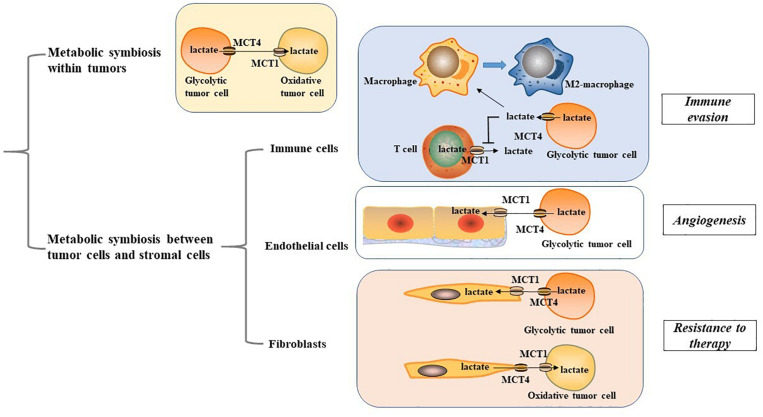
Proton-coupled monocarboxylate transporters (MCTs), representing the first four isoforms of the SLC16A gene family, mainly participate in the transport of lactate, pyruvate, and other monocarboxylates. Cancer cells exhibit a metabolic shift from oxidative metabolism to an enhanced glycolytic phenotype, leading to a higher production of lactate in the cytoplasm. Excessive accumulation of lactate threatens the survival of cancer cells, and the overexpression of proton-coupled MCTs observed in multiple types of cancer facilitates enhanced export of lactate from highly glycolytic cancer cells. Proton-coupled MCTs not only play critical roles in the metabolic symbiosis between hypoxic and normoxic cancer cells within tumors but also mediate metabolic interaction between cancer cells and cancer-associated stromal cells. Of the four proton-coupled MCTs, MCT1 and MCT4 are the predominantly expressed isoforms in cancer and have been identified as potential therapeutic targets in cancer. Therefore, in this review, we primarily focus on the roles of MCT1 and MCT4 in the metabolic reprogramming of cancer cells under hypoxic and nutrient-deprived conditions. Additionally, we discuss how MCT1 and MCT4 serve as metabolic links between cancer cells and cancer-associated stromal cells via transport of crucial monocarboxylates, as well as present emerging opportunities and challenges in targeting MCT1 and MCT4 for cancer treatment.
Keywords: glycolysis; lactic acid; metabolic networks and pathways; monocarboxylic acid transporters; tumor microenvironment.
Copyright © 2020 Sun, Wang, Wang, Yao, Li, Dong, Li, Sun, Liu, Liu and Xu.
Figures
References
-
- Afonso J., Pinto T., Simões-Sousa S., Schmitt F., Longatto-Filho A., Pinheiro C., et al. (2019). Clinical significance of metabolism-related biomarkers in non-Hodgkin lymphoma – MCT1 as potential target in diffuse large B cell lymphoma. Cell Oncol. 42 303–318. 10.1007/s13402-019-00426-2 - DOI - PubMed
-
- Beloueche-Babari M., Wantuch S., Casals Galobart T., Koniordou M., Parkes H. G., Arunan V., et al. (2017). MCT1 inhibitor AZD3965 increases mitochondrial metabolism, facilitating combination therapy and noninvasive magnetic resonance spectroscopy. Cancer Res. 77 5913–5924. 10.1158/0008-5472.CAN-16-2686 - DOI - PMC - PubMed
-
- Benjamin D., Robay D., Hindupur S. K., Pohlmann J., Colombi M., El-Shemerly M. Y., et al. (2018). Dual inhibition of the lactate transporters MCT1 and mct4 is synthetic lethal with metformin due to NAD+ depletion in cancer cells. Cell Rep. 25 3047.e4–3058.e4. 10.1016/j.celrep.2018.11.043 - DOI - PMC - PubMed
Publication types
LinkOut - more resources
Full Text Sources
