


The unique disarticulation layer formed in the rachis of Aegilops longissima probably results from the spatial co-expression of Btr1 and Btr2
- PMID: 32766735
- PMCID: PMC7872126
- DOI: 10.1093/aob/mcaa147
The unique disarticulation layer formed in the rachis of Aegilops longissima probably results from the spatial co-expression of Btr1 and Btr2
Abstract
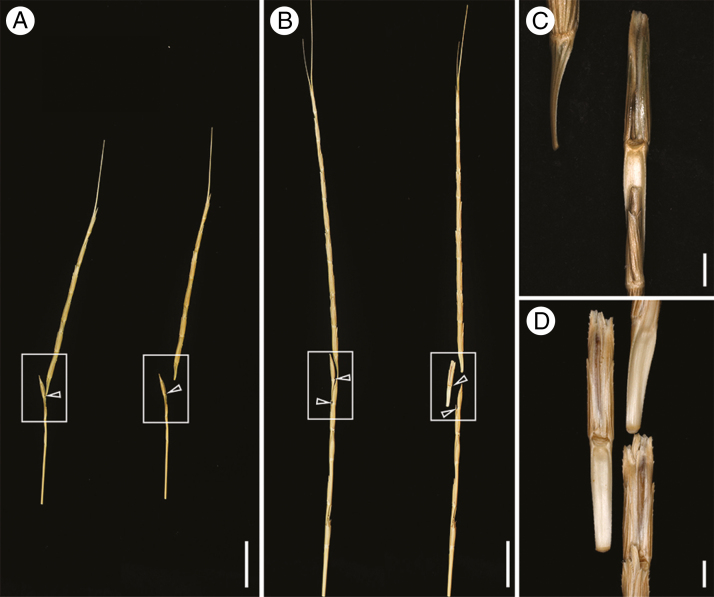
Background and aims: The brittle rachis trait is a feature of many wild grasses, particularly within the tribe Triticeae. Wild Hordeum and Triticum species form a disarticulation layer above the rachis node, resulting in the production of wedge-type dispersal units. In Aegilops longissima, only one or two of the nodes in the central portion of its rachis are brittle. In Triticeae species, the formation of a disarticulation layer above the rachis node requires the co-transcription of the two dominant and complementary genes Btr1 and Btr2. This study aims to establish whether homologues of Btr1 and/or Btr2 underlie the unusual brittle rachis phenotype observed in Ae. longissima.
Methods: Scanning electron microscopy was used to examine the disarticulation surfaces. Quantitative RT-PCR and RNA in situ hybridization experiments were used to identify gene expression in the immature inflorescence.
Key results: Analysis based on scanning electron microscopy was able to demonstrate that the disarticulation surfaces formed in the Ae. longissima rachis are morphologically indistinguishable from those formed in the rachises of wild Hordeum and Triticum species. RNA in situ hybridization showed that in the immature Ae. longissima inflorescence, the intensity of Btr1 transcription varied from high at the rachis base to low at its apex, while that of Btr2 was limited to the nodes in the central to distal portion of the rachis.
Conclusions: The disarticulation pattern shown by Ae. longissima results from the limitation of Btr1 and Btr2 co-expression to nodes lying in the centre of the rachis.
Keywords: Aegilops longissima; Btr1; Btr2; Seed dispersal; disarticulation zone; rachis; spatial co-expression.
© The Author(s) 2020. Published by Oxford University Press on behalf of the Annals of Botany Company. All rights reserved. For permissions, please e-mail: journals.permissions@oup.com.
Figures


Comment in
-
The rachis cannot hold, plants fall apart. A commentary on: 'The unique disarticulation layer formed in the rachis of Aegilops longissima likely results from the spatial co-expression of Btr1 and Btr2'.Ann Bot. 2021 Feb 9;127(3):vi-vii. doi: 10.1093/aob/mcaa194. Ann Bot. 2021. PMID: 33336239 Free PMC article.
References
-
- Avni R, Nave M, Barad O, et al. 2017. Wild emmer genome architecture and diversity elucidate wheat evolution and domestication. Science (New York, N.Y.) 357: 93–97. - PubMed
-
- Blake NK, Lehfeldt BR, Lavin M, Talbert LE. 1999. Phylogenetic reconstruction based on low copy DNA sequence data in an allopolyploid: the B genome of wheat. Genome 42: 351–360. - PubMed
-
- Dubcovsky J, Lukaszewski AJ, Echaide M, Antonelli EF, Porter DR. 1998. Molecular characterization of two Triticum speltoides interstitial translocations carrying leaf rust and green bug resistance genes. Crop Science 38: 1655–1660.
-
- Eig A 1929. Monographisch-kritische Übersicht der Gattung Aegilops. Feddes Repertorium Specierum Novarum regni Vegetabilis Beih 55: 1–228.
Publication types
MeSH terms
LinkOut - more resources
Full Text Sources
Miscellaneous
