


DNA in extracellular vesicles: biological and clinical aspects
- PMID: 32767659
- PMCID: PMC8169445
- DOI: 10.1002/1878-0261.12777
DNA in extracellular vesicles: biological and clinical aspects
Abstract
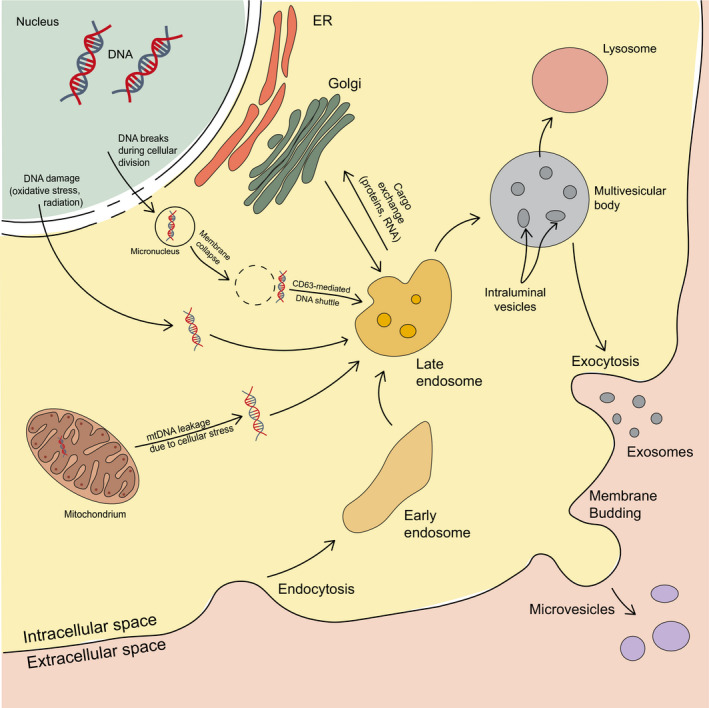
The study of extracellular vesicles (EVs), especially in the liquid biopsy field, has rapidly evolved in recent years. However, most EV studies have focused on RNA or protein content and DNA in EVs (EV-DNA) has largely been unnoticed. In this review, we compile current evidence regarding EV-DNA and provide an extensive discussion on EV-DNA biology. We look into EV-DNA biogenesis and mechanisms of DNA loading into EVs, as well as describe the particularly significant function of DNA-carrying EVs in the maintenance of cellular homeostasis, intracellular communication, and immune response modulation. We also examine the current role of EV-DNA in the clinical setting, specifically in cancer, infections, pregnancy, and prenatal diagnosis.
Trial registration: ClinicalTrials.gov NCT03217266.
Keywords: EV-DNA; cancer; cell-free DNA; extracellular vesicles; infection; liquid biopsies.
© 2020 The Authors. Published by FEBS Press and John Wiley & Sons Ltd.
Conflict of interest statement
The authors declare no conflict of interest.
Figures
References
-
- Chargaff E & West R (1946) The biological significance of the thromboplastic protein of blood. J Biol Chem 166, 189–197. - PubMed
-
- Dalton AJ (1975) Microvesicles and vesicles of multivesicular bodies versus “virus‐like” particles. J Natl Cancer Inst 54, 1137–1148. - PubMed
-
- Dvorak HF, Quay SC, Orenstein NS, Dvorak AM, Hahn P, Bitzer AM & Carvalho A (1981) Tumor shedding and coagulation. Science 212, 923–924. - PubMed
Publication types
MeSH terms
Substances
Associated data
LinkOut - more resources
Full Text Sources
Other Literature Sources
Medical
