. 2020 Oct:84:104493.
doi: 10.1016/j.meegid.2020.104493. Epub 2020 Aug 5.

COVID-19: Time to exonerate the pangolin from the transmission of SARS-CoV-2 to humans

Affiliations

COVID-19: Time to exonerate the pangolin from the transmission of SARS-CoV-2 to humans

Roger Frutos et al. Infect Genet Evol. 2020 Oct.

Abstract

The emergence of COVID-19 has triggered many works aiming at identifying the animal intermediate potentially involved in the transmission of SARS-CoV-2 to humans. The presence of SARS-CoV-2-related viruses in Malayan pangolins, in silico analysis of the ACE2 receptor polymorphism and sequence similarities between the Receptor Binding Domain (RBD) of the spike proteins of pangolin and human Sarbecoviruses led to the proposal of pangolin as intermediary. However, the binding affinity of the pangolin ACE2 receptor for SARS-CoV-2 RBD was later on reported to be low. Here, we provide evidence that the pangolin is not the intermediate animal at the origin of the human pandemic. Moreover, data available do not fit with the spillover model currently proposed for zoonotic emergence which is thus unlikely to account for this outbreak. We propose a different model to explain how SARS-CoV-2 related coronaviruses could have circulated in different species, including humans, before the emergence of COVID-19.

Keywords: COVID-19; Coronavirus; Pangolin; SARS-CoV-2; Zoonosis; Zoonotic model.


Conflict of interest statement

Declaration of Competing Interest None.

Figures
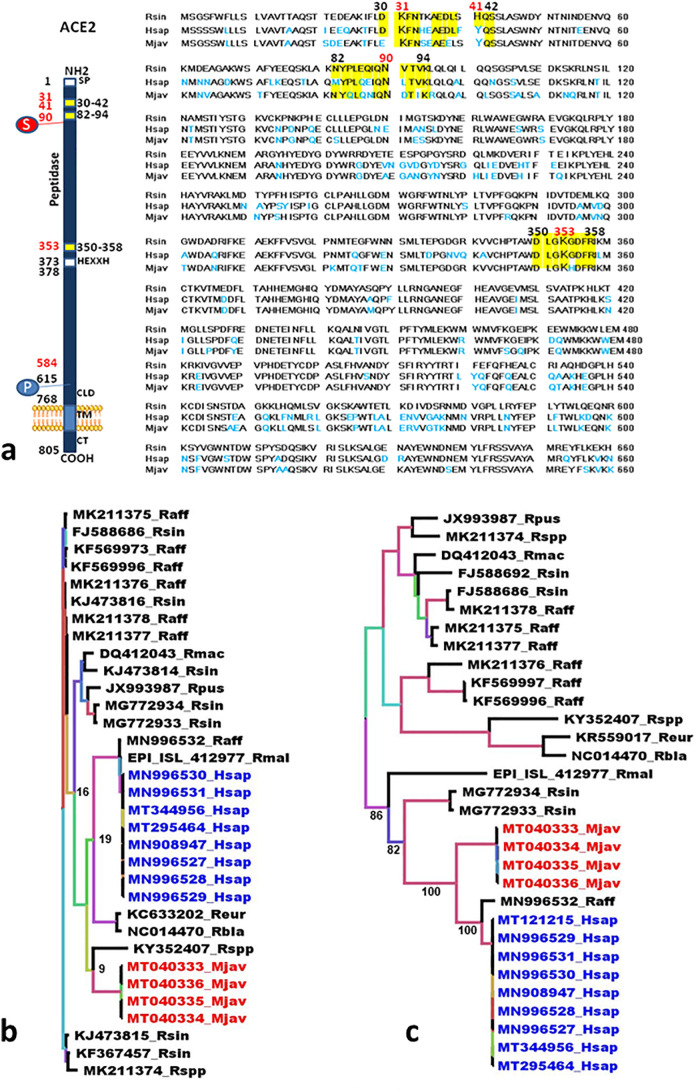
Fig. 1
Fig. 1
Comparative analysis of ACE2 and Sarbecoviruses sequences. 1a. Comparative analysis of ACE2 sequences from bat, human and pangolin. Clustal Omega multiple sequence alignment (EMBL-EBI bioinformatic tool; Copyright © EMBL 2020), was used to compare the extracellular 1 to 660 amino acids portion of the ACE2 protein sequences of bat (Rsin, Rhinolophus sinicus; GenBank: AGZ48803.1), human (Hsap, Homo sapiens; GenBank: BAB40370.1), and pangolin (Mjav, Manis javanica; NCBI Reference Sequence: XP_017505752.1),. Some of the amino acids important for viral tropism are in red (previous studies showed that residues 31 K, 41Y, 90 N and 353 K are important for viral spike binding to human ACE2). Within the regions considered important for the interaction with the spike of SARS-CoV-2 (regions 30–42, 82–94 and 350–358, respectively), the conserved amino acids with respect to the bat ACE2 sequence are highlighted in yellow. Amino acids that differ from the bat ACE2 sequence are in light blue. b. Phylogenetic analysis of the RdRp gene. The alignment of the full RdRp genes was performed with MUSCLE from the SeaView package (Gouy et al., 2010). The tree was built using the maximum likelihood method under the GTR model with 500 repeats. The tree was rooted using the RdRp sequence of a 229E-related bat coronavirus (KT253278) as outgroup. Blue: RdRp sequences from human SARS-CoV-2. Red. RdRp sequences from pangolins' Sarbecoviruses. c. Phylogenetic analysis of the S (spike) gene. The alignment of the full S (spike) genes was performed with MUSCLE from the SeaView package (Gouy et al., 2010). The tree was rooted using the spike sequence of a Neoromicia capensis coronavirus (KC869678) as outgroup. The tree was built using the maximum likelihood method under the GTR model with 500 repeats. Blue: RdRp sequences from human SARS-CoV-2. Red. RdRp sequences from pangolins' Sarbecoviruses.

References

    1. Afelt A., Devaux C., Serra-Cobo J., Frutos R. Bats, bat-borne viruses and environnemental changes. In: Mikolla H., editor. Bats. IntechOpen; 2018. pp. 113–131.
    1. Afelt A., Frutos R., Devaux C. Coronaviruses, and deforestation: toward the emergence of novel infectious diseases? Front. Microbiol. 2018;9:702. - PMC - PubMed
    1. Andersen K.G., Rambaut A., Lipkin W.I., Holmes E.C., Garry R.F. The proximal origin of SARS-CoV-2. Nat. Med. 2020;26:450–452. - PMC - PubMed
    1. Azhar E.I., El-Kafrawy S.A., Farraj S.A., Hassan A.M., Al-Saeed M.S., Hashem A.M., Madani T.A. Evidence for camel-to-human transmission of MERS coronavirus. N. Engl. J. Med. 2014;370:2499–2505. - PubMed
    1. Berto A., Anh P.H., Carrique-Mas J.J., Simmonds P., Van Cuong N., Tue N.T. Detection of potentially novel paramyxovirus and coronavirus viral RNA in bats and rats in the Mekong Delta region of southern Viet Nam. Zoonoses Public Health. 2017;65:30–42. - PMC - PubMed

Publication types

MeSH terms

Substances

LinkOut - more resources
