Review
. 2020 Oct:130:110559.
doi: 10.1016/j.biopha.2020.110559. Epub 2020 Aug 1.

Targeting SARS-CoV2 Spike Protein Receptor Binding Domain by Therapeutic Antibodies

Affiliations
Review

Targeting SARS-CoV2 Spike Protein Receptor Binding Domain by Therapeutic Antibodies

Arif Hussain et al. Biomed Pharmacother. 2020 Oct.

Abstract

As the number of people infected with the newly identified 2019 novel coronavirus (SARS-CoV2) is continuously increasing every day, development of potential therapeutic platforms is vital. Based on the comparatively high similarity of receptor-binding domain (RBD) in SARS-CoV2 and SARS-CoV, it seems crucial to assay the cross-reactivity of anti-SARS-CoV monoclonal antibodies (mAbs) with SARS-CoV2 spike (S)-protein. Indeed, developing mAbs targeting SARS-CoV2 S-protein RBD could show novel applications for rapid and sensitive development of potential epitope-specific vaccines (ESV). Herein, we present an overview on the discovery of new CoV followed by some explanation on the SARS-CoV2 S-protein RBD site. Furthermore, we surveyed the novel therapeutic mAbs for targeting S-protein RBD such as S230, 80R, F26G18, F26G19, CR3014, CR3022, M396, and S230.15. Afterwards, the mechanism of interaction of RBD and different mAbs were explained and it was suggested that one of the SARS-CoV-specific human mAbs, namely CR3022, could show the highest binding affinity with SARS-CoV2 S-protein RBD. Finally, some ongoing challenges and future prospects for rapid and sensitive advancement of therapeutic mAbs targeting S-protein RBD were discussed. In conclusion, it may be proposed that this review may pave the way for recognition of RBD and different mAbs to develop potential therapeutic ESV.

Keywords: Corona virus; antibodies; epitope-specific vaccines (ESV); receptor binding domain; spike protein.


Conflict of interest statement

The authors declare that they have no competing interests.

Figures
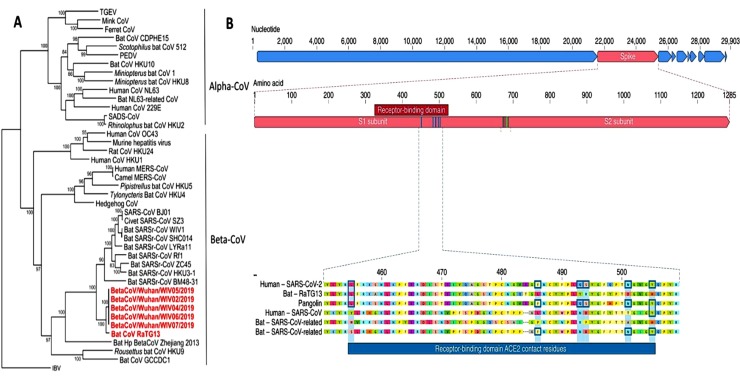
Fig. 1
Fig. 1
(A) The phylogenetic tree related to SARS-CoV2 [26]. (B) S- protein characterization in human SARS-CoV2 and related CoV [31,32]. Reprinted with permission from Refs. [26,31,32].
Fig. 2
Fig. 2
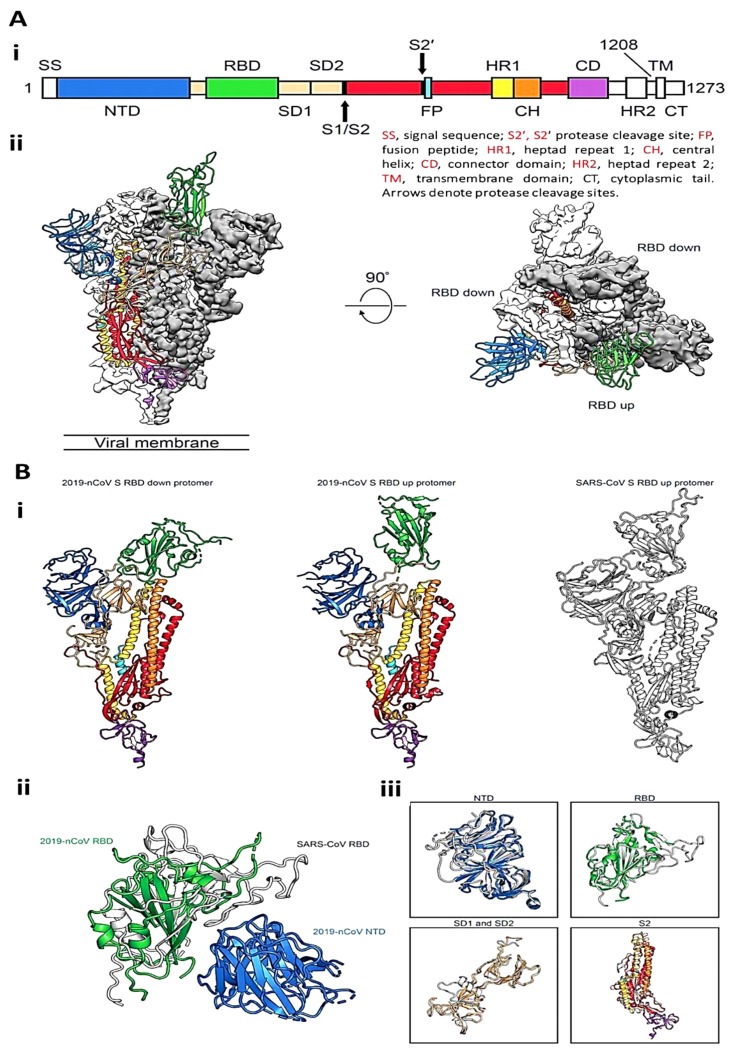
(A) Structure of SARS-CoV2 S-protein, (i) Schematic of SARS-CoV2 S-protein primary structure, (ii) Side- and top- views of the prefusion structure of the SARS-CoV2 S-protein. (B) Conformational comparison between SARS-CoV2 S-protein and SARS-CoV S-protein, (i) Single protomer of SARS-CoV2 S-protein with the RBD, (ii) RBDs of SARS-CoV2 and SARS-CoV and the NTD of SARS-CoV2, (iii) Structural alignments of different domains from SARS-CoV2 S-protein and SARS-CoV S-protein [34]. Reprinted with permission from Ref. [34].
Fig. 3
Fig. 3
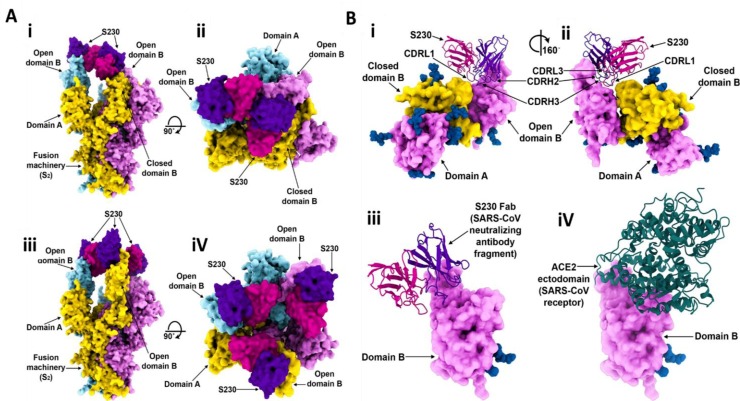
(A) Cryo-EM structure of the SARS-CoV S-protein upon interaction with S230 mAb, (i and ii) Orthogonal views of the S-protein structure with one closed B domain, (iii and iv) Orthogonal views of the S-protein structure with three open B domains. (B) The interaction of S230 with the SARS-CoV S-protein, (i and ii) Different views of the S230 mAb binding site to an open B domain, (iii) S230 and (iv) ACE2 compete in the attachment to SARS-CoV S-protein. Reprinted with permission from Re. f. [35].
Fig. 4
Fig. 4
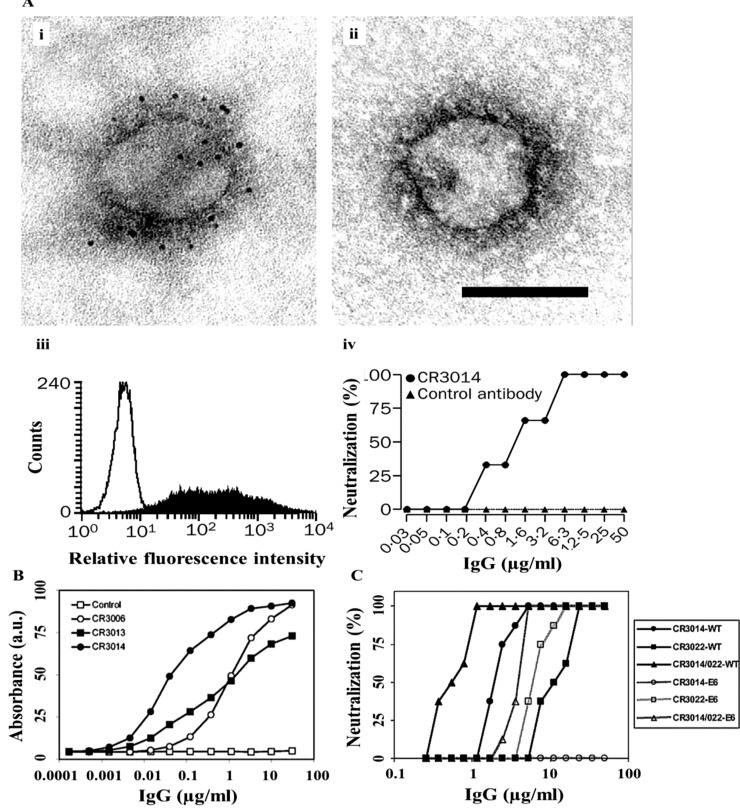
(A) Binding of CR3014 mAb to (i, ii) Viral peplomers of SARS-CoV, (iii) HEK293 T cells with S-protein, (iv) In vitro neutralisation of SARS-Cov [43]. (B) Titration of IgGs CR3006, CR3013, CR3014, and negative control IgG (Control) in an S565 fragment-coated ELISA [44]. (C) Wild-type SARS-CoV and a CR3014-neutralization escape variant (E6) with combined CR3014 and CR3022 mAbs [45]. Reprinted with permission from Refs. [[43], [44], [45]].
Fig. 5
Fig. 5
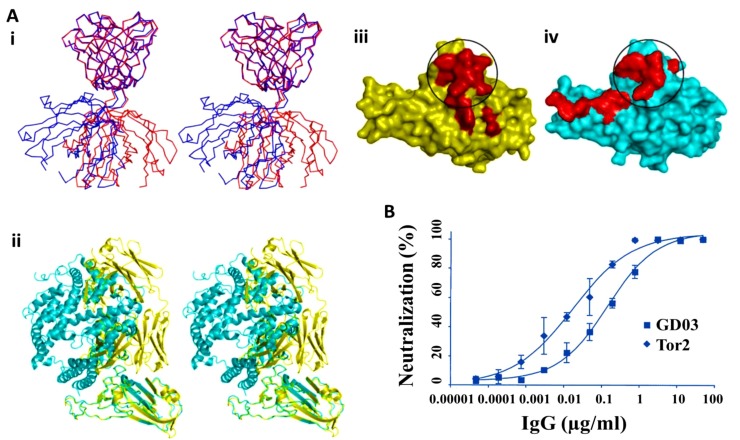
(A) Interaction of m396 and ACE2 with RBD, (i) Superimposed illustration of RBD-unliganded (red) and RBD-interacted Fab (blue), (ii) Comparison of the RBD-Fab and the RBD-ACE2 interaction, (iii, iv) Conformational footprints of the mAb and ACE2 RBD, respectively demonstrated as red balls on the RBD surface [46]. (B) M396 considerably neutralizes viruses pseudotyped with S-protein [47]. Reprinted with permission from Refs. [46,47].
Fig. 6
Fig. 6
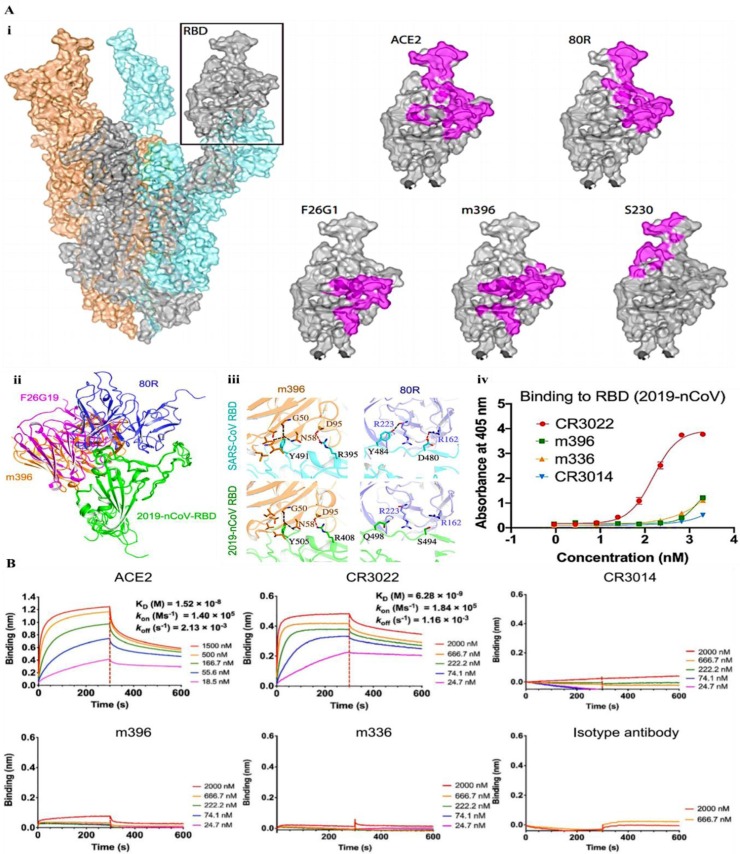
(A) The interaction of different mAbs with S-protein RBD, (i) The docking of SARS-CoV-RBD binding to specific mAbs [35,46,51,[53], [54], [55]], (ii) The docking of SARS-CoV2 S-protein RBD binding to specific mAbs, (iii) The comparison of the residues involved in the interaction of two mAbs with SARS-CoV-RBD and SARS-CoV2 S-protein RBD, (iv) Binding of mAbs to SARS-CoV2 S-protein RBD examined by ELISA [52]. (B) Binding representation of SARS-CoV2 S-protein RBD to ACE2 and mAbs [52]. Reprinted with permission form Refs [35,46,[51], [52], [53], [54], [55]].

References

    1. Lee P.-I., Hsueh P.-R. Emerging threats from zoonotic coronaviruses-from SARS and MERS to SARS-CoV2. Journal of Microbiology, Immunology and Infection. 2020 - PMC - PubMed
    1. Schwartz D.A., Graham A.L. Potential maternal and infant outcomes from (Wuhan) coronavirus SARS-CoV2 infecting pregnant women: lessons from SARS, MERS, and other human coronavirus infections. Viruses. 2020;12(2):194. - PMC - PubMed
    1. Zhong N., Zheng B., Li Y., Poon L., Xie Z., Chan K., Li P., Tan S., Chang Q., Xie J. Epidemiology and cause of severe acute respiratory syndrome (SARS) in Guangdong, People’s Republic of China, in February, 2003. The Lancet. 2003;362(9393):1353–1358. - PMC - PubMed
    1. Anderson R.M., Fraser C., Ghani A.C., Donnelly C.A., Riley S., Ferguson N.M., Leung G.M., Lam T.H., Hedley A.J. Epidemiology, transmission dynamics and control of SARS: the 2002–2003 epidemic, Philosophical Transactions of the Royal Society of London. Series B: Biological Sciences. 1447;359(2004):1091–1105. - PMC - PubMed
    1. Heymann D.L. The international response to the outbreak of SARS in 2003, Philosophical Transactions of the Royal Society of London. Series B: Biological Sciences. 1447;359(2004):1127–1129. - PMC - PubMed

MeSH terms