Multicenter Study
. 2020 Sep 15;95(11):e1565-e1574.
doi: 10.1212/WNL.0000000000010460. Epub 2020 Aug 7.

Association of social network structure and physical function in patients with multiple sclerosis

Affiliations
Multicenter Study

Association of social network structure and physical function in patients with multiple sclerosis

Seth N Levin et al. Neurology. .

Abstract

Objective: To test the association between physical function and the social environment in multiple sclerosis (MS), we quantified personal social networks.

Methods: In this cross-sectional study, we analyzed data from 2 academic MS centers, with center 1 serving as a discovery group and center 2 as the extension group. We performed a meta-analysis of the centers to extend the analysis. We used responses from a questionnaire to map the structure and health habits of participants' social networks as well as the NIH Patient-Reported Outcomes Measurement Information System (PROMIS) physical function scale (0-100, mean 50 for US general population) as the primary outcome. We applied multivariable models to test the association between network metrics and physical function.

Results: The discovery cohort included 263 patients with MS: 81% were women, 96% non-Hispanic European, 78% had relapsing MS, average age was 50 (12.4) years, and mean disease duration was 17 (12.3) years. The extension group included 163 patients, who were younger, more racially diverse, and less physically disabled, and had shorter disease duration. In the meta-analysis, higher network constraint, a measure of tightly bound networks, was associated with worse physical function (β = -0.163 ± 0.047, p < 0.001), while larger network effective size, a measure of clustered groups in the network, correlated with better physical function (β = 0.134 ± 0.046, p = 0.003).

Conclusions: Our study highlights personal networks as an important environmental factor associated with physical function in MS. Patients with close-knit networks had worse function than those with more open networks. Longitudinal studies are warranted to evaluate a causal relationship between network structure and physical impairment.


Figures

Figure 1
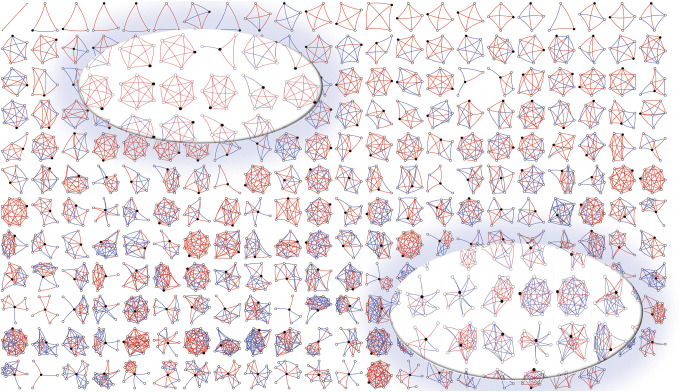
Figure 1. Structure of participants' personal social networks in the discovery cohort at University of Pittsburgh Medical Center
Each egocentric network has a black circle that represents the participant and white circles that represent the network members. The lines connecting the circles are red if the relationship is strong and blue if the relationship is weak. Networks are arranged in order of constraint from the most constrained (top left) to the least constrained (bottom right). Constraint is a measure of tightly bound networks and ranges in value from 0 to 125. In the upper left inset, several highly constrained networks have identical structures; in the lower inset, we highlight several networks with low constraint scores because they include many weak (blue) connections.
Figure 2
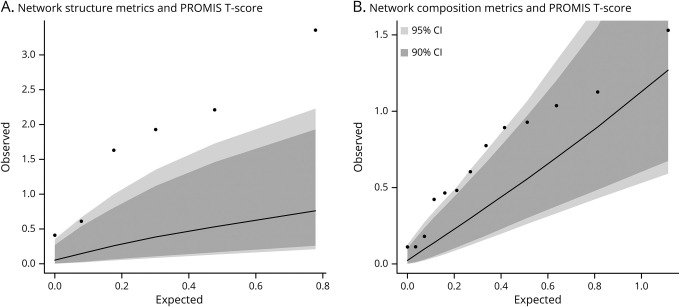
Figure 2. Comparison of expected vs observed regression results for social network structure and composition
Quantile-quantile plot of expected vs observed p values of composite network structure (A) and network composition (B) metrics in relation to physical function (Patient-Reported Outcomes Measurement Information System [PROMIS] T score) in the discovery cohort at University of Pittsburgh Medical Center. The expected p values (−log10 [p value]) are shown on the x-axis and the observed p values (−log10 [p value]) are shown on the y-axis. The dark gray and light gray areas indicate the confidence interval (CI) ranges as generated by 10,000 permutations at a threshold of p = 0.10, and at p = 0.05, respectively. The observed p values for social network structure metrics are outside of the gray areas, suggesting that network structure is associated with the PROMIS T score beyond chance after accounting for multiple testing burden.
Figure 3
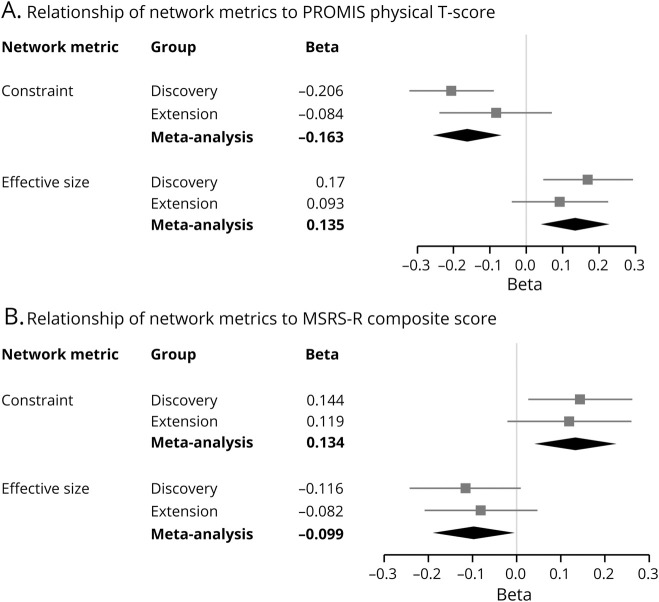
Figure 3. Forest plots of personal social network metrics and their relationship to neurologic outcomes
For each cohort, the standardized beta coefficients from linear regressions of network metrics were plotted for Patient-Reported Outcomes Measurement Information System (PROMIS) (A) and Multiple Sclerosis Rating Scale–Revised (MSRS-R) (B). Higher scores on PROMIS indicate better physical function, whereas higher scores on MSRS-R indicate greater disability. Each square is the β coefficient, and each line is the 95% confidence interval (CI) of a network metric after adjustment for covariates. The diamond represents the summary β coefficient and 95% CI after a fixed-effects meta-analysis of the 2 cohorts. Constraint was inversely associated with PROMIS and directly associated with MSRS-R in the meta-analyses.
Figure 4
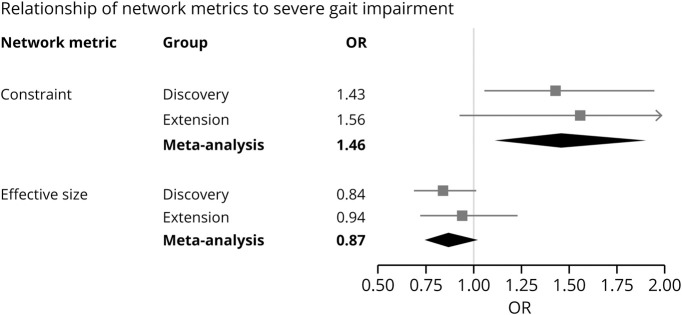
Figure 4. Forest plot of network metrics and association with severe gait impairment
Severe gait impairment is defined as requiring an assistive device for walking distances greater than 25 feet. For each cohort, the square is the odds ratio (OR) and lines are the 95% confidence interval (CI) of a network metric after adjustment for covariates. The diamond represents the summary OR and 95% CI after a fixed-effects meta-analysis of the 2 cohorts. A standardized measure of network constraint was associated with severe gait impairment in the meta-analysis.

Comment in

References

    1. Koch-Henriksen N, Sorensen PS. The changing demographic pattern of multiple sclerosis epidemiology. Lancet Neurol 2010;9:520–532. - PubMed
    1. Stampanoni Bassi M, Iezzi E, Buttari F, et al. Obesity worsens central inflammation and disability in multiple sclerosis. Mult Scler 2019;1352458519853473. - PubMed
    1. Manouchehrinia A, Tench CR, Maxted J, Bibani RH, Britton J, Constantinescu CS. Tobacco smoking and disability progression in multiple sclerosis: United Kingdom cohort study. Brain 2013;136:2298–2304. - PMC - PubMed
    1. Motl RW, Dlugonski D, Pilutti L, Sandroff B, McAuley E. Premorbid physical activity predicts disability progression in relapsing-remitting multiple sclerosis. J Neurol Sci 2012;323:123–127. - PubMed
    1. Hakim EA, Bakheit AM, Bryant TN, et al. The social impact of multiple sclerosis: a study of 305 patients and their relatives. Disabil Rehabil 2000;22:288–293. - PubMed

Publication types