Inotuzumab ozogamicin for relapsed/refractory acute lymphoblastic leukemia: outcomes by disease burden
- PMID: 32769965
- PMCID: PMC7414105
- DOI: 10.1038/s41408-020-00345-8
Inotuzumab ozogamicin for relapsed/refractory acute lymphoblastic leukemia: outcomes by disease burden
Abstract
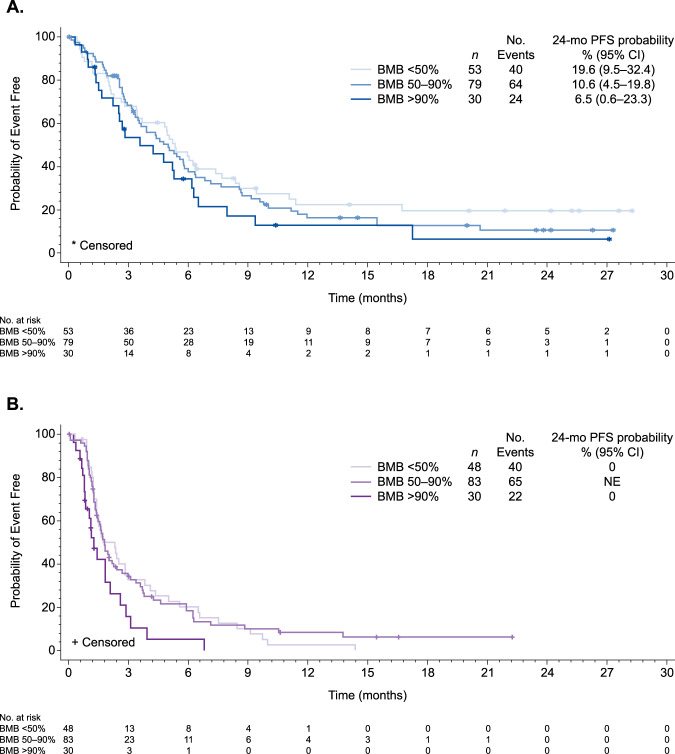
Adults with relapsed/refractory acute lymphoblastic leukemia (R/R ALL) have a poor prognosis, especially if disease burden is high. This post hoc analysis of the phase 3 INO-VATE trial examined the efficacy and safety of inotuzumab ozogamicin (InO) vs. standard of care chemotherapy (SC) among R/R ALL patients with low, moderate, or high disease burden, respectively, defined as bone marrow blasts (BMB) < 50% (n = 53 vs. 48), 50-90% (n = 79 vs. 83), and >90% (n = 30 vs. 30). Patients in the InO vs. SC arm with low, moderate, and high BMB%, respectively, had improved rates of complete remission/complete remission with incomplete hematologic recovery (74% vs. 46% [p = 0.0022], 75 vs. 27% [p < 0.0001], and 70 vs. 17% [p < 0.0001]), and improved overall survival (hazard ratio: 0.64 [p = 0.0260], 0.81 [p = 0.1109], and 0.60 [p = 0.0335]). Irrespective of BMB%, cytopenias were the most common treatment-emergent adverse events, and post-transplant veno-occlusive disease was more common with InO vs. SC. Patients with extramedullary disease or lymphoblastic lymphoma showed similar efficacy and safety outcomes. This favorable benefit-to-risk ratio of InO treatment irrespective of disease burden supports its use in challenging and high disease burden subpopulations. INO-VATE is registered at www.clinicaltrials.gov : #NCT01564784.
Conflict of interest statement
D.J.D. declares honoraria from Pfizer. A.S.A. declares consulting fees and honoraria from Pfizer, research funding from Amgen and AbbVie, and honoraria from Kite Pharma. D.I.M. declares consultancy with Pfizer, Amgen, and Novartis. M.S. declares research support and honoraria from Pfizer. M.L. declares honoraria from Pfizer. W.S. declares honoraria from Jazz Pharmaceuticals. N.G. declares research support and honoraria from Amgen and Pfizer. E.J. has received research grants and consultancy fees from Amgen, Pfizer, Takeda, Adaptive Biotechnologies, AbbVie, and Bristol-Myers Squibb. A.M. has received research support from Pfizer. T.W., E.V., and A.N. are employees of and own stock in Pfizer. H.K. declares honoraria from AbbVie, Amgen, ARIAD, Bristol-Myers Squibb, ImmunoGen, and Pfizer. S.O. declares research support and honoraria from Pfizer.
Figures