


Particulate matter (PM10) enhances RNA virus infection through modulation of innate immune responses
- PMID: 32771845
- PMCID: PMC7357538
- DOI: 10.1016/j.envpol.2020.115148
Particulate matter (PM10) enhances RNA virus infection through modulation of innate immune responses
Abstract
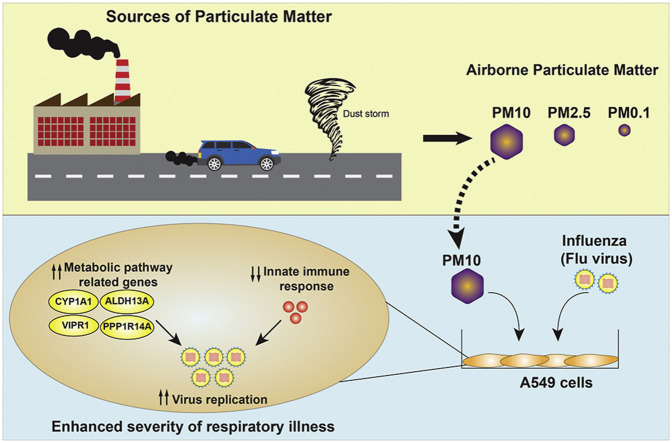
Sensing of pathogens by specialized receptors is the hallmark of the innate immunity. Innate immune response also mounts a defense response against various allergens and pollutants including particulate matter present in the atmosphere. Air pollution has been included as the top threat to global health declared by WHO which aims to cover more than three billion people against health emergencies from 2019 to 2023. Particulate matter (PM), one of the major components of air pollution, is a significant risk factor for many human diseases and its adverse effects include morbidity and premature deaths throughout the world. Several clinical and epidemiological studies have identified a key link between the PM existence and the prevalence of respiratory and inflammatory disorders. However, the underlying molecular mechanism is not well understood. Here, we investigated the influence of air pollutant, PM10 (particles with aerodynamic diameter less than 10 μm) during RNA virus infections using Highly Pathogenic Avian Influenza (HPAI) - H5N1 virus. We thus characterized the transcriptomic profile of lung epithelial cell line, A549 treated with PM10 prior to H5N1infection, which is known to cause severe lung damage and respiratory disease. We found that PM10 enhances vulnerability (by cellular damage) and regulates virus infectivity to enhance overall pathogenic burden in the lung cells. Additionally, the transcriptomic profile highlights the connection of host factors related to various metabolic pathways and immune responses which were dysregulated during virus infection. Collectively, our findings suggest a strong link between the prevalence of respiratory illness and its association with the air quality.
Keywords: Air pollution; Anti-viral innate immunity; Metabolic pathways genes; PM(10); Viral infection.
Copyright © 2020 Elsevier Ltd. All rights reserved.
Conflict of interest statement
Declaration of competing interest The authors declare no conflict of interests.
Figures
References
-
- Anake W.U., Ana G.R., Benson N.U. Study of surface morphology, elemental composition and sources of airborne fine particulate matter in Agbara industrial estate, Nigeria. Int. J. Appl. Environ. Sci. 2016;11:881–890.
-
- Andrews S., Krueger F., Segonds-Pichon A., Biggins L., Krueger C., Wingett S., Montgomery J. FastQ: a Quality Control Tool for High Throughput Sequence Data. Babraham Bioinformatics: A bioinformatic Tool. 2010 https://www.bioinformatics.babraham.ac.uk/projects/fastqc/
-
- Arai T. Ministry of Heavy Industries and Public Enterprises; New Delhi: 2018. Source Apportionment of PM2.5 & PM10 of Delhi NCR for Identification of Major Sources Department of Heavy Industry.
MeSH terms
Substances
LinkOut - more resources
Full Text Sources
Medical
Molecular Biology Databases
