. 2021 Jun;47(3):763-772.
doi: 10.1007/s00068-020-01458-2. Epub 2020 Aug 9.

Anterior knee pain and functional outcome following different surgical techniques for tibial nailing: a systematic review

Affiliations

Anterior knee pain and functional outcome following different surgical techniques for tibial nailing: a systematic review

Mandala S Leliveld et al. Eur J Trauma Emerg Surg. 2021 Jun.

Abstract

Purpose: The aim of this systematic review was to compare knee pain and function after tibial nail insertion through an infrapatellar, semi-extended and suprapatellar technique.

Methods: A search was carried out to identify articles with an exact description of the method used for insertion of the tibial nail and description of the outcome parameters (knee pain or function). Data on study design, population, rate and severity of anterior knee pain and function scores were extracted. Pooled rates and scores were calculated.

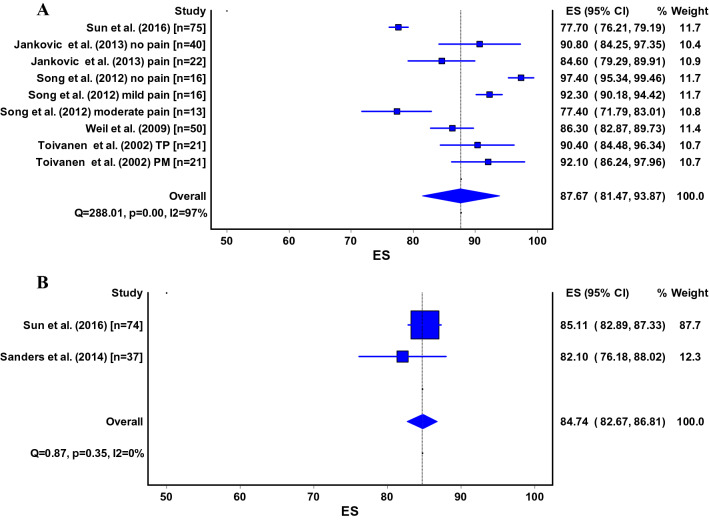
Results: 67 studies with 3,499 patients were included. The pooled rate of patients with anterior knee pain was 38% (95% CI 32-44) after nail insertion through an infrapatellar approach and 10% (95% CI 1-26) after insertion through a suprapatellar approach. Pooled analysis was not possible for the semi-extended technique. Knee pain scores as measured by visual analogue score (0-10) ranged from 0.2 (95% CI - 0.1-0.5) for general knee pain to 3.7 (95% CI 1.3-6.1) for pain during kneeling. Pooled estimates for the Lysholm score were 87 points (range 77-97) for the infrapatellar technique and 85 points (range 82-85) for the suprapatellar technique. Iowa Knee scores were 94 (range 86-96) and Anterior Knee Pain Scale scores were 76 (range 75-80) after infrapatellar nail insertion.

Discussion: Depending on the technique used, the proportion of patients with knee pain after tibial nailing varied between 10 and 38%. The actual measured knee pain scores were, however, surprisingly low. Knee function was good for both the infra- and suprapatellar technique.

Keywords: Infrapatellar tibial nailing; Outcome; Suprapatellar tibial nailing.


Conflict of interest statement

The authors state that they have no financial disclosures and have no conflicts of interest to report.

Figures

Fig. 1
Fig. 1
Study flowchart
Fig. 2
Fig. 2
a, b ES, effect size (pooled estimate for Visual Analogue Score); 95% CI, 95% Confidence Interval; Q, Cochran’s Q-statistic for study heterogeneity; I2, statistic for study heterogeneity; numbers indicate the number of patients in each study or subgroup; TP, transpatellar approach; PM, parapatellar medial approach
Fig. 3
Fig. 3
a, b ES, effect size (pooled estimate for Lysholm score); 95% CI, 95% Confidence Interval; Q, Cochran’s Q-statistic for study heterogeneity; I2, statistic for study heterogeneity; numbers indicate the number of patients in each study or subgroup; TP, transpatellar approach; PM, parapatellar medial approach Pooled estimates for the other surgical methods could not be calculated and are thus not shown
Fig. 4
Fig. 4
ES, effect size (pooled estimate for Iowa knee score); 95% CI, 95% Confidence Interval; Q, Cochran’s Q-statistic for study heterogeneity; I2, statistic for study heterogeneity; numbers indicate the number of patients in each study or subgroup; TP, transpatellar approach; PM, parapatellar medial approach Pooled estimates for the other surgical methods could not be calculated and are thus not shown
Fig. 5
Fig. 5
ES, effect size (pooled estimate for Anterior Knee Pain Scale); 95% CI, 95% Confidence Interval; Q, Cochran’s Q-statistic for study heterogeneity; I2, statistic for study heterogeneity; numbers indicate the number of patients in each study or subgroup; TP, transpatellar approach; PM, parapatellar medial approach. Pooled estimates for semi-extended technique could not be calculated and are thus not shown
Fig. 6
Fig. 6
a, b SF-36, Short Form-36; PCS, physical component score; ES, effect size (pooled estimate for PCS); 95% CI, 95% Confidence Interval; Q, Cochran’s Q-statistic for study heterogeneity; I2, statistic for study heterogeneity; numbers indicate the number of patients in each study or subgroup; TP, transpatellar approach; PM, parapatellar medial approach. Pooled estimates for the semi-extended technique could not be calculated and are thus not shown
Fig. 7
Fig. 7
a, b SF-36, Short Form-36; MCS, mental component score; ES, effect size (pooled estimate for MCS); 95% CI, 95% Confidence Interval; Q, Cochran’s Q-statistic for study heterogeneity; I2, statistic for study heterogeneity; numbers indicate the number of patients in each study or subgroup; TP, transpatellar approach; PM, parapatellar medial approach. Pooled estimates for the semi-extended technique could not be calculated and are thus not shown

References

    1. Tornetta P, III, Collins E. Semiextended position for intramedullary nailing of the proximal tibia. Clin Orthop Relat Res. 1996;328:185–189. doi: 10.1097/00003086-199607000-00029. - DOI - PubMed
    1. Kubiak EN, Widmer BJ, Horwitz DS. Extra-articular technique for semiextended tibial nailing. J Orthop Trauma. 2010;24(11):704–708. doi: 10.1097/BOT.0b013e3181d5d9f4. - DOI - PubMed
    1. Morandi M, Banka T, Gaiarsa GP, Guthrie ST, Khalil J, Hoegler J. Intramedullary nailing of tibial fractures: review of surgical techniques and description of a percutaneous lateral suprapatellar approach. Orthopedics. 2010 doi: 10.3928/01477447-20100129-22. - DOI - PubMed
    1. Jones M, Parry M, Whitehouse M, Mitchell S. Radiologic outcome and patient-reported function after intramedullary nailing: A comparison of the retropatellar and infrapatellar approach. J Orthop Trauma. 2014;28(5):256–262. doi: 10.1097/bot.0000000000000070. - DOI - PubMed
    1. Sanders RW, DiPasquale TG, Jordan CJ, Arrington JA, Sagi HC. Semiextended intramedullary nailing of the tibia using a suprapatellar approach: radiographic results and clinical outcomes at a minimum of 12 months follow-up. J Orthop Trauma. 2014;28(5):245–255. doi: 10.1097/BOT.0000000000000082. - DOI - PubMed

Publication types