Review
. 2020 Sep 28;375(1808):20190596.
doi: 10.1098/rstb.2019.0596. Epub 2020 Aug 10.

Microbiota-host interactions shape ageing dynamics

Affiliations
Review

Microbiota-host interactions shape ageing dynamics

Miriam Popkes et al. Philos Trans R Soc Lond B Biol Sci. .

Abstract

Occupying the interface between host and environment, host-associated microbes play fundamental roles in nutrient absorption, essential metabolite synthesis, development of the immune system, defence against pathogens and pathogenesis. Microbiota composition and function is rather stable during adulthood, while it dramatically changes during early development, frailty and disease. Ageing is associated with progressive decrease of homeostasis, often resulting in disruption of the physiological balance between host and commensal microbes, ultimately leading to dysbiosis and host demise. Generally, high microbial diversity is associated with health and a youthful state, while low individual microbial diversity and larger inter-individual microbial diversity is associated with ageing and disease states. Different species are equipped with species-specific commensal, symbiotic and pathogenic microbial communities. How and whether the specific host-microbiota consortia co-evolved with host physiology to ensure homeostasis and promote individual fitness remains an open question. In this essay, we propose that the evolution of vertebrate-specific immune adaptations may have enabled the establishment of highly diverse, species-specific commensal microbial communities. We discuss how the maintenance of intact immune surveillance mechanisms, which allow discrimination between commensal and pathogenic bacteria, fail during ageing and lead to the onset of known ageing-related diseases. We discuss how host-microbiota interactions are key to maintaining homeostasis despite external perturbations, but also how they affect a range of host-specific ageing-related phenotypes. This article is part of the theme issue 'The role of the microbiome in host evolution'.

Keywords: adaptive immunity; ageing; immune system; longevity; microbiota.


Conflict of interest statement

We declare we have no competing interests.

Figures
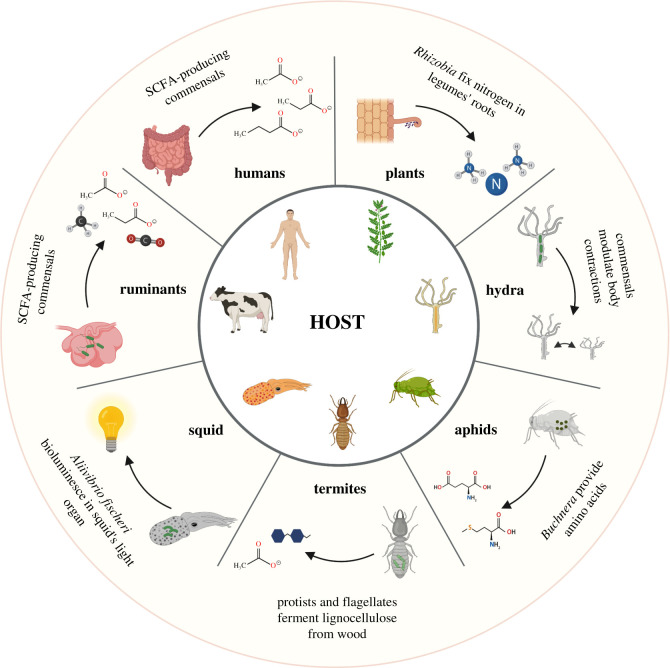
Figure 1.
Figure 1.
Host-specific microbiota. Coevolution of microbes and multicellular hosts leads to mutualistic relationships. The host builds a dynamic ecological niche which provides nutrients and a stable environment to the microbes. The microbiota, in turn, provide nutrients and novel metabolic pathways. Clockwise, from top right: legume roots establish symbiotic interactions with Rhizobia bacteria in the soil, which fix nitrogen to molecular forms accessible to the plant. Species-specific microbiota in the hydra modulate spontaneous body contractions and prevent lethal fungal infections. In sap-feeding aphids, endosymbiotic Buchnera provide the host with essential amino acids lacking in the sap. Protists and flagellates in termites ferment lignocellulose from wood. The bobtail squid hosts symbiotic colonies of bioluminescent Aliivibrio fischeri in its light organ, helping with defence and hunting behaviours. In ruminants, cellulose-fermenting bacteria digest fibre-rich plants into host-accessible metabolites, such as short-chain fatty acids (SCFA). Commensal microbes in the human intestine provide nutrients like SCFA, secondary bile acids and essential vitamins. This figure was generated with Biorender.
Figure 2.
Figure 2.
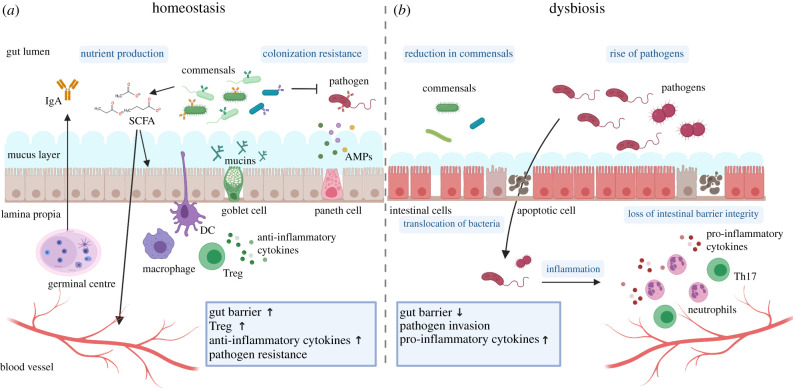
Host–microbiota interactions under homeostatic and dysbiotic conditions. (a) Under homeostatic conditions, the intestine shows a well-balanced interplay between host and microbiota. The host allows specific microbes to reside in the lumen, which in turn provide nutrients, such as short-chain fatty acids (SCFA), and help the defence against pathogens contributing to colonization resistance. To ensure proper homeostasis, the host actively selects for specific commensal bacteria—resulting in a diverse commensal community—while keeping the bacteria at a safe distance through the intestinal gut barrier. The gut barrier is composed of a thin layer of epithelial cells, a thick mucus barrier and defence molecules, such as anti-microbial peptides (AMPs). Mucin production by goblet cells and barrier function is enhanced by the bacterial-derived SCFA. Plasma cells in the lamina propria or the germinal centres (GC) produce secretory IgA, which coat both commensal and pathogenic bacteria. Intestinal macrophages produce large amounts of anti-inflammatory cytokines that block pro-inflammatory signals and promote regulatory T cells (Treg), which help maintain immune homeostasis in the intestine. (b) Under dysbiosis and ageing, the intestinal microbiota composition undergoes a reduction of commensal and a rise of pathogenic bacteria. Loss of intestinal barrier integrity enables translocation of bacteria into the host tissue, through the basement membrane into the lamina propria. Pathogen invasion results in a recruitment of inflammation-associated immune cells like neutrophils and Th17 cells, leading to a burst of pro-inflammatory cytokines. This figure was generated with Biorender.
Figure 3.
Figure 3.
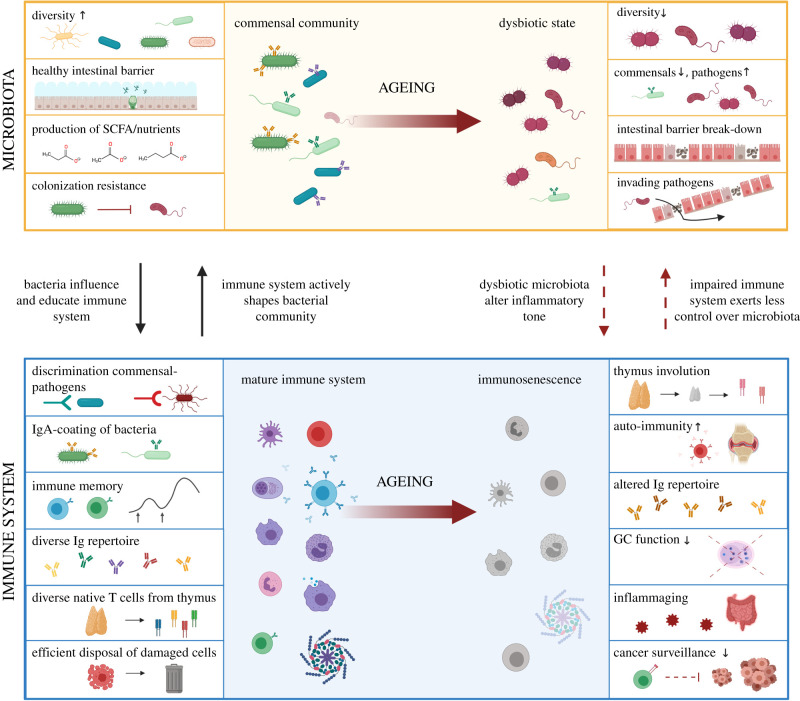
Loss of immune-microbiota balance during ageing. Top left: a young and healthy host is characterized by a diverse commensal microbial community. SCFA produced by microbes enhance the intestinal barrier function and act as potent immune modulators. Commensal microbes prevent growth of pathogens providing colonization resistance. The intestinal microbiota as a whole contributes to the development of the mature immune system. Bottom left: the adaptive immune system helps discriminate between commensal and pathogenic bacteria, actively shaping the microbial community by neutralizing pathogenic microbes and creating immune tolerance towards beneficial bacteria. Innate immune cells, together with T cells, ensure proper disposal of damaged, senescent and cancerous cells. Top right: during ageing, dysbiotic microbial communities affect the inflammatory tone in the intestine and the impaired immune system exerts less control over intestinal microbiota. The bacterial diversity in the intestine decreases, with a decline in commensals and a rise of pathogens. Intestinal barrier breakdown can lead bacteria to invade host tissues, resulting in inflammatory responses. Bottom right: ageing of the immune system (immunosenescence) consists of several processes, such as thymus involution, which leads to a reduced output of naive T cells. T cell receptor (TCR) diversity is consequently decreased and the TCR repertoire is biased towards autoreactive cells, possibly contributing to autoimmunity. The immunoglobulin repertoire diversity is altered, impairing responses to novel immune challenges (e.g. new pathogenic microbes or vaccinations). Germinal centres (GC), playing a major role in IgA production, decrease functionality during ageing. Dysbiosis and intruding pathogens during ageing probably contribute to age-related chronic low-grade inflammation, called ‘inflammaging’. Ageing-related low-grade inflammation promotes cancer progression, exacerbated by declined immune surveillance by aged lymphocytes. This figure was generated with Biorender.

References

    1. Mereschkowsky C. 1905. Über Natur und Ursprung der Chromatophoren im Pflanzenreiche. Biologisches Centralblatt. 25, 593–604.
    1. Margulis (Sagan) L. 1967. On the origin of mitosing cells. J. Theor. Biol. 14, 225–274. - PubMed
    1. Timmis JN, Ayliffe MA, Huang CY, Martin W. 2004. Endosymbiotic gene transfer: organelle genomes forge eukaryotic chromosomes. Nat. Rev. Genet. 5, 123–135. ( 10.1038/nrg1271) - DOI - PubMed
    1. Bosch TC, McFall-Ngai MJ. 2011. Metaorganisms as the new frontier. Zoology (Jena) 114, 185–190. ( 10.1016/j.zool.2011.04.001) - DOI - PMC - PubMed
    1. Rouhbakhsh D, Lai CY, von Dohlen CD, Clark MA, Baumann L, Baumann P, Moran NA, Voegtlin DJ. 1996. The tryptophan biosynthetic pathway of aphid endosymbionts (Buchnera): genetics and evolution of plasmid-associated anthranilate synthase (trpEG) within the aphididae. J. Mol. Evol. 42, 414–421. ( 10.1007/bf02498635) - DOI - PubMed

Publication types