


Consumer confusion about wholegrain content and healthfulness in product labels: a discrete choice experiment and comprehension assessment
- PMID: 32773004
- PMCID: PMC8555857
- DOI: 10.1017/S1368980020001688
Consumer confusion about wholegrain content and healthfulness in product labels: a discrete choice experiment and comprehension assessment
Abstract
Objective: Using a legal standard for scrutinising the regulation of food label claims, this study assessed whether consumers are misled about wholegrain (WG) content and product healthfulness based on common product labels.
Design: First, a discrete choice experiment used pairs of hypothetical products with different amounts of WG, sugar and salt to measure effects on assessment of healthfulness; and second, a WG content comprehension assessment used actual product labels to assess respondent understanding.
Setting: Online national panel survey.
Participants: For a representative sample of US adults (n 1030), survey responses were collected in 2018 and analysed in 2019.
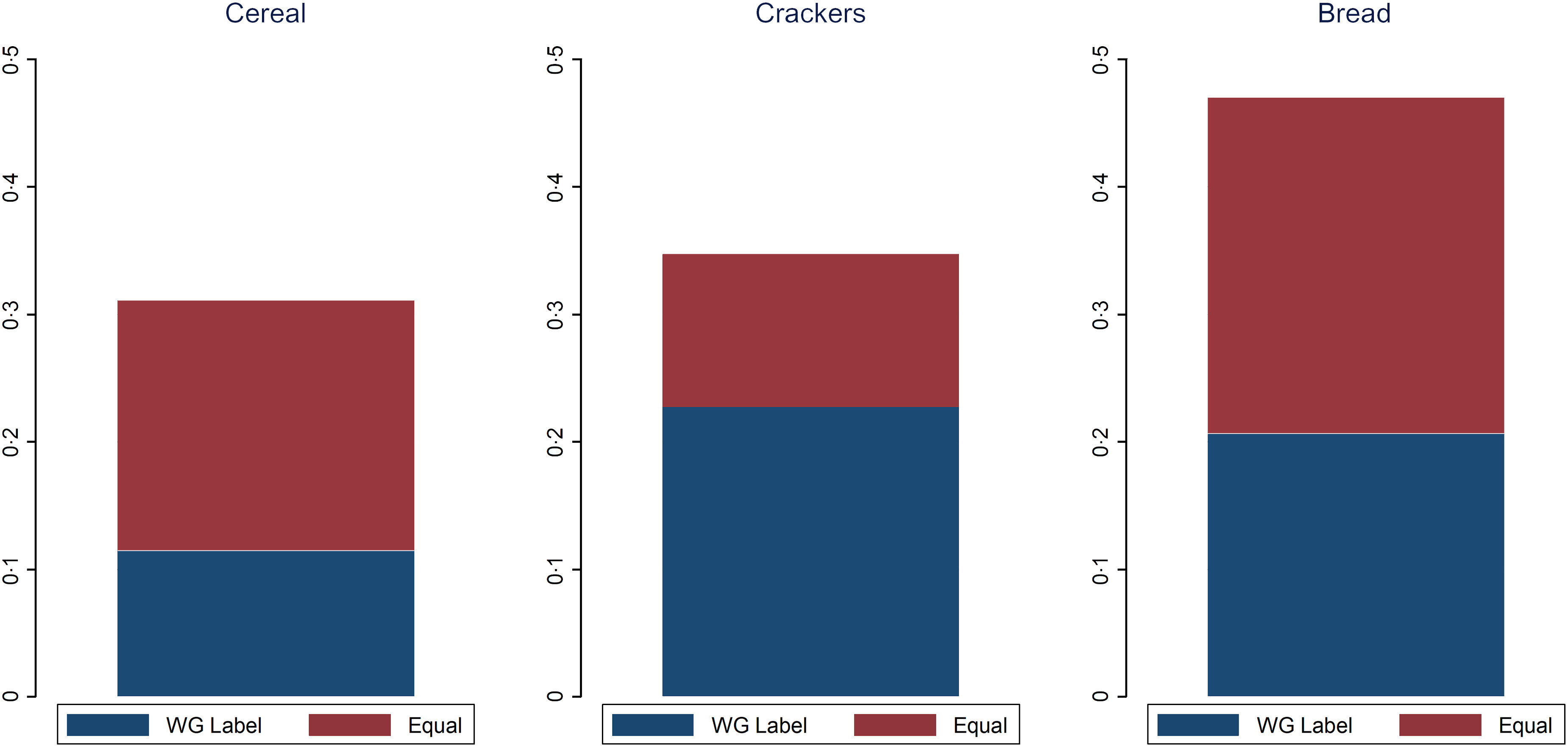
Results: First, 29-47 % of respondents incorrectly identified the healthier product from paired options, and respondents who self-identified as having difficulty in understanding labels were more likely to err. Second, for actual products composed primarily of refined grains, 43-51 % of respondents overstated the WG content, whereas for one product composed primarily of WG, 17 % of respondents understated the WG content.
Conclusions: The frequency of consumer misunderstanding of grain product labels was high in both study components. Potential policies to address consumer confusion include requiring disclosure of WG content as a percentage of total grain content or requiring disclosure of the grams of WG v. refined grains per serving.
Keywords: Consumer confusion; Food labels; Nutrition policy; Whole grains.
Figures
Comment in
-
'Consumer confusion about wholegrain content and healthfulness in product labels' overlooks widely available nutrition communication tool.Public Health Nutr. 2020 Dec;23(18):3332-3333. doi: 10.1017/S1368980020003407. Epub 2020 Sep 18. Public Health Nutr. 2020. PMID: 32943131 Free PMC article. No abstract available.
-
Consumer confusion about wholegrain content and healthfulness in product labels: reply.Public Health Nutr. 2020 Dec;23(18):3334-3335. doi: 10.1017/S1368980020003626. Epub 2020 Oct 12. Public Health Nutr. 2020. PMID: 33040776 Free PMC article. No abstract available.
References
-
- Zhang B, Zhao Q, Guo W et al. (2018) Association of whole grain intake with all-cause, cardiovascular, and cancer mortality: a systematic review and dose-response meta-analysis from prospective cohort studies. Eur J Clin Nutr 72, 57–65. - PubMed
-
- Chen GC, Tong X, Xu JY et al. (2016) Whole-grain intake and total, cardiovascular, and cancer mortality: a systematic review and meta-analysis of prospective studies. Am J Clin Nut 104, 164–172. - PubMed
-
- Kyro C, Tjonneland A, Overvad K et al. (2018) Higher whole-grain intake is associated with lower risk of type 2 diabetes among middle-aged men and women: the Danish diet, cancer, and health cohort. J Nutr 148, 1434–1444. - PubMed
Publication types
MeSH terms
Grants and funding
LinkOut - more resources
Full Text Sources
