


Containing SARS-CoV-2 in hospitals facing finite PPE, limited testing, and physical space variability: Navigating resource constrained enhanced traffic control bundling
- PMID: 32773286
- PMCID: PMC7390767
- DOI: 10.1016/j.jmii.2020.07.009
Containing SARS-CoV-2 in hospitals facing finite PPE, limited testing, and physical space variability: Navigating resource constrained enhanced traffic control bundling
Abstract
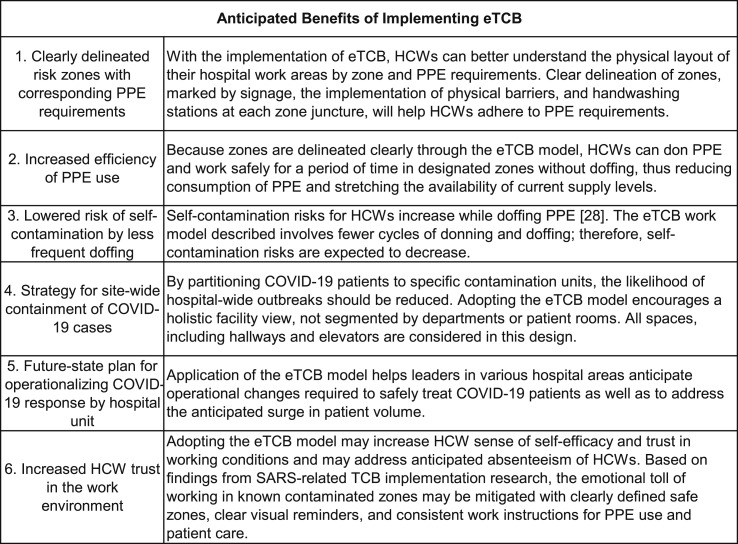
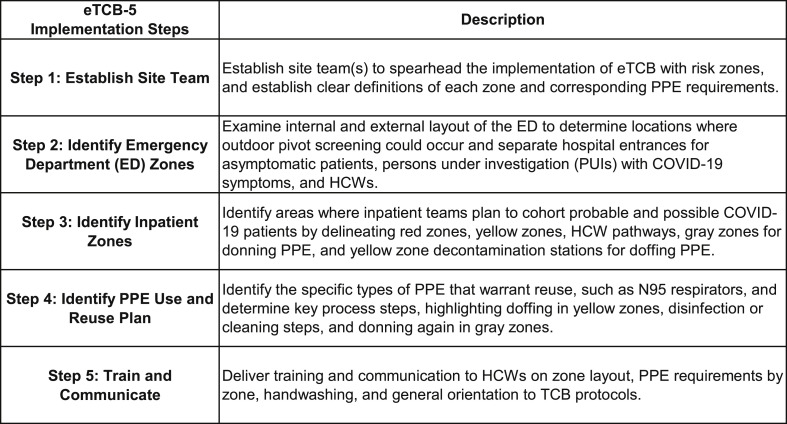
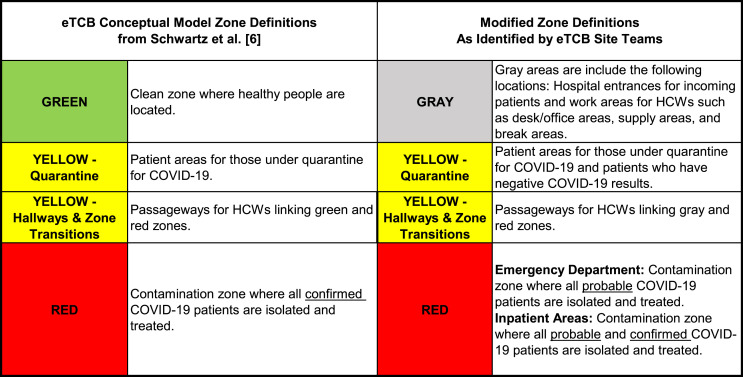
The COVID-19 outbreak has led to a focus by public health practitioners and scholars on ways to limit spread while facing unprecedented challenges and resource constraints. Recent COVID-19-specific enhanced Traffic Control Bundling (eTCB) recommendations provide a cogent framework for managing patient care pathways and reducing health care worker (HCW) and patient exposure to SARS-CoV-2. eTCB has been applied broadly and has proven to be effective in limiting fomite and droplet transmissions in hospitals and between hospitals and the surrounding community. At the same time, resource constrained conditions involving limited personal protective equipment (PPE), low testing availability, and variability in physical space can require modifications in the way hospitals implement eTCB. While eTCB has come to be viewed as a standard of practice, COVID-19 related resource constraints often require hospital implementation teams to customize eTCB solutions. We provide and describe a cross-functional, collaborative on-the-ground adaptive application of eTCB initially piloted at two hospitals and subsequently reproduced at 16 additional hospitals and health systems in the US to date. By effectively facilitating eTCB deployment, hospital leaders and practitioners can establish clearer 'zones of risk' and related protective practices that prevent transmission to HCWs and patients. We outline key insights and recommendations gained from recent implementation under the aforementioned constraints and a cross-functional team process that can be utilized by hospitals to most effectively adapt eTCB under resource constraints.
Keywords: COVID-19; Enhanced traffic control bundling; Health care workers; Mitigation; Nosocomial infection control; Pandemic.
Copyright © 2020. Published by Elsevier B.V.
Conflict of interest statement
Declaration of Competing Interest None.
Figures
References
-
- Center for Systems Science and Engineering Johns Hopkins University. COVID-19 interactive online dashboard. https://coronavirus.jhu.edu/map.html Available at:
-
- Dong E., Du H., Gardner L. An interactive web-based dashboard to track COVID-19 in real time. https://www.thelancet.com/journals/laninf/article/PIIS1473-3099(20)30120... Available at: - PMC - PubMed
-
- Bellisle M. How Many Medical Workers Have Contracted COVID-19? States Lack Key Data. Oregon Public Broadcasting. https://www.opb.org/news/article/:coronavirus-covid-19-data-health-care-... Available at:
Publication types
MeSH terms
LinkOut - more resources
Full Text Sources
Other Literature Sources
Medical
Miscellaneous
