


Evaluation of coagulation status using viscoelastic testing in intensive care patients with coronavirus disease 2019 (COVID-19): An observational point prevalence cohort study
- PMID: 32773357
- PMCID: PMC7373052
- DOI: 10.1016/j.aucc.2020.07.003
Evaluation of coagulation status using viscoelastic testing in intensive care patients with coronavirus disease 2019 (COVID-19): An observational point prevalence cohort study
Abstract
Background: Coronavirus Disease-19 (COVID-19) is associated with a high rate of thrombosis, the pathophysiology of which is not well defined. Viscoelastic testing may identify and characterise hypercoagulable states which are not apparent using conventional coagulation assays.
Objectives: The objective of this study was to undertake viscoelastic evaluation of the coagulation state in critically ill adults with COVID-19-associated respiratory failure METHODS: This was a single-centre observational point prevalence cohort study of adults with COVID-19-associated respiratory failure requiring respiratory support in the intensive care unit. Coagulation status was evaluated using rotational thromboelastometry (ROTEM®) in conjunction with laboratory markers of coagulation.
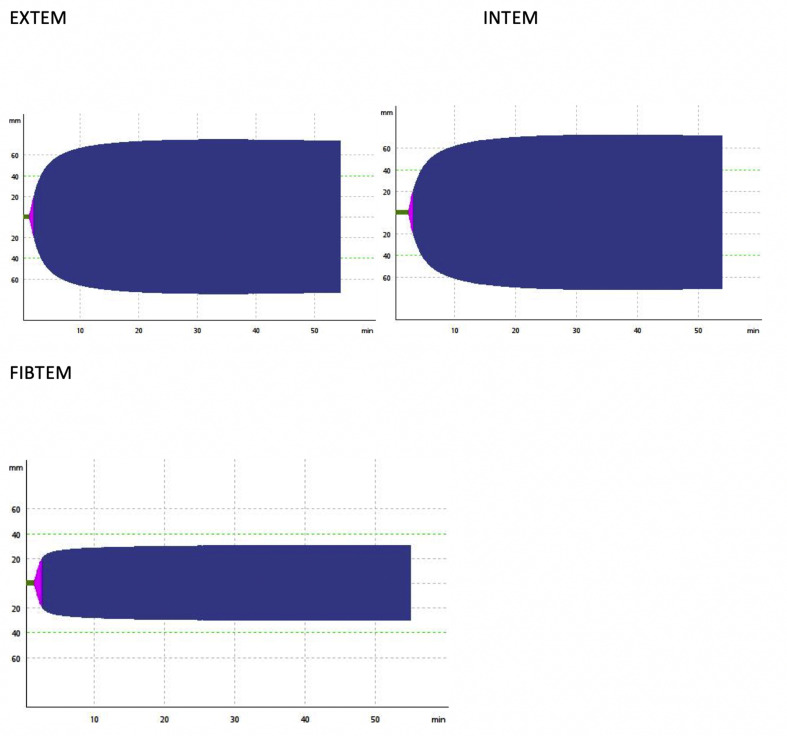
Results: Six patients fulfilled inclusion criteria. Each patient had one ROTEM® performed. All patients had supranormal clot amplitude at 10 min (A10) and supranormal clot firmness (maximal clot firmness) measured in at least one ROTEM® pathway, and five were supranormal on all pathways. Minimal clot lysis was present on all analyses. Fibrinogen and D-dimer were elevated and routine markers of coagulation within normal ranges in all patients.
Conclusion: Patients with COVID-19-associated respiratory failure admitted to the intensive care unit exhibit a hypercoagulable state which is not appreciable on conventional tests of coagulation. Supranormal clot firmness, minimal fibrinolysis, and hyperfibrinogenaemia are key findings. Further research is required into the pathophysiology of this hypercoagulable state, as well as the harms and benefits of different anticoagulation strategies.
Keywords: ARDS; COVID-19; Coronavirus; Rotational thromboelastometry; Viscoelastic testing.
Crown Copyright © 2020. Published by Elsevier Ltd. All rights reserved.
Conflict of interest statement
Conflict of Interest None of the authors have any interests to declare.
Figures
References
-
- Centre ICNAaR . 2020. ICNARC report on COVID-19 in critical care.
-
- Wikkelsø A., Wetterslev J., Møller A.M., Afshari A. Thromboelastography (TEG) or rotational thromboelastometry (ROTEM) to monitor haemostatic treatment in bleeding patients: a systematic review with meta-analysis and trial sequential analysis. Anaesthesia. 2017;72:519–531. - PubMed
Publication types
MeSH terms
LinkOut - more resources
Full Text Sources
Other Literature Sources
Medical
