


Rare Spontaneous Attenuation of Childhood Inflammatory Cerebral Adrenoleukodystrophy
- PMID: 32774083
- PMCID: PMC7410095
- DOI: 10.1055/s-0039-1677805
Rare Spontaneous Attenuation of Childhood Inflammatory Cerebral Adrenoleukodystrophy
Abstract
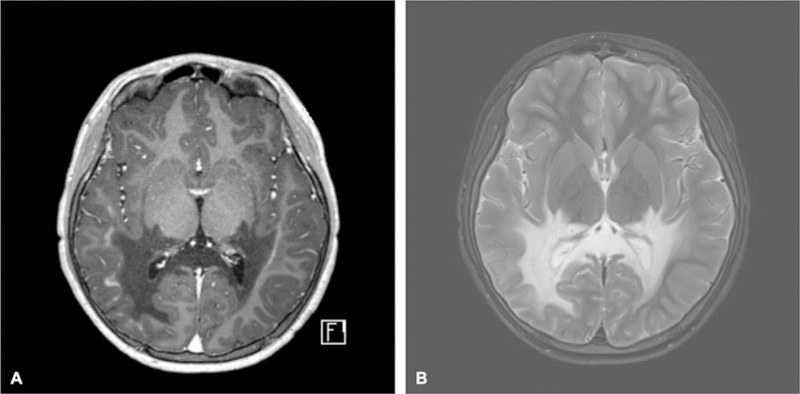
X-linked adrenoleukodystrophy (ALD) is a neurodegenerative peroxisomal disorder with variable clinical phenotypes. Childhood cerebral ALD (CCALD) is at the most severe end of the disease spectrum. In CCALD, the clinical manifestations include increasing deficits in behavior, vision, hearing, coordination, and motor function, as well as seizures. Without treatment, CCALD often results in apparent vegetative state within 1 to 2 years of appearance of initial signs and symptoms. We present the case of a boy with classic inflammatory CCALD who exhibited spontaneous attenuation in disease progression. While extremely rare, spontaneous arrest of disease progression may occur in boys with inflammatory CCALD.
Keywords: cerebral adrenoleukodystrophy; inflammatory; spontaneous arrest.
Figures

References
-
- Moser HW, Moser AB, Smith KD, et al. Adrenoleukodystrophy: phenotypic variability and implications for therapy. J Inherit Metab Dis 1992;15(04):645–664 - PubMed
-
- Raymond GV, Moser AB, Fatemi A X–Linked adrenoleukodystrophy. GeneReviews Available at: https://www.ncbi.nlm.nih.gov/books/NBK1315/. Accessed November 5, 2018
-
- Moser HW, Naidu S, Kumar AJ, Rosenbaum AE. The adrenoleukodystrophies. Crit Rev Neurobiol 1987;3(01):29–88 - PubMed
-
- Korenke GC, Pouwels PJ, Frahm J, et al. Arrested cerebral adrenoleukodystrophy: a clinical and proton magnetic resonance spectroscopy study in three patients. Pediatr Neurol 1996;15(02): 103–107 - PubMed
Grants and funding
LinkOut - more resources
Full Text Sources