


Female northern grass lizards judge mates by body shape to reinforce local adaptation
- PMID: 32774436
- PMCID: PMC7409496
- DOI: 10.1186/s12983-020-00367-9
Female northern grass lizards judge mates by body shape to reinforce local adaptation
Abstract
Background: Identifying the factors that contribute to divergence among populations in mate preferences is important for understanding of the manner in which premating reproductive isolation might arise and how this isolation may in turn contribute to the evolutionary process of population divergence. Here, we offered female northern grass lizards (Takydromus septentrionalis) a choice of males between their own population and another four populations to test whether the preferences that females display in the mating trials correlate with phenotypic adaptation to local environments, or to the neutral genetic distance measured by divergence of mitochondrial DNA sequence loci.
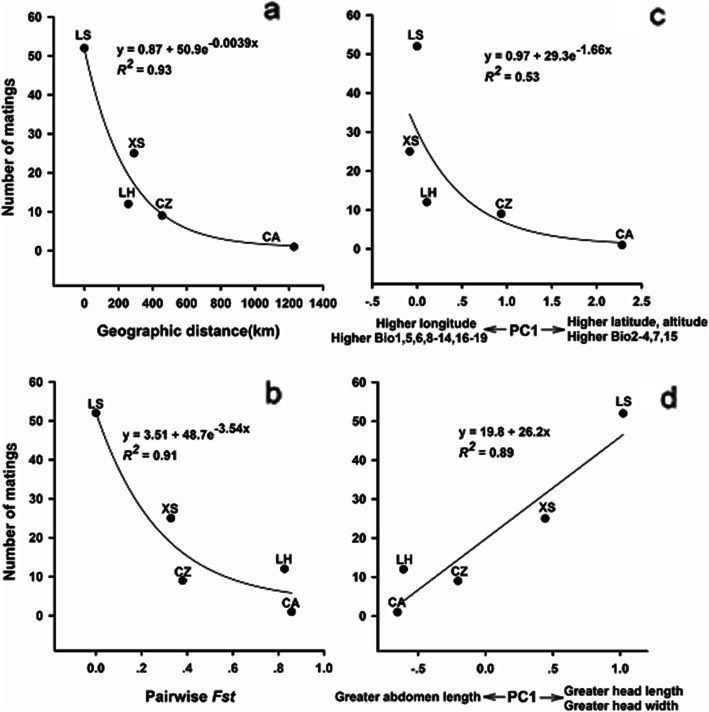
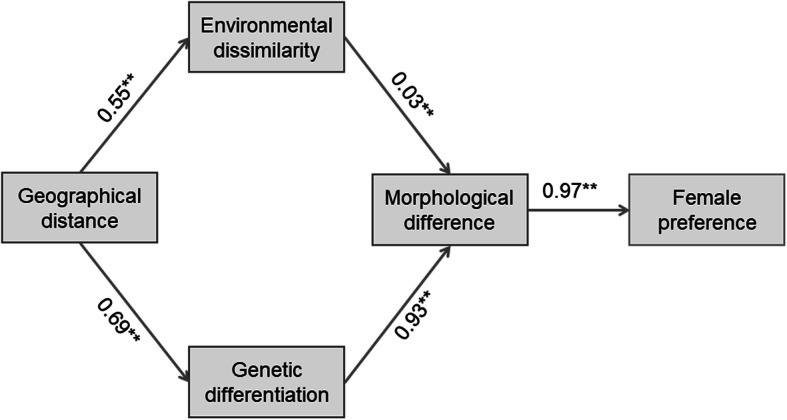
Results: Females showed a strong preference for native over foreign males. Females that mated with native versus foreign males did not differ from each other in mating latency, or copulation duration. From results of the structural equation modelling we knew that: 1) geographical distance directly contributed to genetic differentiation and environmental dissimilarity; 2) genetic differentiation and environmental dissimilarity indirectly contributed to female mate preference, largely through their effects on morphological divergence; and 3) females judged mates by body shape (appearance) and discriminated more strongly against morphologically less familiar allopatric males.
Conclusions: Local adaptation rather than neutral genetic distance influences female mate preference in T. septentrionalis. The tendency to avoid mating with foreign males may indicate that, in T. septentrionalis, local adaptations are more valuable than genetic novelties. Our results highlight the importance of comprehensive studies integrating ecological, molecular and behavioral approaches to understand population divergence in female mate preferences as the consequence of local adaptations.
Keywords: Genetic differentiation; Geographical distance; Local adaptation; Mate preference; Morphology; Structural equation model.
© The Author(s) 2020.
Conflict of interest statement
Competing interestsThe authors declare that they have no competing interests.
Figures
References
-
- Hoskin CJ, Higgie M, McDonald KR, Moritz C. Reinforcement drives rapid allopatric speciation. Nature. 2005;437:1353–1356. - PubMed
-
- Rupp JC, Woolhouse MEJ. Impact of geographical origin on mating behaviour in two species of Biomphalaria (Planorbidae: Gastropoda) Anim Behav. 1999;58:1247–1251. - PubMed
-
- Durand S, Beauché F, Richard FJ, Beltran-Bech S. How do females’ genetic characteristics influence male mate preference in the terrestrial isopod Armadillidium vulgare? Ethology. 2015;121:1122–1130.
-
- Galipaud M, Gauthey Z, Turlin J, Bollache L, Lagrue C. Mate choice and male-male competition among morphologically cryptic but genetically divergent amphipod lineages. Behav Ecol Sociobiol. 2015;69:1907–1916.
LinkOut - more resources
Full Text Sources
