


Association of hypertriglyceridemic waist phenotype with renal function impairment: a cross-sectional study in a population of Chinese adults
- PMID: 32774441
- PMCID: PMC7409629
- DOI: 10.1186/s12986-020-00483-7
Association of hypertriglyceridemic waist phenotype with renal function impairment: a cross-sectional study in a population of Chinese adults
Abstract
Background: Hypertriglyceridemic waist (HTGW) phenotype has been suggested as a risk factor for chronic kidney disease (CKD). However, there is limited evidence on the relationship of triglyceride waist phenotypes with estimated glomerular filtration rate (eGFR) status and severity. Our aim was to explore the associations of triglyceride waist phenotypes with reduced eGFR and various decreased eGFR stages among Chinese adults.
Methods: A population-based, cross-sectional study was conducted among Chinese participants aged 20-74 years from June 2016 to December 2017 in Shanghai, China. An eGFR value below 60 mL/min/1.73 m2 was defined as decreased eGFR. HTGW phenotype was defined as triglyceride (TG) ≥1.7 mmol/L and a waist circumference (WC) of ≥90 cm for men and ≥ 80 cm for women. We examined the association of triglyceride waist phenotypes with decreased eGFR risk using the weighted logistic regression models.
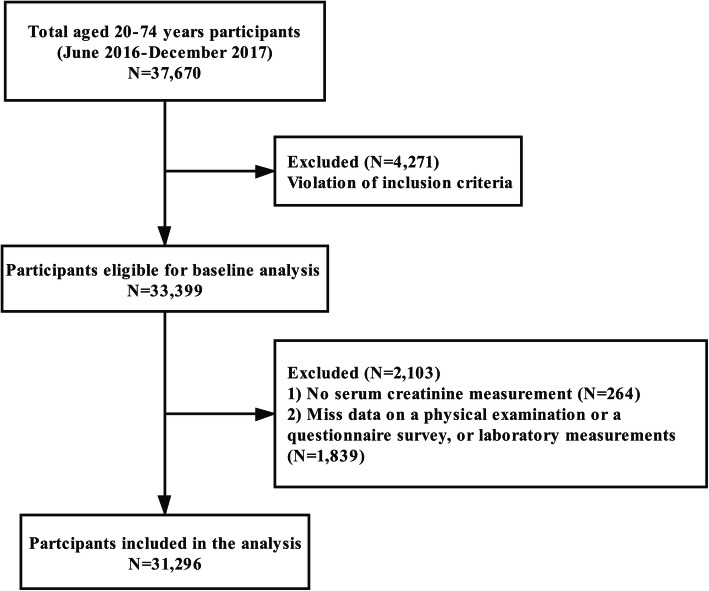
Results: A total of 31,296 adults were included in this study. Compared with normal TG level/normal WC (NTNW) phenotype, normal TG level/enlarged WC (NTGW) and elevated TG level/enlarged WC (HTGW) phenotypes were associated with the increased risk of decreased eGFR. Multivariable-adjusted ORs (95% CI) associated with NTGW, elevated TG level/normal WC (HTNW), and HTGW phenotypes were 1.75 (1.41-2.18), 1.29 (0.99-1.68), and 1.99 (1.54-2.58), respectively. These associations between triglyceride waist phenotypes and decreased eGFR risk remained across almost all the subgroups, including sex, age, BMI, T2DM, and hypertension. HTGW phenotype was consistently positively associated with the risk of mildly and moderately decreased eGFR, but not with severely decreased eGFR risk.
Conclusions: HTGW was consistently associated with the increased risk of decreased eGFR and various decreased eGFR stages, except for severely decreased eGFR. Further prospective studies are warranted to confirm our findings and to investigate the underlying biological mechanisms.
Keywords: Chronic kidney disease; Estimated glomerular filtration rate; Hypertriglyceridemic waist phenotype; Renal function decline.
© The Author(s) 2020.
Conflict of interest statement
Competing interestsThe authors have no conflicts of interest to declare.
References
-
- Levey AS, Coresh J, Balk E, Kausz AT, Levin A, Steffes MW, et al. National Kidney Foundation practice guidelines for chronic kidney disease: evaluation, classification, and stratification. Ann Intern Med. 2003;139(2):137–147. - PubMed
-
- Ene-Iordache B, Perico N, Bikbov B, Carminati S, Remuzzi A, Perna A, et al. Chronic kidney disease and cardiovascular risk in six regions of the world (ISN-KDDC): a cross-sectional study. Lancet Glob Health. 2016;4(5):e307–e319. - PubMed
-
- Zhang L, Wang F, Wang L, Wang W, Liu B, Liu J, et al. Prevalence of chronic kidney disease in China: a cross-sectional survey. Lancet. 2012;379(9818):815–822. - PubMed
-
- Nugent RA, Fathima SF, Feigl AB, Chyung D. The burden of chronic kidney disease on developing nations: a 21st century challenge in global health. Nephron Clin Pract. 2011;118(3):c269–c277. - PubMed
LinkOut - more resources
Full Text Sources
Research Materials
Miscellaneous
