Prevalence and associated factors of birth defects among newborns in sub-Saharan African countries: a systematic review and meta-analysis
- PMID: 32774596
- PMCID: PMC7388615
- DOI: 10.11604/pamj.2020.36.19.19411
Prevalence and associated factors of birth defects among newborns in sub-Saharan African countries: a systematic review and meta-analysis
Abstract
Introduction: Birth defects are the most serious causes of infant mortality and disability in sub-Saharan African countries with variable magnitude. Hence, this study was aimed to determine the pooled prevalence of birth defects and its associated risk factors among newborn infants in sub-Saharan African countries.
Methods: A total of 43 eligible studies were identified through literature search from Medline (PubMed), EMBASE, HINARI, Google scholar, Science Direct, Cochrane Library and other sources. Extracted data were analyzed using STATA 15.0 statistical software. A random effect meta-analysis model was used.
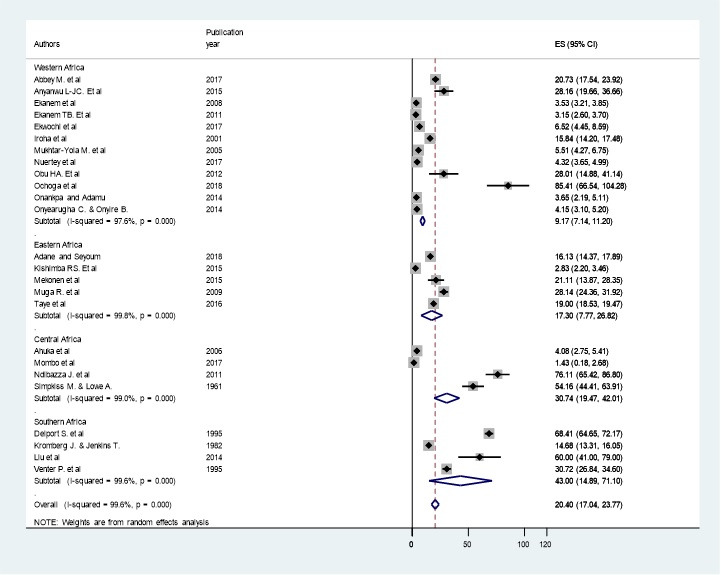
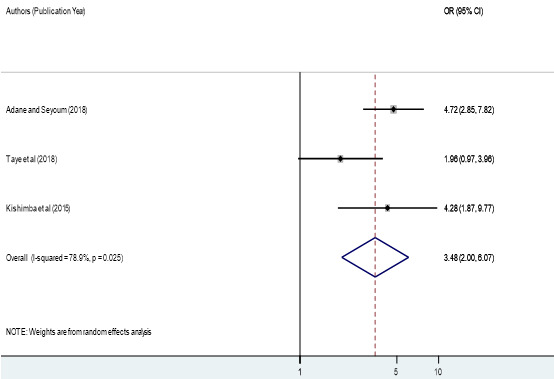
Results: Twenty-five studies in 9 countries showed that the pooled prevalence of birth defects was 20.40 per 1,000 births (95% CI: 17.04, 23.77). In the sub-group analysis, the highest prevalence was observed in southern Africa region with a prevalence of 43 per 1000 (95% CI: 14.89, 71.10). The most prevalent types of birth defects were musculo-skeletal system defects with a pooled prevalence of 3.90 per 1000 (95% CI: 3.11, 4.70) while the least was Down syndrome 0.62 per 1000 (95% CI: 0.40, 0.84). Lack of folic acid supplementation (95% CI: 1.95, 7.88), presence of chronic disease (95% CI: 2.00, 6.07) and intake of drugs (95% CI: 3.88, 14.66) during pregnancy were significantly associated with the birth defects.
Conclusion: The prevalence of birth defects is relatively high with high degree of regional variabilities. The most common types of birth defects were musculoskeletal defects. Lack of folic acid supplementation, presence of chronic disease and intake of drugs during pregnancy were significantly associated with birth defects.
Keywords: Associated factors; birth defects; prevalence; sub-Saharan African countries.
© Fentahun Adane et al.
Conflict of interest statement
The authors declare no competing interests.
Figures




References
-
- Organization WH . The Selection and Use of Essential Medicines: Report of the WHO Expert Committee, 2015 (including the 19th WHO Model List of Essential Medicines and the 5th WHO Model List of Essential Medicines for Children) WHO; 2015.
-
- Organization WH . Breastfeeding in the context of Zika virus: interim guidance. 2016.
Publication types
MeSH terms
LinkOut - more resources
Full Text Sources
Medical