Review
. 2020 Jul 22:2020:5047987.
doi: 10.1155/2020/5047987. eCollection 2020.

ROS-Mediated Therapeutic Strategy in Chemo-/Radiotherapy of Head and Neck Cancer

Affiliations
Review

ROS-Mediated Therapeutic Strategy in Chemo-/Radiotherapy of Head and Neck Cancer

Gan Huang et al. Oxid Med Cell Longev. .

Abstract

Head and neck cancer is a highly genetic and metabolic heterogeneous collection of malignancies of the lip, oral cavity, salivary glands, pharynx, esophagus, paranasal sinuses, and larynx with five-year survival rates ranging from 12% to 93%. Patients with head and neck cancer typically present with advanced stage III, IVa, or IVb disease and are treated with comprehensive modality including chemotherapy, radiotherapy, and surgery. Despite advancements in treatment modality and technique, noisome recurrence, invasiveness, and resistance as well as posttreatment complications severely influence survival rate and quality of life. Thus, new therapeutic strategies are urgently needed that offer enhanced efficacy with less toxicity. ROS in cancer cells plays a vital role in regulating cell death, DNA repair, stemness maintenance, metabolic reprogramming, and tumor microenvironment, all of which have been implicated in resistance to chemo-/radiotherapy of head and neck cancer. Adjusting ROS generation and elimination to reverse the resistance of cancer cells without impairing normal cells show great hope in improving the therapeutic efficacy of chemo-/radiotherapy of head and neck cancer. In the current review, we discuss the pivotal and targetable redox-regulating system including superoxide dismutases (SODs), tripeptide glutathione (GSH), thioredoxin (Trxs), peroxiredoxins (PRXs), nuclear factor erythroid 2-related factor 2/Kelch-like ECH-associated protein 1 (Nrf2/keap1), and mitochondria electron transporter chain (ETC) complexes and their roles in regulating ROS levels and their clinical significance implicated in chemo-/radiotherapy of head and neck cancer. We also summarize several old drugs (referred to as the non-anti-cancer drugs used in other diseases for a long time) and small molecular compounds as well as natural herbs which effectively modulate cellular ROS of head and neck cancer to synergize the efficacy of conventional chemo-/radiotherapy. Emerging interdisciplinary techniques including photodynamic, nanoparticle system, and Bio-Electro-Magnetic-Energy-Regulation (BEMER) therapy are promising measures to broaden the potency of ROS modulation for the benefit of chemo-/radiotherapy in head and neck cancer.


Conflict of interest statement

The authors declare that there is no conflict of interest regarding the publication of this paper.

Figures
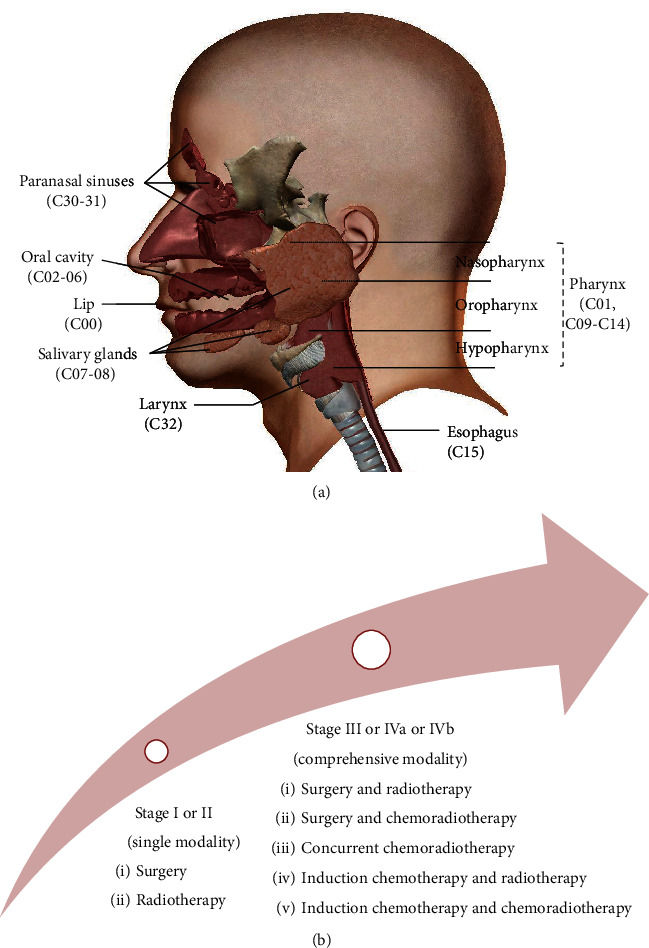
Figure 1
Figure 1
Anatomical sites and treatment of HNC. (a) Head and neck cancers incorporate multiple anatomical regions concerning the lip (C00), oral cavity (C02-06), salivary glands (C07-08), oropharynx (C01, C09-C10), nasopharynx (C11), hypopharynx (C12-14), esophagus (C15), paranasal sinuses (C30-31), and larynx (C32). International Classification of Diseases 10th revision, website: http://www.who.int/classifications/icd/icdonlineversions/en/. (b) HNC patients with early stages (stages I and II) are recommended for single modality including surgery or radiotherapy. Comprehensive modality including surgery, radiotherapy, and chemotherapy is guided for advanced cases (stages III, IVa, and IVb). Note. NCCN Clinical Practice Guidelines in Oncology: Head and Neck Cancers, website: https://www.nccn.org.
Figure 2
Figure 2
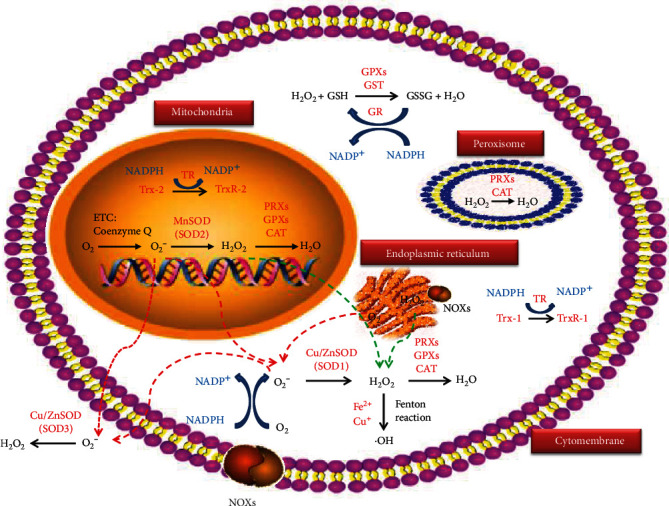
ROS sources and antioxidant systems. Mitochondrial respiration ETC and the membrane-bond NOX complexes are the two major ROS resources. Leakage of electrons from ETC is mediated by coenzyme Q and produces O2 through O2. There are three isoforms of SODs to defend oxidation. Cu/Zn SOD (SOD1) in the cytoplasm, MnSOD (SOD2) in the mitochondria, and Cu/Zn SOD (SOD3) in the extracellular matrix can rapidly convert O2 to H2O2. NOXs catalyze the generation of O2 from O2 and NADPH. H2O2 is converted to toxic ·OH by a metal (Fe2+ or Cu+) catalyst through the Fenton reaction. H2O2 can be converted into H2O by PRXs, GPXs, and CAT. Besides, Trxs (the cytoplasmic Trx-1 and the mitochondrial Trx-2) can reduce oxidized PRXs. Trxs themselves are also reduced to TrxR by TR using NADPH as an electron donor. GPXs oxidize reduced GSH to GSSH. GSSH is reduced back to GSH by GR accompanied by an electron from NADPH. Note. ETC: electron transport chain; NOXs: NADPH oxidase; SODs: superoxide dismutases; H2O2: hydrogen peroxide; NADPH: nicotinamide adenine dinucleotide phosphate; ·OH: hydroxyl radicals; PRXs: peroxiredoxins; GPXs: glutathione peroxidases; CAT: catalase; Trx: thioredoxin (oxidized); Trx-R: thioredoxin (reduced); TR: thioredoxin reductase; GSH: tripeptide glutathione (reduced); GSSH: glutathione disulfide (oxidized); GR: glutathione. Green dotted lines denote H2O2 diffusion. Red dotted lines denote O2 diffusion.
Figure 3
Figure 3
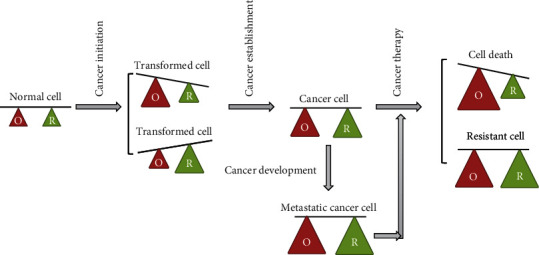
Redox adaptation in cancer formation, development, and therapy. Cellular redox homeostasis is maintained by ROS generation and elimination balance in normal cells. Once continuous exogenous stimulus and endogenous oncogene activation disrupt the balance, either a high level of ROS is produced or antioxidants are excessively enhanced, and cancer cells are hence formed. In order to survive oxidative stress, these cancer cells regain redox homeostasis via multiple mechanisms such as increasing ROS-scavenging enzymes. During the development of cancer and even during the process of therapy resistance, the cancer cells gradually enhance both ROS level and antioxidant enzymes. Thus, abrogating the adaptation mechanisms by increasing the ROS level beyond a threshold that is incompatible for cellular survival and attenuating antioxidant defense systems can be an attractive strategy to kill cancer cells and thus reverse resistance and limit cancer progression. Note. O: oxidative status; R: reducing status.
Figure 4
Figure 4
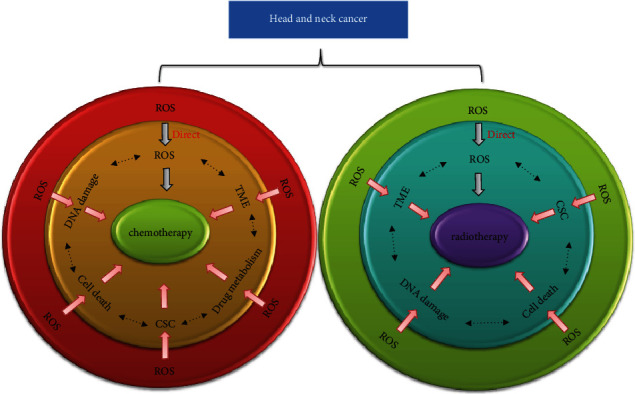
ROS is implicated in the modulation in the chemo-/radiotherapy of HNC. ROS can directly and indirectly affect the efficiency of chemotherapy drugs such as cisplatin and 5-Fu and/or radiation therapy in HNC. A direct effect is seen in terms of ROS-induced lethal genetic damage. Indirect mechanisms include cell death regulation such as apoptosis and autophagy, DNA damage repair, drug metabolism, cancer stem cell (CSC) characteristics, and tumor microenvironment (TME) which are modulated by ROS in the chemotherapy of HNC. Radiotherapy exerts its function through induction of DNA damage within the cell. Except for drug metabolism, other mechanisms are all involved in ROS-mediated radiotherapy efficacy in HNC. Because of the dual role of ROS, the complex modulation network can adapt towards the killing effect of cancer cells or readapting the therapy stimuli. Generally, low and chronic ROS may call for more antioxidant stress defense to protect cancer cells, while high and acute ROS may kill cancer cells with no margin for adaptation. Note. ROS: reactive oxygen species; HNC: head and neck cancer; 5-Fu: 5-flurouracil; DNA: deoxyribonucleic acid; CSC: cancer stem cell; TME: tumor microenvironment.

References

    1. Bray F., Ferlay J., Soerjomataram I., Siegel R. L., Torre L. A., Jemal A. Global cancer statistics 2018: GLOBOCAN estimates of incidence and mortality worldwide for 36 cancers in 185 countries. CA: A Cancer Journal for Clinicians. 2018;68(6):394–424. doi: 10.3322/caac.21492. - DOI - PubMed
    1. Shield K. D., Ferlay J., Jemal A., et al. The global incidence of lip, oral cavity, and pharyngeal cancers by subsite in 2012. CA: A Cancer Journal for Clinicians. 2017;67(1):51–64. doi: 10.3322/caac.21384. - DOI - PubMed
    1. Arnold M., Laversanne M., Brown L. M., Devesa S. S., Bray F. Predicting the future burden of esophageal cancer by histological subtype: international trends in incidence up to 2030. American Journal of Gastroenterology. 2017;112(8):1247–1255. doi: 10.1038/ajg.2017.155. - DOI - PubMed
    1. Srinivas U. S., Tan B. W. Q., Vellayappan B. A., Jeyasekharan A. D. ROS and the DNA damage response in cancer. Redox Biology. 2019;25, article 101084 doi: 10.1016/j.redox.2018.101084. - DOI - PMC - PubMed
    1. Sies H., Jones D. P. Reactive oxygen species (ROS) as pleiotropic physiological signalling agents. Nature Reviews Molecular Cell Biology. 2020;21(7):363–383. doi: 10.1038/s41580-020-0230-3. - DOI - PubMed

Substances