


No room to roam: King Cobras reduce movement in agriculture
- PMID: 32774861
- PMCID: PMC7397683
- DOI: 10.1186/s40462-020-00219-5
No room to roam: King Cobras reduce movement in agriculture
Abstract
Background: Studying animal movement provides insights into how animals react to land-use changes. As agriculture expands, we can use animal movement to examine how animals change their behaviour in response. Recent reviews show a tendency for mammalian species to reduce movements in response to increased human landscape modification, but reptile movements have not been as extensively studied.
Methods: We examined movements of a large reptilian predator, the King Cobra (Ophiophagus hannah), in Northeast Thailand. We used a consistent regime of radio telemetry tracking to document movements across protected forest and adjacent agricultural areas. Using dynamic Brownian Bridge Movement Model derived motion variance, Integrated Step-Selection Functions, and metrics of site reuse, we examined how King Cobra movements changed in agricultural areas.
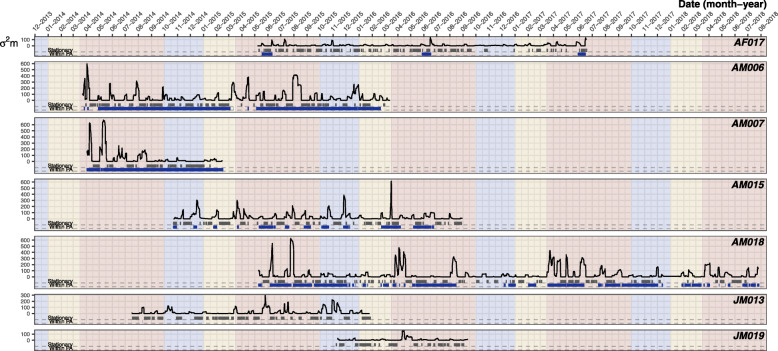
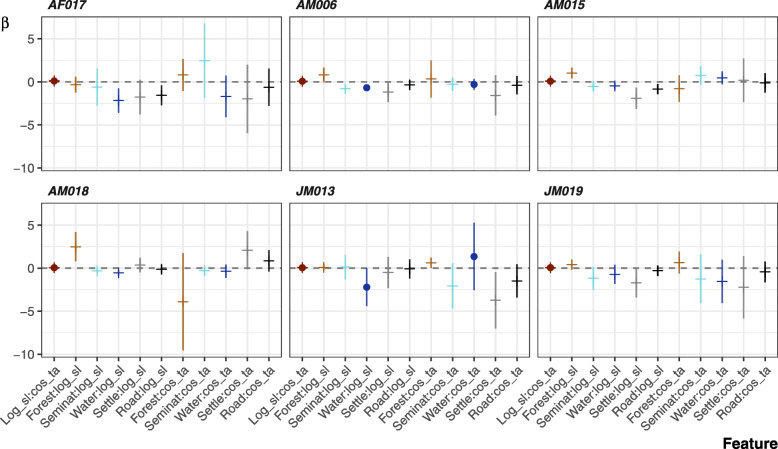
Results: Motion variance values indicated that King Cobra movements increased in forested areas and tended to decrease in agricultural areas. Our Integrated Step-Selection Functions revealed that when moving in agricultural areas King Cobras restricted their movements to remain within vegetated semi-natural areas, often located along the banks of irrigation canals. Site reuse metrics of residency time and number of revisits appeared unaffected by distance to landscape features (forests, semi-natural areas, settlements, water bodies, and roads). Neither motion variance nor reuse metrics were consistently affected by the presence of threatening landscape features (e.g. roads, human settlements), suggesting that King Cobras will remain in close proximity to threats, provided habitat patches are available.
Conclusions: Although King Cobras displayed individual heterogeneity in their response to agricultural landscapes, the overall trend suggested reduced movements when faced with fragmented habitat patches embedded in an otherwise inhospitable land-use matrix. Movement reductions are consistent with findings for mammals and forest specialist species.
Keywords: Elapid; Ophiophagus hannah; Reptile; Site fidelity; Snake; Space-use; Step-selection; Tropical; dBBMM.
© The Author(s) 2020.
Conflict of interest statement
Competing interestsWe declare that there are no conflicts of interest.
Figures



References
-
- Jellen BC, Shepard DB, Dreslik MJ, Phillips CA. Male movement and body size affect mate acquisition in the Eastern Massasauga (Sistrurus Catenatus) J Herpetol. 2007;41:451–457.
-
- Courbin N, Loveridge AJ, Macdonald DW, Fritz H, Valeix M, Makuwe ET, et al. Reactive responses of zebras to lion encounters shape their predator-prey space game at large scale. Oikos. 2016;125:829–838.
-
- Vogt K, Vimercati E, Ryser A, Hofer E, Signer S, Signer C, et al. Suitability of GPS telemetry for studying the predation of Eurasian lynx on small- and medium-sized prey animals in the northwestern Swiss Alps. Eur J Wildl Res. 2018;64:73.
-
- Valeix M, Hemson G, Loveridge AJ, Mills G, Macdonald DW. Behavioural adjustments of a large carnivore to access secondary prey in a human-dominated landscape: Wild prey, livestock and lion ecology. J Appl Ecol. 2012;49:73–81.
LinkOut - more resources
Full Text Sources
Research Materials
