


Semantic loss marks early Alzheimer's disease-related neurodegeneration in older adults without dementia
- PMID: 32775598
- PMCID: PMC7403823
- DOI: 10.1002/dad2.12066
Semantic loss marks early Alzheimer's disease-related neurodegeneration in older adults without dementia
Abstract
Objective: To assess progression of semantic loss in early stages of cognitive decline using semantic and letter fluency performance, and its relation with Alzheimer's disease (AD)-specific neurodegeneration using longitudinal multimodal neuroimaging measures.
Methods: Change in verbal fluency was analyzed among 2261 non-demented individuals with a follow-up diagnosis of no mild cognitive impairment (MCI), amnestic MCI (aMCI), non-amnestic MCI (naMCI), or incident dementia, using linear mixed models across 4 years of follow-up, and relations with magnetic resonance imaging (MRI; n = 1536) and 18F-fluorodeoxyglucose brain positron emission tomography (18F-FDG-PET) imaging (n = 756) using linear regression models across 2 years of follow-up.
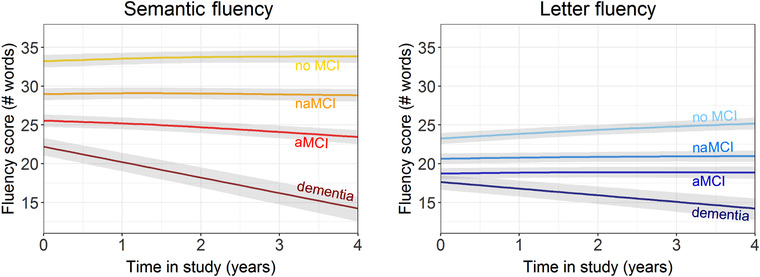
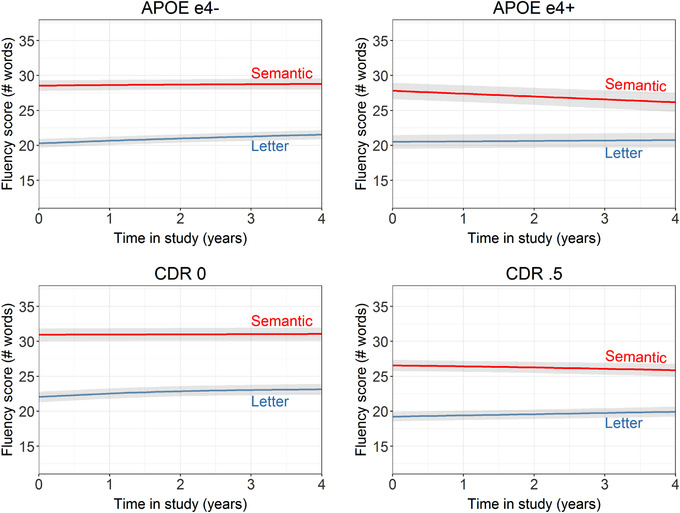
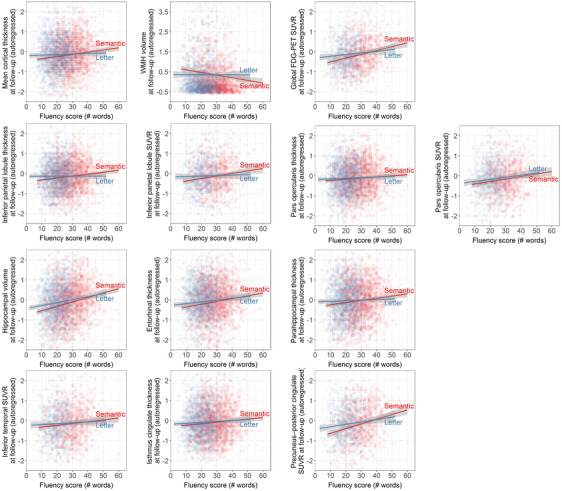
Results: Semantic fluency declined-fastest in those at higher risk for AD (apolipoprotein E [APOE] e4 carriers, Clinical Dementia Rating score of .5, aMCI, or incident dementia)-while letter fluency did not except for those with incident dementia. Lower baseline semantic fluency was associated with an increase in white matter hyperintensities and total mean cortical thinning over time, and regionally with less hippocampal volume as well as more cortical thinning and reduced 18F-FDG-PET uptake in the inferior parietal lobule, entorhinal cortex, isthmus cingulate, and precuneus-posterior cingulate area. In contrast, baseline letter fluency was not associated with change in total nor regional neurodegeneration. Whole-brain neurodegeneration over time was associated with faster decline in both fluencies, while AD-specific regions were associated with a faster rate of decline in semantic but not letter fluency.
Interpretation: This study provides strong evidence of distinctive degeneration of semantic abilities early on in relation to both cognitive decline and AD-specific neurodegeneration.
Keywords: Alzheimer's disease; MCI; amnestic; biomarkers; category fluency; cognitive aging; cohort studies; letter fluency; neuroimaging; semantic fluency; verbal fluency.
© 2020 The Authors. Alzheimer's & Dementia: Diagnosis, Assessment & Disease Monitoring published by Wiley Periodicals LLC on behalf of Alzheimer's Association.
Conflict of interest statement
The authors have no relevant conflicts of interest or financial or other nonprofessional benefits to disclose that could bias the authors in the conduct of the reported work.
Figures
References
-
- Bäckman L, Jones S, Berger A‐K, Laukka EJ, Small BJ. Cognitive impairment in preclinical Alzheimer's disease: a meta‐analysis. Neuropsychology. 2005;19:520‐531. - PubMed
-
- Rascovsky K, Salmon DP, Hansen LA, Thal LJ, Galasko D. Disparate letter and semantic category fluency deficits in autopsy‐confirmed frontotemporal dementia and Alzheimer's disease. Neuropsychology. 2007;21:20‐30. - PubMed
-
- Cerhan JH, Ivnik RJ, Smith GE, Tangalos EC, Petersen RC, Boeve BF. Diagnostic utility of letter fluency, category fluency, and fluency difference scores in Alzheimer's disease. Clin Neuropsychol. 2002;16:35‐42. - PubMed
Grants and funding
LinkOut - more resources
Full Text Sources
Miscellaneous