. 2020 Jul 31;6(31):eaba0588.
doi: 10.1126/sciadv.aba0588. eCollection 2020 Jul.

A polymer-based systemic hemostatic agent

Affiliations

A polymer-based systemic hemostatic agent

Yongsheng Gao et al. Sci Adv. .

Abstract

Uncontrolled noncompressible hemorrhage is a major cause of mortality following traumatic injuries in civilian and military populations. An injectable hemostat for point-of-care treatment of noncompressible hemorrhage represents an urgent medical need. Here, we describe an injectable hemostatic agent via polymer peptide interfusion (HAPPI), a hyaluronic acid conjugate with a collagen-binding peptide and a von Willebrand factor-binding peptide. HAPPI exhibited selective binding to activated platelets and promoted their accumulation at the wound site in vitro. In vivo studies in mouse tail vein laceration model demonstrated a reduction of >97% in both bleeding time and blood loss. A 284% improvement in the survival time was observed in the rat inferior vena cava traumatic model. Lyophilized HAPPI could be stably stored at room temperature for several months and reconstituted during therapeutic intervention. HAPPI provides a potentially clinically translatable intravenous hemostat.


Figures

Fig. 1
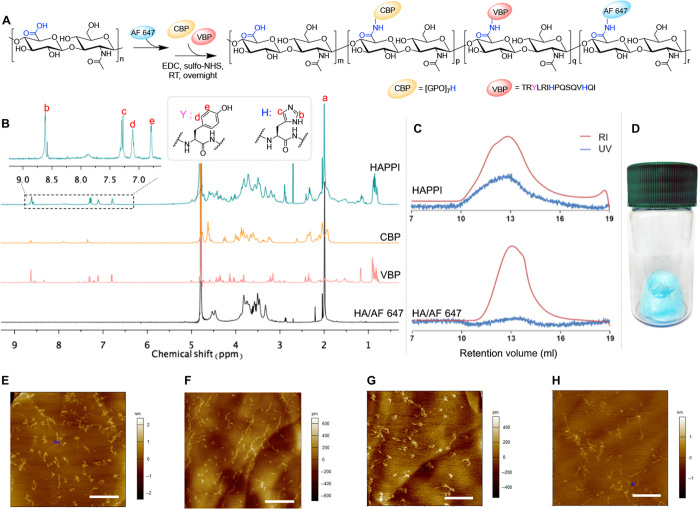
Fig. 1. Synthesis and characterization of AF 647–labeled HA-CBP-VBP conjugates (HAPPI).
(A) Reaction scheme for conjugation of fluorescent dye and peptides on HA backbone using EDC/sulfo-NHS chemistry. (B) 1H nuclear magnetic resonance (NMR) spectrum shows the presence of characteristic peaks b, c, d, and e from the peptides, indicating their successful conjugation to HA. (C) GPC profile of HAPPI shows the appearance of ultraviolet (UV) absorbance at the elution time of conjugates [refractive index (RI) signals], in contrast to the profile of fluorescent HA alone, further validating the chemical conjugation. (D) Image of freeze-dried HAPPI as the bluish material in the vial. Topographic air tapping mode atomic force micrographs for HA (E), HA-VBP (F), HA-CBP (G), and HAPPI (H) (scale bars, 500 nm). Photo credit: (D) Y. Gao, Harvard University.
Fig. 2
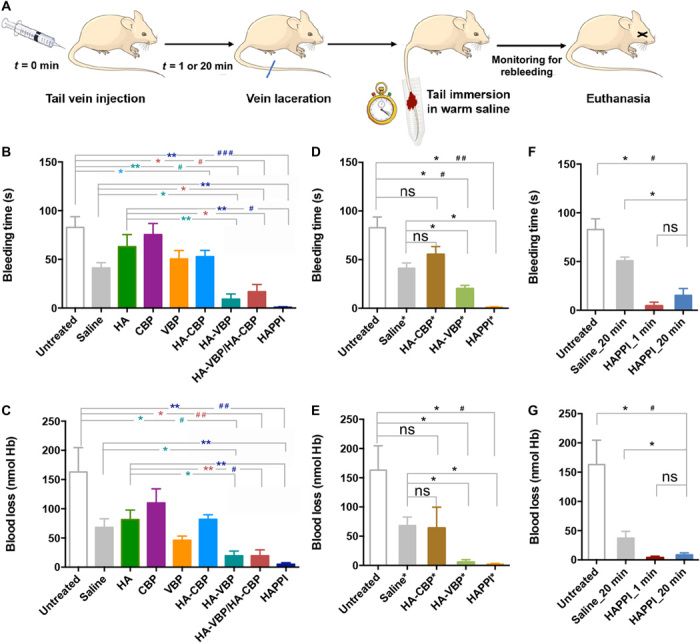
Fig. 2. Hemostatic action of HA-peptide conjugates in mouse tail laceration model.
(A) Schematic representation of the hemostatic efficacy studies in BALB/c mice. Mice were intravenously administered with saline, HA, or HA-peptide conjugates, and a tail vein laceration was induced following 1- or 20-min circulation time. Bleeding times (B, D, and F) and total blood loss (C, E, and G) were quantified. (B and C) Hemostatic efficacy of HA-CBP, HA-VBP, HA-VBP/HA-CBP, and HAPPI with untreated, saline, native HA, and free peptides (CBP and VBP) as controls. In HA-CBP, HA-VBP, and HAPPI groups, mice were administered with 4.6 mg/kg of equivalent HA dose. HA-VBP/HA-CBP was formulated by mixing the desired amounts of HA-VBP and HA-CBP conjugates to obtain final individual concentrations equal to the HA-VBP group and HA-CBP group, respectively (n = 5 mice). (D and E) HA-CBP*, HA-VBP*, and HAPPI* were dosed with the same amount of peptides as detailed in Materials and Methods (n ≥ 3 mice). (F and G) Efficacy of HAPPI with 20 min circulation time was compared with untreated mice and mice treated with saline of 20 min circulation and HAPPI of 1 min circulation time (n ≥ 4 mice). All data are means ± SEM; statistics by two-tailed, nonparametric Mann-Whitney test (*P < 0.05 and **P < 0.01) and Kruskal-Wallis test followed by Dunn’s multiple comparisons test (#P < 0.05, ##P < 0.01, and ###P < 0.01). ns, not significant; Hb, hemoglobin.
Fig. 3
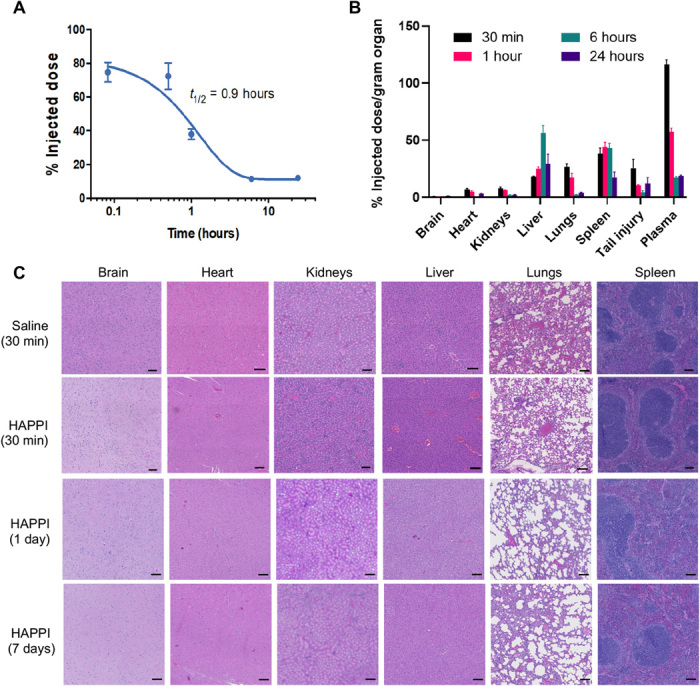
Fig. 3. Pharmacokinetic, biodistribution, and histology analyses of HAPPI in BALB/c mice.
(A) Pharmacokinetic studies for HAPPI indicating plasma circulation half-life (t1/2) of ~1 hour. Data were fitted using a one-phase exponential decay model with half-life values that are extracted as shown. (B) Percent injected dose normalized per organ mass at 30-min, 1-hour, 6-hour, and 24-hour time points after injection (n = 5 per group). (C) Representative micrographs of H&E staining of six vital organs, after 30 min, 1 day, and 7 days of treatment administration (scale bars, 100 μm).
Fig. 4
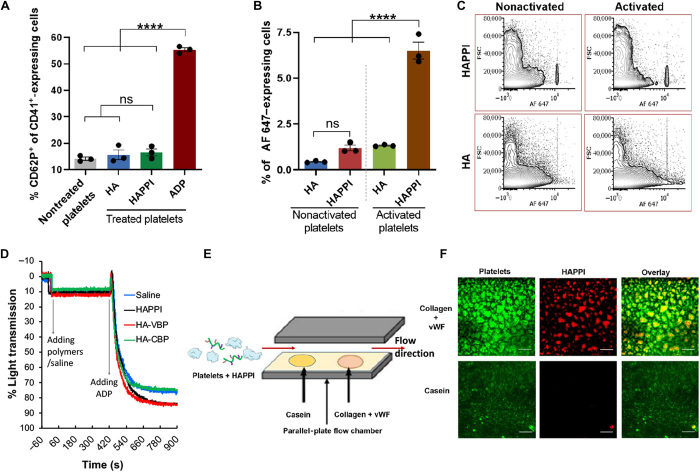
Fig. 4. Interaction of HAPPI with platelets and their preferable binding ability.
(A) FACS analysis of HAPPI-mediated platelet activation as measured by coexpression of CD62P/CD41 after 10 min of incubation. Data are presented as percentage of platelets positive for both epitopes. (B) FACS analysis of attachment of AF 647–HA and HAPPI to platelets in their nonactivated and activated states [n = 3, one-way analysis of variance (ANOVA) test and Tukey’s multiple comparisons test, ****P < 0.0001]. (C) Representative dot plots for expression of AF 647–HA and HAPPI to indicate binding of platelets to HA and HAPPI following 10 min of incubation. (D) Human platelet aggregation assay of HAPPI, HA-VBP, and HA-CBP with saline as control. (E) Schematic of experimental setup for dynamic binding studies using PPFC to validate preferable binding ability of HAPPI to wound-specific proteins, collagen, and vWF, under flow. (F) Representative fluorescence images (×20 magnification) of (F1) DiOC6-stained platelets (green), (F2) AF 647–HAPPI (red), and (F3) overlay of F1 and F2 in the same field of view, demonstrating colocalization of platelets with HAPPI at the collagen + vWF surface (scale bars, 100 μm). ns, not significant; ADP, adenosine diphosphate; FACS, fluorescence-activated cell sorting.
Fig. 5
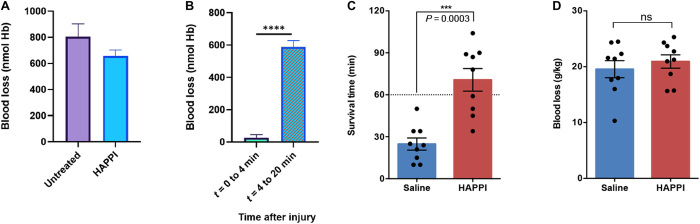
Fig. 5. Hemostatic action of HAPPI on the tail laceration models in thrombocytopenic BALB/c mice (A,B) and the IVC traumatic models in Sprague-Dawley rat (C,D).
Blood loss in injured, thrombocytopenic mice treated with HAPPI (equivalent HA dose of 4.6 mg/kg): total blood loss over 20-min observation time (A) and graph representing significant difference in the bleeding kinetics (B). Survival time (C) and blood loss (D) in IVC injured rats following treatment with HAPPI (12 mg/kg) versus equal volume of saline (***P < 0.001 and ****P < 0.0001).
Fig. 6
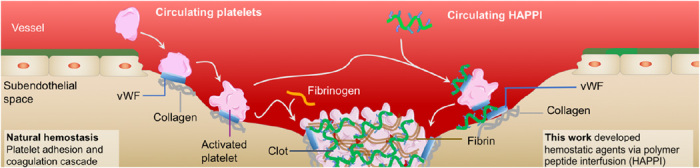
Fig. 6. Graphical schematic of the proposed hemostatic mechanism of HAPPI following vascular injury.
HAPPI binds to vWF and collagen exposed at the site of vascular injury and vWF immobilized on the activated platelet surface, facilitating the recruitment and aggregation of platelets at the injury site to further augment the clotting process.

References

    1. D. Berwick, A. Downey, Elizabeth Cornett, A National Trauma Care System: Integrating Military and Civilian Trauma Systems to Achieve Zero Preventable Deaths After Injury (National Academies Press, 2016). - PubMed
    1. S. Shackelford, B. J. Eastridge, in Damage Control Resuscitation (Springer, 2020), pp. 31–40.
    1. Rhee P., Joseph B., Pandit V., Aziz H., Vercruysse G., Kulvatunyou N., Friese R. S., Increasing trauma deaths in the United States. Ann. Surg. 260, 13–21 (2014). - PubMed
    1. Davis J. S., Satahoo S. S., Butler F. K., Dermer H., Naranjo D., Julien K., Van Haren R. M., Namias N., Blackbourne L. H., Schulman C. I., An analysis of prehospital deaths: Who can we save? J. Trauma Acute Care Surg. 77, 213–218 (2014). - PubMed
    1. Spinella P. C., Zero preventable deaths after traumatic injury: An achievable goal. J. Trauma Acute Care Surg. 82, S2–S8 (2017). - PubMed

Publication types

LinkOut - more resources