Association of preoperative sleep pattern with posthysterectomy pain: a pilot study
- PMID: 32776870
- PMCID: PMC8034220
- DOI: 10.5664/jcsm.8730
Association of preoperative sleep pattern with posthysterectomy pain: a pilot study
Abstract
Study objectives: To evaluate the association of preoperative sleep pattern with posthysterectomy pain perception and satisfaction with surgery.
Methods: This pilot study included women undergoing minimally invasive hysterectomy for benign conditions. Sleep quality, insomnia severity, and insomnia risk were assessed pre- and postoperatively via standard questionnaires. Total sleep time, wake after sleep onset, and sleep efficiency were measured before and after hysterectomy using daily sleep diaries and wrist-worn actigraphy. Pain perception and satisfaction with hysterectomy were assessed postoperatively. Repeated-measures analysis of variance, Pearson's correlation, and linear regression were used for analysis.
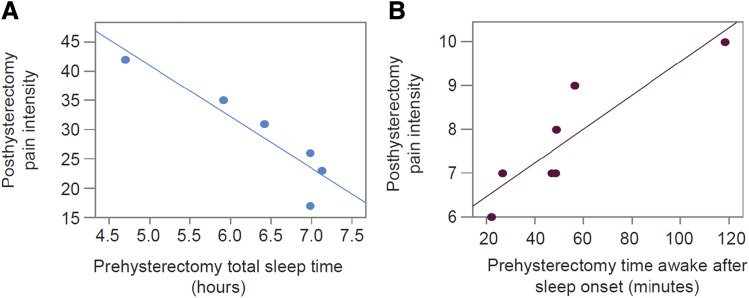
Results: Twenty women participated; of them 16 had complete data and were analyzed. Total sleep time increased from 384 ± 102 minutes before to 468 ± 96 minutes after surgery (P = .023). Wake after sleep onset, a measure of sleep fragmentation, increased from 26 ± 15.1 minutes before to 52 ± 22.9 minutes after surgery (P = .014). Pearson's correlation showed preoperative total sleep time was inversely correlated with postoperative pain intensity (r = -.92, P = .01). Preoperative wake after sleep onset was positively correlated with postoperative pain intensity (r = .86, P = .008). Preoperative insomnia severity and insomnia risk were positively associated with postoperative pain and pain behaviors (β = 0.41, P < .05; β = 0.55, P < .01, respectively). Finally, preoperative sleep efficiency was positively associated with overall satisfaction with hysterectomy (β = 0.39, P < .05).
Conclusions: Sleep duration and fragmentation increase following hysterectomy. Shorter, more fragmented preoperative sleep is associated with greater postoperative pain intensity. Better preoperative sleep was associated with more satisfaction after hysterectomy. Further studies are needed to determine if preoperative sleep interventions such as cognitive behavioral therapy improve pain perception and satisfaction after hysterectomy.
Keywords: actigraphy; hysterectomy; postoperative pain; preoperative sleep; sleep; women.
© 2020 American Academy of Sleep Medicine.
Figures
References
Publication types
MeSH terms
Grants and funding
LinkOut - more resources
Full Text Sources
Medical