


Characterizing upper extremity motor behavior in the first week after stroke
- PMID: 32776927
- PMCID: PMC7416933
- DOI: 10.1371/journal.pone.0221668
Characterizing upper extremity motor behavior in the first week after stroke
Abstract
Background: Animal models of brain recovery identify the first days after lesioning as a time of great flux in sensorimotor function and physiology. After rodent motor system lesioning, daily skill training in the less affected forelimb reduces skill acquisition in the more affected forelimb. We asked whether spontaneous human motor behaviors of the less affected upper extremity (UE) early after stroke resemble the animal training model, with the potential to suppress clinical recovery.
Methods: This prospective observational study used a convenience sample of patients (n = 25, mean 4.5 ±1.8) days after stroke with a wide severity range; Controls were hospitalized for non-neurological conditions (n = 12). Outcome measures were Accelerometry, Upper-Extremity Fugl-Meyer (UEFM), Action Research Arm Test (ARAT), Shoulder Abduction/ Finger Extension Test (SAFE), NIH Stroke Scale (NIHSS).
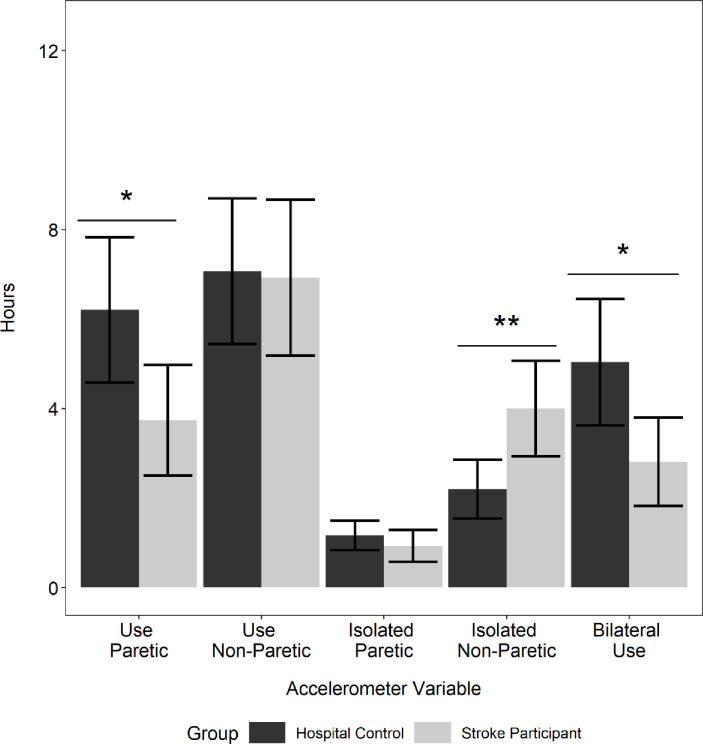
Results: Accelerometry indicated total paretic UE movement was reduced compared to controls, primarily due to a 44% reduction of bilateral UE use. Unilateral paretic movement was unchanged. Thus, movement shifted early after stroke; bilateral use was reduced and unilateral use of the non-paretic UE was increased by 77%. Low correlations between movement time and motor performance prompted an exploratory factor analysis (EFA) revealing a 2-component solution; motor performance tests load on one component (motor performance) whereas accelerometry-derived variables load on a second orthogonal component (quantity of movement).
Conclusions: Early after stroke, spontaneous overall UE movement is reduced, and movement shifts to unilateral use of the non-paretic UE. Two mechanisms that could influence motor recovery may already be in place 4.5 ± 1.8 days post stroke: (1) the overuse of the less affected UE, which could set the stage for learned non-use and (2) skill acquisition in the non-paretic limb that could impede recovery. Accurate UE motor assessment requires two independent constructs: motor performance and quantity of movement. These findings provide opportunities and measurement methods for studies to develop new behaviorally-based stroke recovery treatments that begin early after onset.
Conflict of interest statement
The authors have declared that no competing interests exist.
Figures
References
-
- JReding M. Rehabilitation outcome following initial unilateral hemispheric stroke. Life table analysis approach. Stroke 1988. - PubMed
Publication types
MeSH terms
LinkOut - more resources
Full Text Sources
Medical
