. 2020 Aug 10;16(8):e1008505.
doi: 10.1371/journal.pgen.1008505. eCollection 2020 Aug.

Immediate activation of chemosensory neuron gene expression by bacterial metabolites is selectively induced by distinct cyclic GMP-dependent pathways in Caenorhabditis elegans

Affiliations

Immediate activation of chemosensory neuron gene expression by bacterial metabolites is selectively induced by distinct cyclic GMP-dependent pathways in Caenorhabditis elegans

Jaeseok Park et al. PLoS Genet. .

Abstract

Dynamic gene expression in neurons shapes fundamental processes in the nervous systems of animals. However, how neuronal activation by different stimuli can lead to distinct transcriptional responses is not well understood. We have been studying how microbial metabolites modulate gene expression in chemosensory neurons of Caenorhabditis elegans. Considering the diverse environmental stimuli that can activate chemosensory neurons of C. elegans, we sought to understand how specific transcriptional responses can be generated in these neurons in response to distinct cues. We have focused on the mechanism of rapid (<6 min) and selective transcriptional induction of daf-7, a gene encoding a TGF-β ligand, in the ASJ chemosensory neurons in response to the pathogenic bacterium Pseudomonas aeruginosa. DAF-7 is required for the protective behavioral avoidance of P. aeruginosa by C. elegans. Here, we define the involvement of two distinct cyclic GMP (cGMP)-dependent pathways that are required for daf-7 expression in the ASJ neuron pair in response to P. aeruginosa. We show that a calcium-independent pathway dependent on the cGMP-dependent protein kinase G (PKG) EGL-4, and a canonical calcium-dependent signaling pathway dependent on the activity of a cyclic nucleotide-gated channel subunit CNG-2, function in parallel to activate rapid, selective transcription of daf-7 in response to P. aeruginosa metabolites. Our data suggest that fast, selective early transcription of neuronal genes require PKG in shaping responses to distinct microbial stimuli in a pair of C. elegans chemosensory neurons.


Conflict of interest statement

The authors have declared that no competing interests exist.

Figures
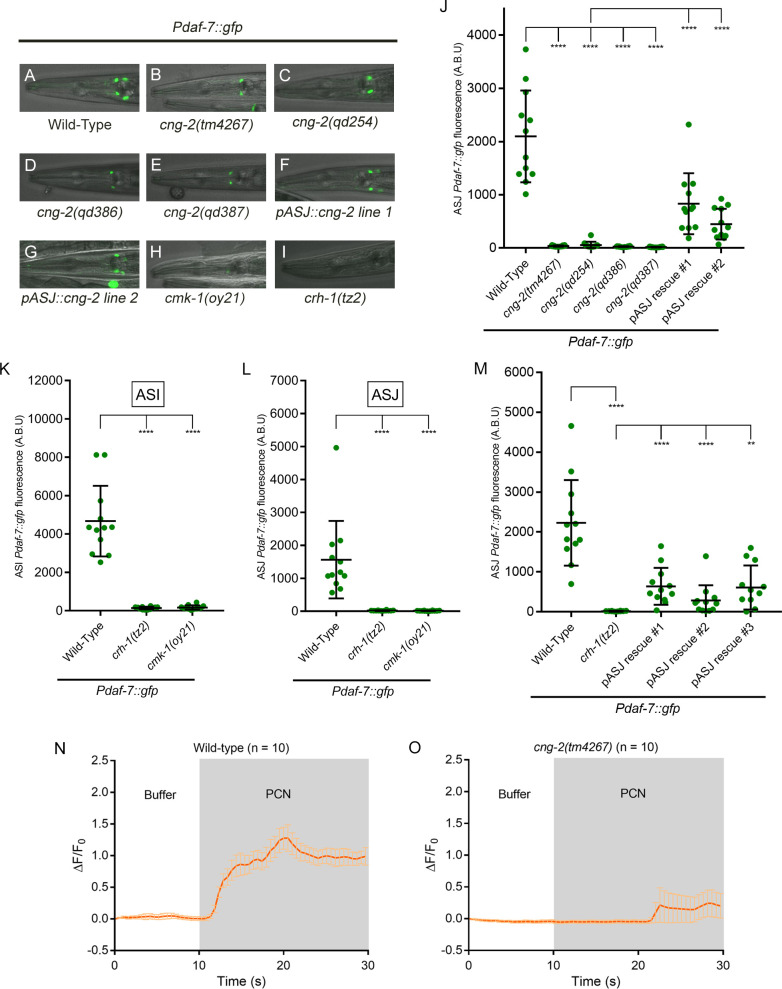
Fig 1
Fig 1. CNG-2 activates daf-7 induction upon P. aeruginosa exposure in a calcium-dependent manner.
(A-I) Pdaf-7::gfp expression after exposure to P. aeruginosa for various genotypes. (J) Maximum fluorescence values of Pdaf-7::gfp in ASJ neurons in various cng-2 mutant backgrounds following P. aeruginosa exposure. Both rescue lines shown have the mutation cng-2(qd254) in the background. (K-L) Maximum fluorescence values of Pdaf-7::gfp in ASI and ASJ neurons in crh-1 and cmk-1 mutants following P. aeruginosa exposure. (M) Maximum fluorescence values of Pdaf-7::gfp in ASJ neurons of crh-1 mutants expressing crh-1 cDNA in ASJ neurons. All three rescue lines shown have the mutation crh-1(tz2) in the background. (N-O) GCaMP5 fluorescence change in the ASJ neurons of wild-type or cng-2 mutant when exposed to buffer (DMSO) followed by 80 μg/ml phenazine-1-carboxamide (PCN). Error bars in J-M indicate standard deviation, and error bars in N-O indicate standard error of the mean. ****p < 0.0001, **p < 0.01 by Mann-Whitney U test.
Fig 2
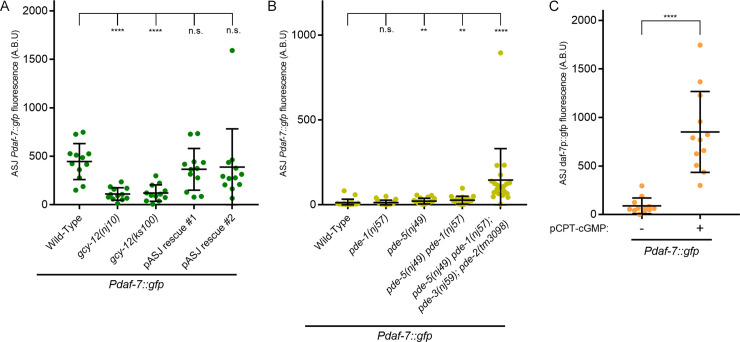
Fig 2. Elevation of cGMP levels is sufficient for the induction of daf-7 in the ASJ neurons.
(A) Maximum fluorescence values of Pdaf-7::gfp in ASJ neurons in various gcy-12 mutant backgrounds following P. aeruginosa exposure. Both rescue lines shown have the mutation gcy-12(ks100) in the background. (B) Maximum fluorescence values of Pdaf-7::gfp in ASJ neurons of various phosphodiesterase (PDE) mutants. Animals were maintained on the E. coli strain OP50. (C) Maximum fluorescence values of Pdaf-7::gfp in ASJ neurons after exposure to 5 mM pCPT-cGMP; animals were maintained on the E. coli strain OP50. All error bars indicate standard deviation. ****p < 0.0001, **p < 0.01 by Mann-Whitney U test.
Fig 3
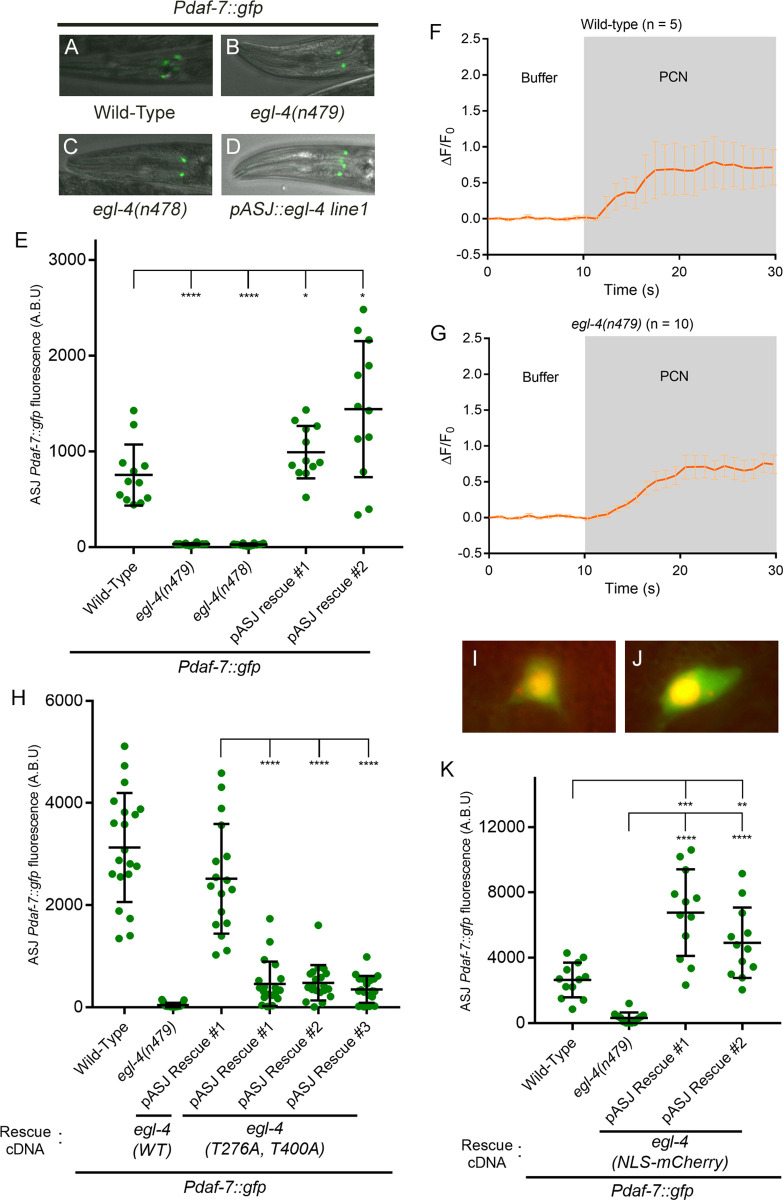
Fig 3. EGL-4 is required in the nucleus for the induction of daf-7 in ASJ neurons upon P. aeruginosa exposure.
(A-D) Pdaf-7::gfp expression after exposure to P. aeruginosa for various egl-4 backgrounds. (E) Maximum fluorescence values of Pdaf-7::gfp in ASJ neurons in various egl-4 mutant backgrounds following P. aeruginosa exposure. Both rescue lines shown have the mutation egl-4(n479) in the background. (F-G) GCaMP5 fluorescence change in the ASJ neurons when exposed to buffer (DMSO) followed by 66 μg/ml phenazine-1-carboxamide (PCN) in wild-type or egl-4 mutants. (H) Maximum fluorescence values of Pdaf-7::gfp in ASJ neurons of egl-4(n479) mutants expressing WT egl-4 cDNA or cGMP-binding defective (T276A, T400A) egl-4 cDNA in the ASJ neurons. (I-J) NLS-mCherry-EGL-4 proteins are localized to the nucleus of ASJ neurons. NLS-mCherry-EGL-4 is seen in the red channels, and GFP from Pdaf-7::gfp is seen in the green channels. GFP is observed throughout the ASJ neurons, outlining the cells. (K) Maximum fluorescence values of Pdaf-7::gfp in ASJ neurons of egl-4(n479) mutants containing the NLS-mCherry-EGL-4 constructs following exposure to P. aeruginosa; the egl-4(n479) column data was from non-transgenic siblings of rescue line #1. Error bars in E, H and K indicate standard deviation, and errors bars in F and G indicate standard errors of the mean. ****p < 0.0001, ***p < 0.001, **p < 0.01, *p < 0.05 by Mann-Whitney U test.
Fig 4
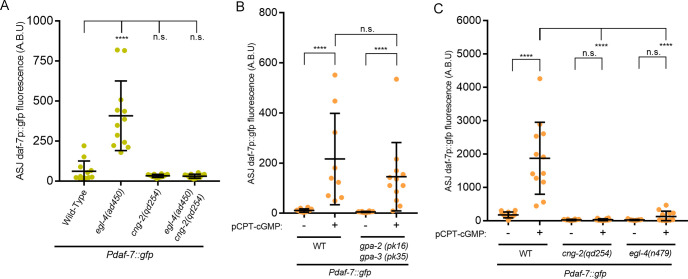
Fig 4. EGL-4 and CNG-2 work concurrently in parallel pathways downstream of cGMP to induce daf-7.
(A) Epistasis analysis using cng-2(loss-of-function) and egl-4(gain-of-function) alleles. Animals were maintained on the E. coli strain OP50. (B-C) Maximum fluorescence values of Pdaf-7::gfp in ASJ neurons of various mutants following exposure to 5mM pCPT-cGMP; animals were maintained on the E. coli strain OP50. All error bars indicate standard deviation. ****p < 0.0001 by Mann-Whitney U test.
Fig 5
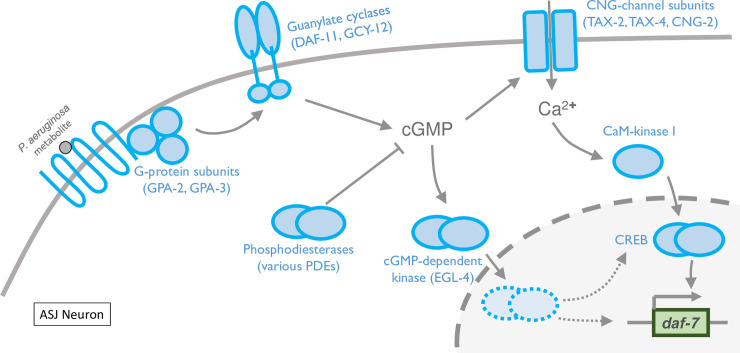
Fig 5. Immediate transcription of daf-7 is selectively induced by activation of calcium-dependent and calcium-independent pathways in ASJ neurons.
A schematic describing the current model for the sensory transduction pathway in the ASJ neurons resulting in fast neuronal gene transcription in response to P. aeruginosa metabolite phenazine-1-carboxamide (PCN). The model highlights the role of canonical signal transduction pathway molecules as well the added role of the cGMP-dependent kinase EGL-4 as one of the two parallel pathways required for the induction of daf-7. Note that the activation of both pathways are required for the full induction of daf-7.

References

    1. Hildebrand JG, Shepherd GM. Mechanisms of olfactory discrimination: converging evidence for common principles across phyla. Annu Rev Neurosci. 1997;20: 595–631. 10.1146/annurev.neuro.20.1.595 - DOI - PubMed
    1. Yarmolinsky DA, Zuker CS, Ryba NJP. Common sense about taste: from mammals to insects. Cell. 2009;139: 234–244. 10.1016/j.cell.2009.10.001 - DOI - PMC - PubMed
    1. Yohe LR, Brand P. Evolutionary ecology of chemosensation and its role in sensory drive. Curr Zool. 2018;64: 525–533. 10.1093/cz/zoy048 - DOI - PMC - PubMed
    1. Flavell SW, Greenberg ME. Signaling mechanisms linking neuronal activity to gene expression and plasticity of the nervous system. Annu Rev Neurosci. 2008;31: 563–590. 10.1146/annurev.neuro.31.060407.125631 - DOI - PMC - PubMed
    1. Hilbert ZA, Kim DH. Sexually dimorphic control of gene expression in sensory neurons regulates decision-making behavior in C. elegans. Elife. 2017;6 10.7554/eLife.21166 - DOI - PMC - PubMed

Publication types

MeSH terms

Substances