


Neuronal intranuclear inclusion disease is genetically heterogeneous
- PMID: 32777174
- PMCID: PMC7480908
- DOI: 10.1002/acn3.51151
Neuronal intranuclear inclusion disease is genetically heterogeneous
Abstract
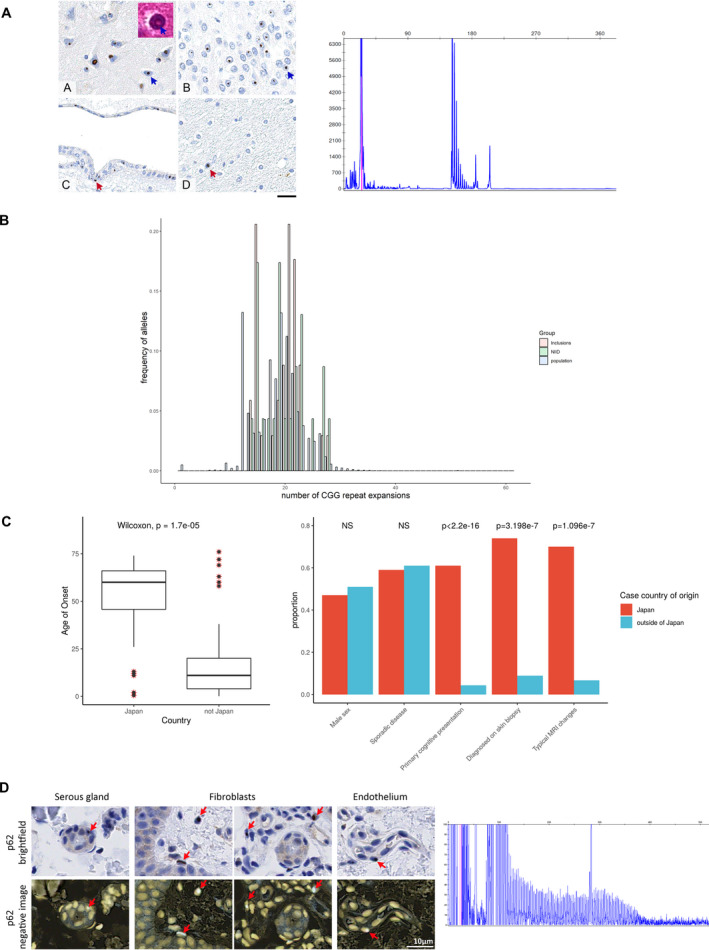
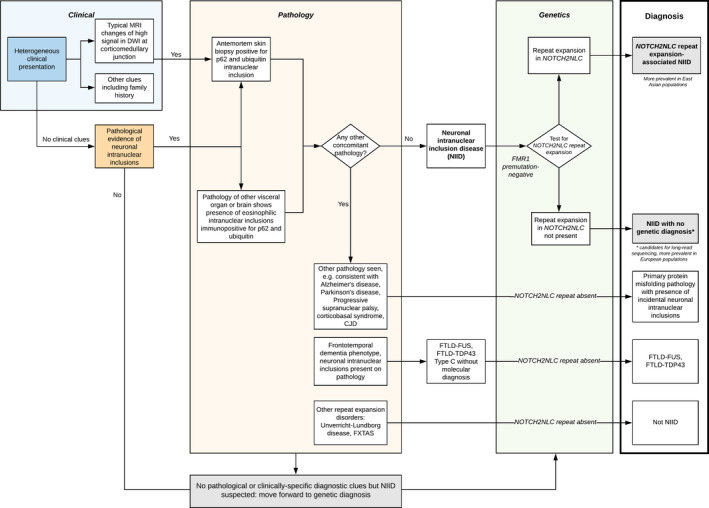
Neuronal intranuclear inclusion disease (NIID) is a clinically heterogeneous neurodegenerative condition characterized by pathological intranuclear eosinophilic inclusions. A CGG repeat expansion in NOTCH2NLC was recently identified to be associated with NIID in patients of Japanese descent. We screened pathologically confirmed European NIID, cases of neurodegenerative disease with intranuclear inclusions and applied in silico-based screening using whole-genome sequencing data from 20 536 participants in the 100 000 Genomes Project. We identified a single European case harbouring the pathogenic repeat expansion with a distinct haplotype structure. Thus, we propose new diagnostic criteria as European NIID represents a distinct disease entity from East Asian cases.
© 2020 The Authors. Annals of Clinical and Translational Neurology published by Wiley Periodicals LLC on behalf of American Neurological Association.
Conflict of interest statement
The authors declare no competing interests.
Figures
Comment in
-
Reply to: No evidence supports genetic heterogeneity of neuronal intranuclear inclusion disease.Ann Clin Transl Neurol. 2020 Dec;7(12):2544-2545. doi: 10.1002/acn3.51222. Epub 2020 Oct 30. Ann Clin Transl Neurol. 2020. PMID: 33124767 Free PMC article. No abstract available.
-
No evidence supports the genetic heterogeneity of Neuronal intranuclear inclusion disease.Ann Clin Transl Neurol. 2020 Dec;7(12):2542-2543. doi: 10.1002/acn3.51223. Epub 2020 Oct 30. Ann Clin Transl Neurol. 2020. PMID: 33124781 Free PMC article. No abstract available.
-
Reply: Genetic heterogeneity of neuronal intranuclear inclusion disease. What about the infantile variant?Ann Clin Transl Neurol. 2021 Apr;8(4):1002-1004. doi: 10.1002/acn3.51330. Epub 2021 Mar 29. Ann Clin Transl Neurol. 2021. PMID: 33780167 Free PMC article. No abstract available.
-
Genetic heterogeneity of neuronal intranuclear inclusion disease: What about the infantile variant?Ann Clin Transl Neurol. 2021 Apr;8(4):994-1001. doi: 10.1002/acn3.51332. Epub 2021 Mar 29. Ann Clin Transl Neurol. 2021. PMID: 33780169 Free PMC article. No abstract available.
References
-
- Lindenberg R, Rubinstein LJ, Herman MM, Haydon GB. A light and electron microscopy study of an unusual widespread nuclear inclusion body disease. Acta Neuropathol 1968;10(1):54–73. - PubMed
-
- Ishiura H, Shibata S, Yoshimura J, et al. Noncoding CGG repeat expansions in neuronal intranuclear inclusion disease, oculopharyngodistal myopathy and an overlapping disease. Nat Genet 2019;51(8):1222–1232. - PubMed
-
- Sone J, Mitsuhashi S, Fujita A, et al. Long‐read sequencing identifies GGC repeat expansions in NOTCH2NLC associated with neuronal intranuclear inclusion disease. Nat Genet 2019;51(8):1215–1221. - PubMed
-
- Gelpi E, Botta‐Orfila T, Bodi L, et al. Neuronal intranuclear (hyaline) inclusion disease and fragile X‐associated tremor/ataxia syndrome: a morphological and molecular dilemma. Brain 2017;140(8):e51. - PubMed
Publication types
MeSH terms
Substances
Supplementary concepts
Grants and funding
- MR/L501542/1/MRC_/Medical Research Council/United Kingdom
- G-0907/PUK_/Parkinson's UK/United Kingdom
- G0701075/MRC_/Medical Research Council/United Kingdom
- MC_PC_14089/MRC_/Medical Research Council/United Kingdom
- MR/M009203/1/MRC_/Medical Research Council/United Kingdom
- WT104033AIA/WT_/Wellcome Trust/United Kingdom
- MR/N026004/1/MRC_/Medical Research Council/United Kingdom
- MR/S01165X/1/MRC_/Medical Research Council/United Kingdom
- MC_EX_MR/M009203/1/MRC_/Medical Research Council/United Kingdom
- WT093205MA/WT_/Wellcome Trust/United Kingdom
- WT_/Wellcome Trust/United Kingdom
- MR/S006753/1/MRC_/Medical Research Council/United Kingdom
- MR/N008324/1/MRC_/Medical Research Council/United Kingdom
- G0901254/MRC_/Medical Research Council/United Kingdom
LinkOut - more resources
Full Text Sources
Medical
Miscellaneous