


Study protocol: pragmatic randomized control trial of my tools 4 care- in care (MT4C-in care) a web-based tool for family Carers of persons with dementia residing in long term care
- PMID: 32778059
- PMCID: PMC7418203
- DOI: 10.1186/s12877-020-01690-w
Study protocol: pragmatic randomized control trial of my tools 4 care- in care (MT4C-in care) a web-based tool for family Carers of persons with dementia residing in long term care
Abstract
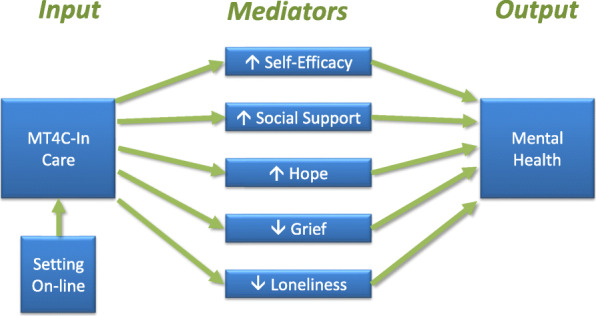
Background: When a family member resides in long term care facility (LTC), family carers continue caregiving and have been found to have decreases in mental health. The aim of My Tools 4 Care - In Care (an online intervention) is to support carers of persons living with dementia residing in LTC through transitions and increase their self-efficacy, hope, social support and mental health. This article comprises the protocol for a study to evaluate My Tools 4 Care-In Care (MT4C-In Care) by asking the following research questions: 1) Is there a 2 month (immediately post-intervention) and 4 month (2 months post-intervention) increase in mental health, general self-efficacy, social support and hope, and decrease in grief and loneliness, in carers of a person living with dementia residing in LTC using MT4C-In CARE compared to an educational control group? 2) Do carers of persons living with dementia residing in LTC perceive My Tools 4 Care- In Care helps them with the transitions they experience?
Methods: This study is a single blinded pragmatic mixed methods randomized controlled trial. Approximately 280 family carers of older persons (65 years of age and older) with dementia residing in LTC will be recruited for this study. Data will be collected at three time points: baseline, 2 month, and 4 months. Based on the feasibility study, we hypothesize that participants using MT4C-In Care will report significant increases in hope, general self-efficacy, social support and mental health quality of life, and significant decreases in grief and loneliness from baseline, as compared to an educational control group. To determine differences between groups and over time, generalized estimating equations analysis will be used. Qualitative descriptive analysis will be used to further evaluate MT4C-In Care and if it supports carers through transitions.
Discussion: Data collection will begin in four Canadian provinces (Alberta, Manitoba, Ontario and Saskatchewan) in February 2020 and is expected to be completed in June 2021. The results will inform policy and practice as MT4C-In Care can be revised for local contexts and posted on websites such as those hosted by the Alzheimer Society of Canada.
Trial registration: NCT04226872 ClinicalTrials.gov Registered 09 January 2020 Protocol Version #2 Feb 19, 2020.
Keywords: Carers; Dementia; Long term care; Online intervention; Pragmatic trial.
Conflict of interest statement
The author’s declare they have no competing interests.
Figures
References
-
- Alzheimer Society of Canada . Dementia numbers in Canada. Toronto: Alzheimer Society of Canada; 2020.
-
- Donelan K, Failk M, Deroches CM. The costs of caring: impact of dementia on family caregivers. Womens Health Issues. 2011;11:185–2000.
-
- Afram B, Verbeek H, Bleijlevens MHC, Hammers JPH. Needs of informal caregivers during transition from home towards institutional care in dementia: asystematic review of qualitative studies. Int Psychogeriatr. 2015;27(6):891–902. - PubMed
-
- Garity J. Caring for a family member with Alzheimer’s disease: coping with caregiver burden post nursing home placement. J Gerontol Nurs. 2006;32(6):39–48. - PubMed
Publication types
MeSH terms
Associated data
LinkOut - more resources
Full Text Sources
Medical
