


Effect of Aspirin on Cancer Incidence and Mortality in Older Adults
- PMID: 32778876
- PMCID: PMC7936068
- DOI: 10.1093/jnci/djaa114
Effect of Aspirin on Cancer Incidence and Mortality in Older Adults
Abstract
Background: ASPirin in Reducing Events in the Elderly, a randomized, double-blind, placebo-controlled trial of daily low-dose aspirin (100 mg) in older adults, showed an increase in all-cause mortality, primarily due to cancer. In contrast, prior randomized controlled trials, mainly involving younger individuals, demonstrated a delayed cancer benefit with aspirin. We now report a detailed analysis of cancer incidence and mortality.
Methods: 19 114 Australian and US community-dwelling participants aged 70 years and older (US minorities 65 years and older) without cardiovascular disease, dementia, or physical disability were randomly assigned and followed for a median of 4.7 years. Fatal and nonfatal cancer events, a prespecified secondary endpoint, were adjudicated based on clinical records.
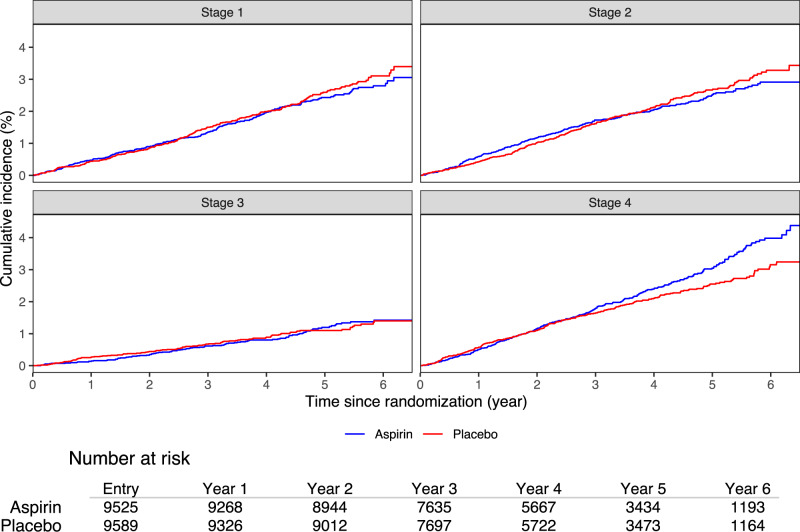
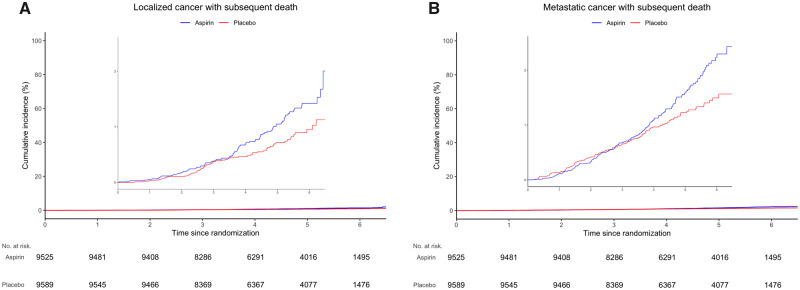
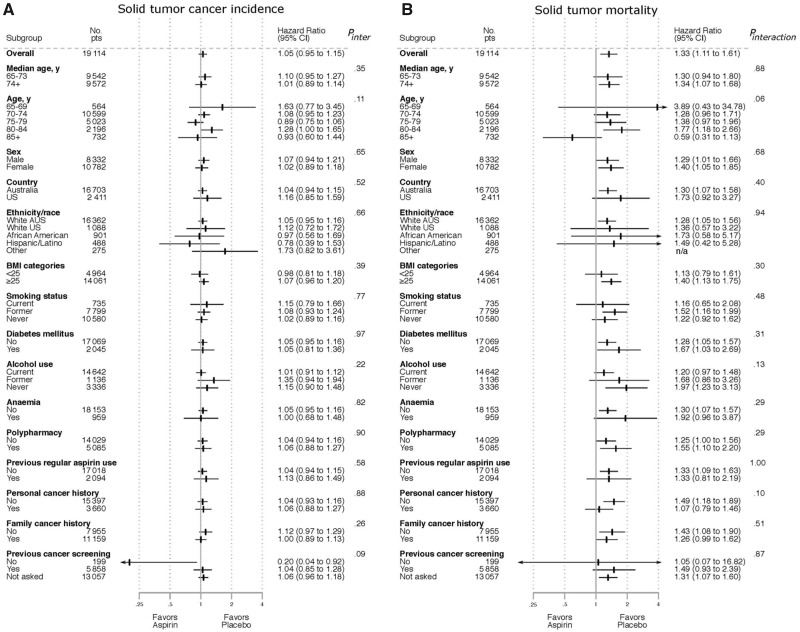
Results: 981 cancer events occurred in the aspirin and 952 in the placebo groups. There was no statistically significant difference between groups for all incident cancers (hazard ratio [HR] = 1.04, 95% confidence interval [CI] = 0.95 to 1.14), hematological cancer (HR = 0.98, 95% CI = 0.73 to 1.30), or all solid cancers (HR = 1.05, 95% CI = 0.95 to 1.15), including by specific tumor type. However, aspirin was associated with an increased risk of incident cancer that had metastasized (HR = 1.19, 95% CI = 1.00 to 1.43) or was stage 4 at diagnosis (HR = 1.22, 95% CI = 1.02 to 1.45), and with higher risk of death for cancers that presented at stages 3 (HR = 2.11, 95% CI = 1.03 to 4.33) or 4 (HR = 1.31, 95% CI = 1.04 to 1.64).
Conclusions: In older adults, aspirin treatment had an adverse effect on later stages of cancer evolution. These findings suggest that in older persons, aspirin may accelerate the progression of cancer and, thus, suggest caution with its use in this age group.
© The Author(s) 2020. Published by Oxford University Press.
Figures
Comment in
-
The ASPREE Trial: An Unanticipated Stimulus for Greater Precision in Prevention?J Natl Cancer Inst. 2021 Mar 1;113(3):221-222. doi: 10.1093/jnci/djaa115. J Natl Cancer Inst. 2021. PMID: 32778864 Free PMC article. No abstract available.
-
In healthy older adults, daily aspirin increased cancer mortality.Ann Intern Med. 2021 Jul;174(7):JC74. doi: 10.7326/ACPJ202107200-074. Epub 2021 Jul 6. Ann Intern Med. 2021. PMID: 34224271
References
-
- Rothwell PM, Price JF, Fowkes FG, et al. Short-term effects of daily aspirin on cancer incidence, mortality, and non-vascular death: analysis of the time course of risks and benefits in 51 randomised controlled trials. Lancet. 2012;379(9826):1602–1612. - PubMed
-
- Rothwell PM, Fowkes FG, Belch JF, Ogawa H, Warlow CP, Meade TW.. Effect of daily aspirin on long-term risk of death due to cancer: analysis of individual patient data from randomised trials. Lancet. 2011;377(9759):31–41. - PubMed
Publication types
MeSH terms
Substances
Grants and funding
LinkOut - more resources
Full Text Sources
Medical
