


Prescription of oral anticoagulants and antiplatelets for stroke prophylaxis in atrial fibrillation: nationwide time series ecological analysis
- PMID: 32778878
- PMCID: PMC7478320
- DOI: 10.1093/europace/euaa126
Prescription of oral anticoagulants and antiplatelets for stroke prophylaxis in atrial fibrillation: nationwide time series ecological analysis
Abstract
Aims: To investigate trends in the prescription of oral anticoagulants (OACs) and antiplatelet agents for atrial fibrillation (AF).
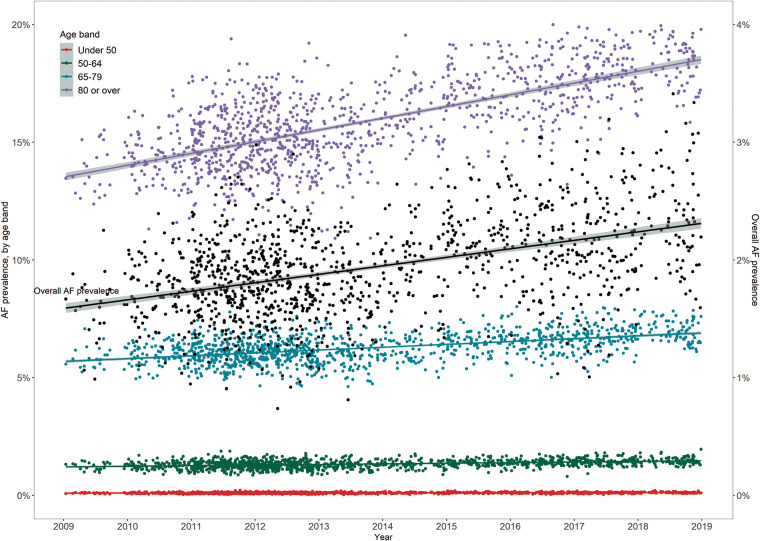
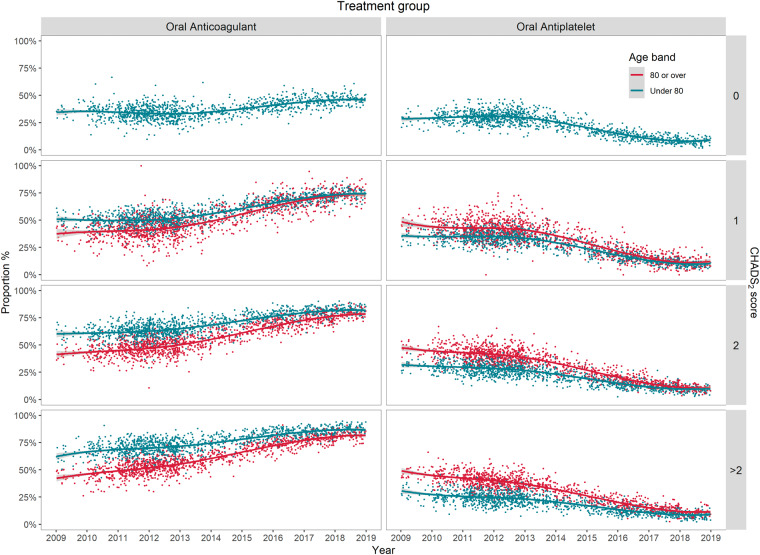
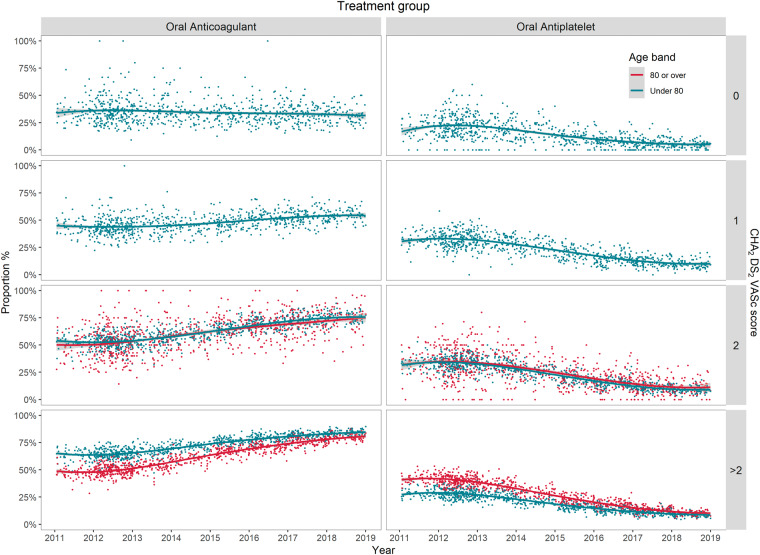
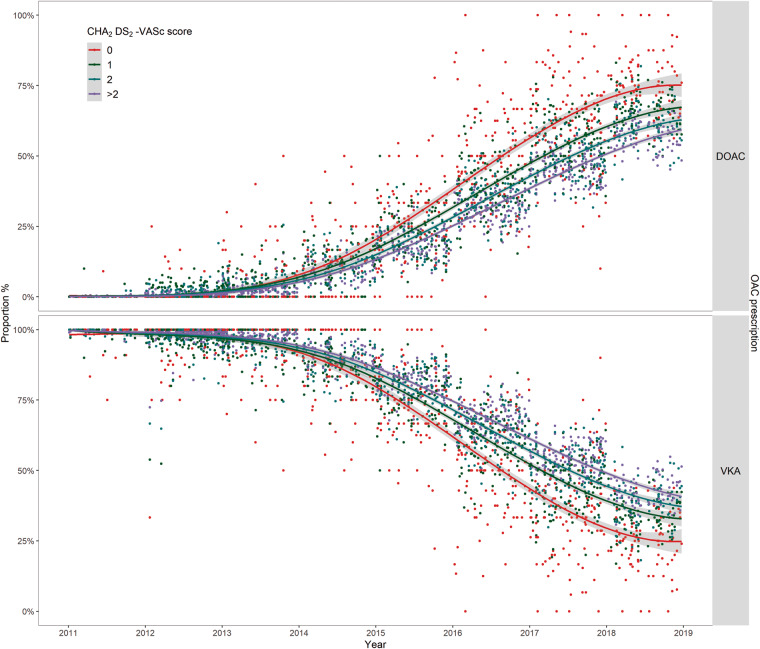
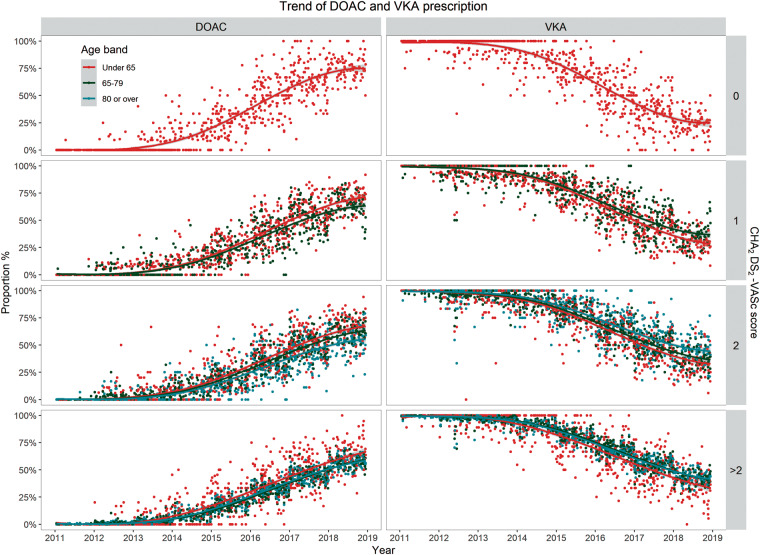
Methods and results: Prescription data for 450 518 patients with AF from 3352 General Practices in England, was obtained from the GRASP-AF registry, 2009-2018. Annualized temporal trends for OAC and antiplatelet prescription were reported according to eligibility based on stroke risk (CHADS2 or CHA2DS2-VASc scores ≥1 or >2, respectively). From 2009 to 2018, the prevalence of AF increased from 1.6% [95% confidence interval (CI) 1.5-1.7%] to 2.4% (2.3-2.5%), and for those with AF the proportion prescribed OAC increased from 47.6% to 75.0% (P-trend < 0.001; relative risk 1.57, 95% CI 1.55-1.60) and for antiplatelet decreased from 37.4% to 9.2% (P-trend < 0.001). In early-years (2009-2013), eligible patients aged ≥80 years were less likely to be prescribed OAC than patients aged <80 years [odds ratio (OR) 0.55, 95% CI 0.51-0.59 for CHADS2≥1 in 2009] (all P-trends < 0.001). This 'OAC prescription gap' reduced over the study period (OR 0.93, 0.90-0.96 in 2018). Whilst the prescription of direct oral anticoagulant (DOAC) as a proportion of all OAC increased from 0.1% (95% CI 0.0-0.2%) in 2011 to 58.8% (58.4-59.2%) in 2018, it was inversely associated with patient age (P-trend < 0.001) and their risk of stroke.
Conclusion: Between 2009 and 2018, in England, the use of OAC for stroke prophylaxis in AF increased, with DOAC accounting for over half of OAC uptake in 2018. Despite a reduction in the OAC-prescription gap, a new paradox exists relating to DOAC prescription for the elderly and those at higher risk of stroke.
Keywords: Antiplatelet; Atrial fibrillation; Direct oral anticoagulants; Oral anticoagulation; Stroke.
Published on behalf of the European Society of Cardiology. All rights reserved. © The Author(s) 2020. For permissions, please email: journals.permissions@oup.com.
Figures
References
-
- Friberg L, Rosenqvist M, Lindgren A, Terent A, Norrving B, Asplund K.. High prevalence of atrial fibrillation among patients with ischemic stroke. Stroke 2014;45:2599–605. - PubMed
-
- Freedman B, Potpara TS, Lip GY.. Stroke prevention in atrial fibrillation. Lancet 2016;388:806–17. - PubMed
-
- Camm AJ, Kirchhof P, Lip GY, Schotten U, Savelieva I, Ernst S. et al. Guidelines for the management of atrial fibrillation: the task force for the management of atrial fibrillation of the European Society of Cardiology (ESC). Europace 2010;12:1360–420. - PubMed
-
- Kirchhof P, Benussi S, Kotecha D, Ahlsson A, Atar D, Casadei B et al. 2016 ESC Guidelines for the management of atrial fibrillation developed in collaboration with EACTS. Europace 2016;18:1609–78. - PubMed
-
- Martinez C, Katholing A, Wallenhorst C, Freedman SB.. Therapy persistence in newly diagnosed non-valvular atrial fibrillation treated with warfarin or NOAC. A cohort study. Thromb Haemost 2016;115:31–9. - PubMed
Publication types
MeSH terms
Substances
Grants and funding
LinkOut - more resources
Full Text Sources
Medical
Miscellaneous
