Review
. 2020 Aug;28(Suppl 1):99-107.
doi: 10.1007/s12471-020-01461-7.

Invasive coronary physiology: a Dutch tradition

Affiliations
Review

Invasive coronary physiology: a Dutch tradition

T P van de Hoef et al. Neth Heart J. 2020 Aug.

Abstract

Invasive coronary physiology has been applied since the early days of percutaneous transluminal coronary angioplasty, and has become a rapidly emerging field of research. Many physiology indices have been developed, tested in clinical studies, and are now applied in daily clinical practice. Recent clinical practice guidelines further support the use of advanced invasive physiology methods to optimise the diagnosis and treatment of patients with acute and chronic coronary syndromes. This article provides a succinct review of the history of invasive coronary physiology, the basic concepts of currently available physiological parameters, and will particularly highlight the Dutch contribution to this field of invasive coronary physiology.

Keywords: Coronary flow capacity; Coronary flow reserve; Fractional flow reserve; Microvascular resistance; Non-hyperaemic coronary pressure ratios; Stenosis resistance index.


Conflict of interest statement

T.P. van de Hoef reports serving as speaker at educational events organised by Boston Scientific, Philips-Volcano and St. Jude Medical (now Abbott Vascular), which are manufacturers of sensor-equipped guide wires. N. van Royen has received research grants from Philips Healthcare and Abbott. J.J. Piek received significant institutional research support from Philips Volcano Corporation for the DEFINE-FLOW study (NCT02328820). G.A. de Waard, M. Meuwissen, M. Voskuil and S.A.J. Chamuleau declare that they have no competing interests.

Figures
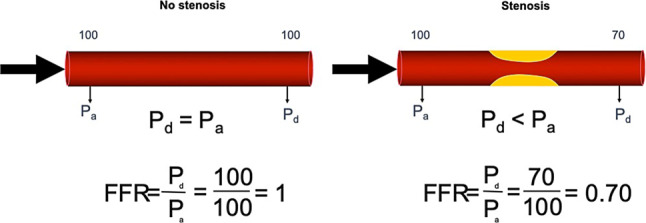
Fig. 1
Fig. 1
Concept of fractional flow reserve (FFR). FFR is defined as the ratio of mean proximal to mean distal coronary pressure. When no epicardial stenosis is present (left panel), the pressure loss across the coronary artery is negligible, and proximal aortic pressure (Pa) and distal coronary pressure (Pd) are equivalent, leading to an FFR of 1. In the presence of a stenosis (right panel), pressure loss across the stenosis will occur, and distal coronary pressure will be lower than proximal coronary pressure, leading to an FFR smaller than 1.0. In this example, the stenosis leads to a pressure gradient across the stenosis of 30 mm Hg, leading to an FFR of 0.70
Fig. 2
Fig. 2
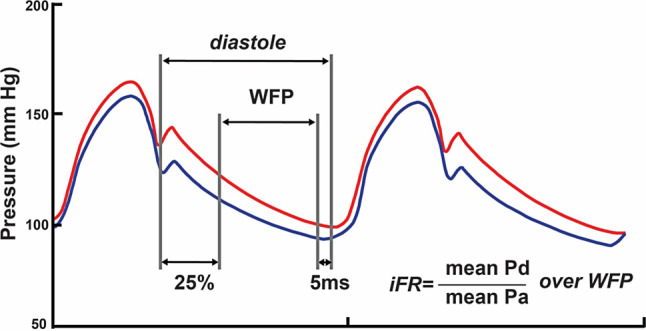
Instantaneous wave-free ratio. Instantaneous wave-free ratio (iFR) is defined as the mean distal coronary pressure (Pd) to mean aortic pressure (Pa) ratio over the wave-free period (WFP). The WFP is defined as starting 25% into cardiac diastole, and ending 5 ms before the end of diastole as illustrated
Fig. 3
Fig. 3
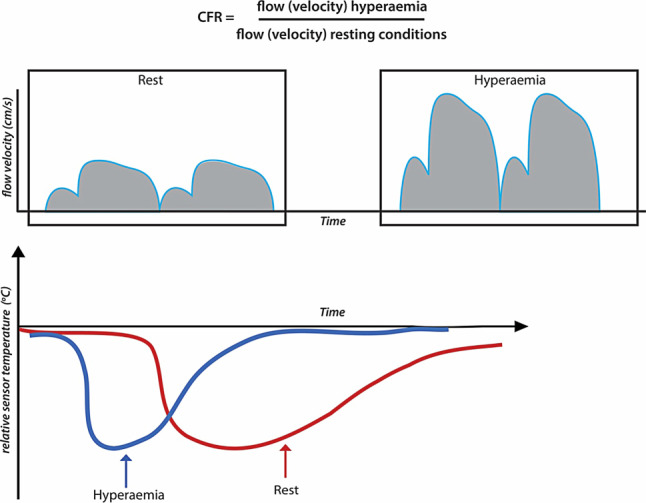
Coronary flow (velocity) reserve. Coronary flow (velocity) reserve (CFR) is defined as the ratio of hyperaemic to resting coronary flow (velocity). Coronary flow can be measured using the Doppler flow velocity technique (upper panel), and the coronary thermodilution technique (lower panel). The Doppler technique displays temporal changes in instantaneous peak coronary flow velocity, represented by the blue line in the schematic. The average peak coronary flow velocity over several cardiac cycles is used for the calculation of CFR. The thermodilution technique displays the individual thermodilution curves of a bolus of room-temperature saline. For thermodilution-derived flow measurements, the thermodilution curves are obtained in triplicate in resting and hyperaemic conditions. The mean transit time is calculated from these curves, and is average over three bolus injections in resting conditions, and three bolus injections in hyperaemic conditions for the calculation of CFR
Fig. 4
Fig. 4
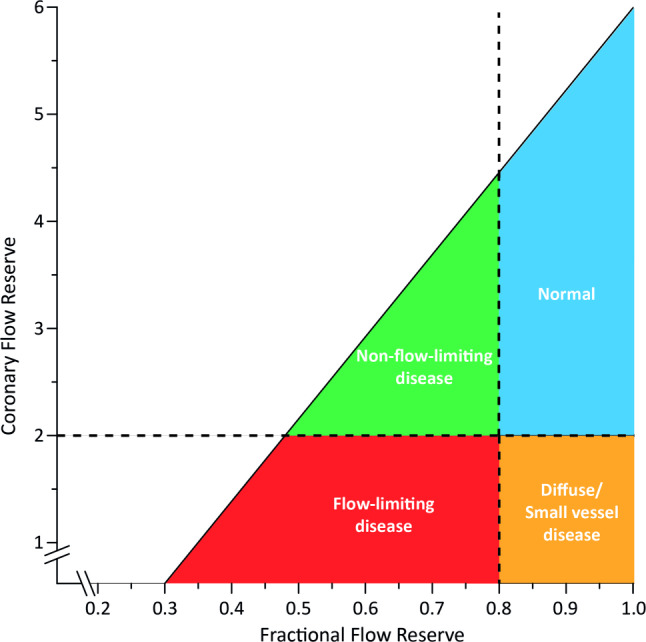
Conceptual plot of the fractional flow reserve (FFR)—coronary flow reserve (CFR) relationship. Four main quadrants can be identified by applying the clinically applicable cut-off values for FFR and CFR, indicated by the dotted lines. Patients in the upper right blue area are characterised by concordantly normal FFR and CFR, and patients in the red lower left area are characterised by concordantly abnormal FFR and CFR. Patients in the upper left green area and lower right orange area are characterised by discordant results between FFR and CFR, where the combination of an abnormal FFR and a normal CFR indicates predominant focal epicardial, but non-flow-limiting, coronary artery disease, and the combination of a normal FFR and an abnormal CFR indicates predominant microvascular or diffuse epicardial involvement in coronary artery disease. Adapted from Van de Hoef et al. [52] with permission of Wolters Kluwer Health
Fig. 5
Fig. 5
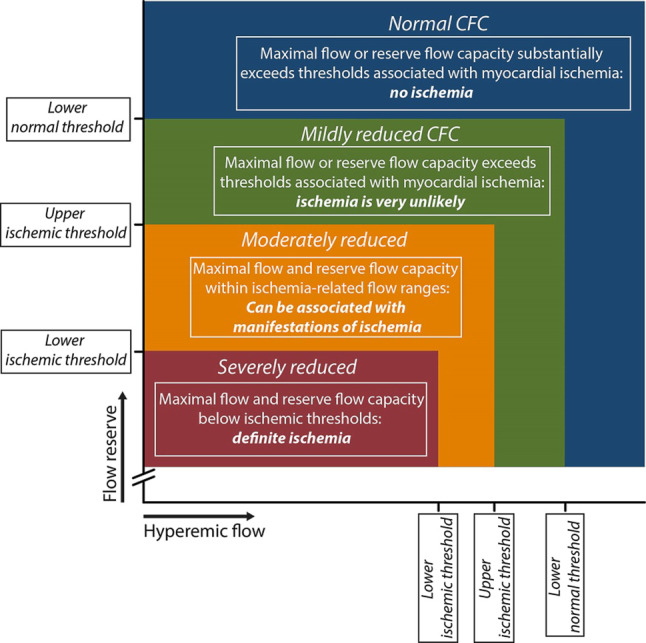
Coronary flow capacity concept. Since coronary flow reserve (CFR) equals hyperaemic to baseline average peak flow velocity (hAPV), a 2-dimensional map of CFR versus hAPV comprehensively describes the invasive flow characteristics of the coronary vasculature under investigation. Within this concept, four clinically meaningful categories are defined (coded with different colours in the graph) based on well-validated invasive CFR cut-off values and the corresponding hAPV percentiles. Reproduced from Van de Hoef, et al. [58] with permission of Elsevier
Fig. 6
Fig. 6
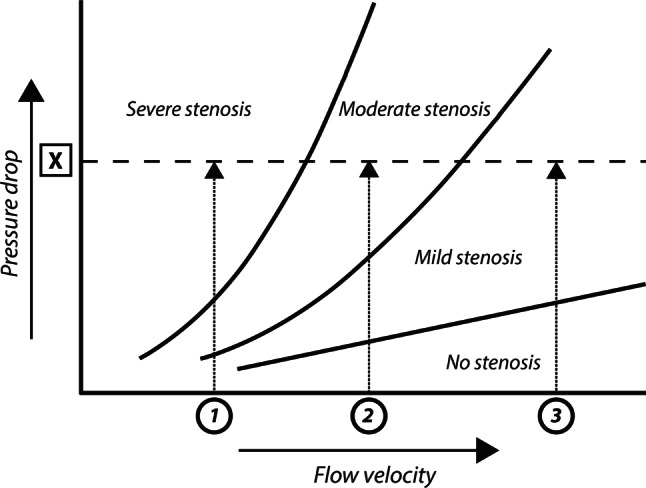
Stenosis pressure drop—flow velocity relationship. The stenosis-specific pressure-drop flow velocity relationship implicates that the pressure drop across a stenosis increases with increasing flow through the stenosis. Hence, a given pressure drop across a stenosis, X, may represent a stenosis severity ranging from mild to severe, depending on the flow velocity at which it was obtained, 1 to 3. The stenosis resistance index, defined as the ratio of the pressure drop across the stenosis to distal coronary flow velocity, ‘normalises’ the pressure drop for the magnitude of flow at which it was obtained, providing a more objective assessment of haemodynamic stenosis severity, and allows the attribution of the measured pressure drop to stenosis severity 1, 2, or 3

References

    1. Van De Hoef TP, Meuwissen M, Escaned J, et al. Fractional flow reserve as a surrogate for inducible myocardial ischaemia. Nat Rev Cardiol. 2013;10:439–452. - PubMed
    1. van de Hoef TP, Nolte F, Rolandi MC, et al. Coronary pressure-flow relations as basis for the understanding of coronary physiology. J Mol Cell Cardiol. 2012;52:786–793. - PubMed
    1. Grüntzig AR, Senning Å, Siegenthaler WE. Nonoperative dilatation of coronary-artery stenosis: percutaneous transluminal coronary angioplasty. N Engl J Med. 1979;301:61–68. - PubMed
    1. Wijns W, Serruys PW, Reiber JHC, et al. Quantitative angiography of the left anterior descending coronary artery: correlations with pressure gradient and results of exercise thallium scintigraphy. Circulation. 1985;71:273–279. - PubMed
    1. Topol EJ. Coronary angioplasty for acute myocardial infarction. Ann Intern Med. 1988;109:970–980. - PubMed

LinkOut - more resources