


PARP inhibition and immune modulation: scientific rationale and perspectives for the treatment of gynecologic cancers
- PMID: 32782491
- PMCID: PMC7383615
- DOI: 10.1177/1758835920944116
PARP inhibition and immune modulation: scientific rationale and perspectives for the treatment of gynecologic cancers
Abstract
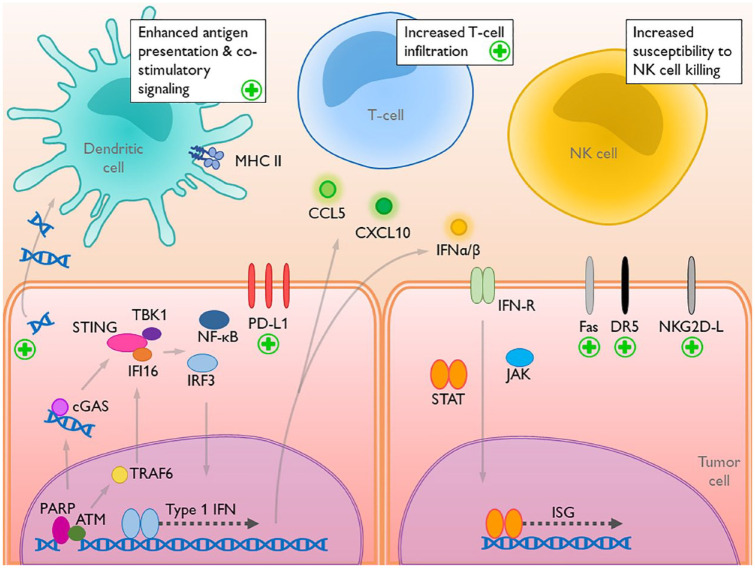
Poly[adenosine diphosphate (ADP) ribose]polymerase (PARP) has multifaceted roles in the maintenance of genomic integrity, deoxyribonucleic acid (DNA) repair and replication, and the maintenance of immune-system homeostasis. PARP inhibitors are an attractive oncologic therapy, causing direct cancer cell cytotoxicity by propagating DNA damage and indirectly, by various mechanisms of immunostimulation, including activation of the cGAS/STING pathway, paracrine stimulation of dendritic cells, increased T-cell infiltration, and upregulation of death-ligand receptors to increase susceptibility to natural-killer-cell killing. However, these immunostimulatory effects are counterbalanced by PARPi-mediated upregulation of programmed cell-death-ligand 1 (PD-L1), which leads to immunosuppression. Combining PARP inhibition with immune-checkpoint blockade seeks to exploit the immune stimulatory effects of PARP inhibition while negating the immunosuppressive effects of PD-L1 upregulation.
Keywords: PARP inhibitor; PD-L1; STING; gynecologic cancer; immune modulation; immune-checkpoint inhibition; ovarian cancer.
© The Author(s), 2020.
Conflict of interest statement
Conflict of interest statement: EKL declares no conflicting interests. PAK reports participation in advisory boards from GSK/Tesaro, Merck, AstraZeneca, and Bayer, outside the submitted work.
Figures
References
Publication types
LinkOut - more resources
Full Text Sources
Research Materials
