Review
. 2020 Jul 24:12:1758835920944116.
doi: 10.1177/1758835920944116. eCollection 2020.

PARP inhibition and immune modulation: scientific rationale and perspectives for the treatment of gynecologic cancers

Affiliations
Review

PARP inhibition and immune modulation: scientific rationale and perspectives for the treatment of gynecologic cancers

Elizabeth K Lee et al. Ther Adv Med Oncol. .

Abstract

Poly[adenosine diphosphate (ADP) ribose]polymerase (PARP) has multifaceted roles in the maintenance of genomic integrity, deoxyribonucleic acid (DNA) repair and replication, and the maintenance of immune-system homeostasis. PARP inhibitors are an attractive oncologic therapy, causing direct cancer cell cytotoxicity by propagating DNA damage and indirectly, by various mechanisms of immunostimulation, including activation of the cGAS/STING pathway, paracrine stimulation of dendritic cells, increased T-cell infiltration, and upregulation of death-ligand receptors to increase susceptibility to natural-killer-cell killing. However, these immunostimulatory effects are counterbalanced by PARPi-mediated upregulation of programmed cell-death-ligand 1 (PD-L1), which leads to immunosuppression. Combining PARP inhibition with immune-checkpoint blockade seeks to exploit the immune stimulatory effects of PARP inhibition while negating the immunosuppressive effects of PD-L1 upregulation.

Keywords: PARP inhibitor; PD-L1; STING; gynecologic cancer; immune modulation; immune-checkpoint inhibition; ovarian cancer.


Conflict of interest statement

Conflict of interest statement: EKL declares no conflicting interests. PAK reports participation in advisory boards from GSK/Tesaro, Merck, AstraZeneca, and Bayer, outside the submitted work.

Figures
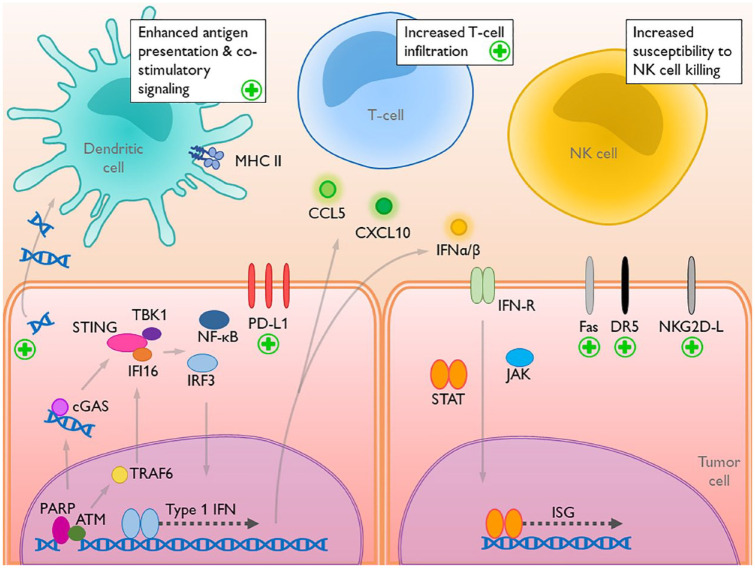
Figure 1.
Figure 1.
The interaction between DNA damage, intratumoral alterations, and activation of the immune cells. Plus signs denote where PARP inhibition acts to influence the tumor–immune interaction. PARP inhibition increases DNA damage, generating cytosolic DNA that activates cGAS/STING intratumorally and in dendritic cells. PARP inhibition upregulates costimulatory CD80/CD86 and MHC class II on dendritic cells, enhancing antigen presentation and T-cell interactions. PD-L1 is upregulated following PARP inhibition, due to several mechanisms. Increased expression of T-cell chemokines increase tumor infiltration of activated, effector T-cells. Increased expression of cell-death receptor ligands and NKG2D ligands increase tumor-cell sensitivity to NK-cell killing. ATM, ataxia–telangiectasia mutated; CCL5, C-C motif ligand 5; cGAS, cyclic guanosine monophosphate–adenosine monophosphate synthase; CXCL10, C-X-C motif chemokine 10; DNA, deoxyribonucleic acid; DR5, death receptor 5; IFI16, gamma-interferon inducible protein IFI-16; IFN, interferon; IFN-R, interferon receptor; ISG, IFN-stimulated gene; JAK, Janus kinase; MHC II, major histocompatibility complex class II; NF-kB, nuclear-factor-kappa light-chain enhancer of activated B cells; NK, natural killer; NKG2D-L, natural-killer group 2 member D ligand; PARP, poly(ADP ribose)polymerase; PD-L1, programmed cell-death ligand 1; STAT, signal transducer and activator of transcription proteins; STING, stimulator of interferon genes; TBK1, tank-binding kinase 1; TRAF6, tumor necrosis factor receptor-associated factor 6.

References

    1. Vyas S, Matic I, Uchima L, et al. Family-wide analysis of poly(ADP-ribose) polymerase activity. Nat Commun 2014; 5: 4426. - PMC - PubMed
    1. Langelier MF, Eisemann T, Riccio AA, et al. PARP family enzymes: regulation and catalysis of the poly(ADP-ribose) posttranslational modification. Curr Opin Struct Biol 2018; 53: 187–198. - PMC - PubMed
    1. Antolin AA, Ameratunga M, Banerji U, et al. The kinase polypharmacology landscape of clinical PARP inhibitors. Sci Rep 2020; 10: 2585. - PMC - PubMed
    1. LaFargue CJ, Molin GZD, Sood AK, et al. Exploring and comparing adverse events between PARP inhibitors. Lancet Oncol 2019; 20: e15–e28. - PMC - PubMed
    1. Ray Chaudhuri A, Nussenzweig A. The multifaceted roles of PARP1 in DNA repair and chromatin remodelling. Nat Rev Mol Cell Biol 2017; 18: 610–621. - PMC - PubMed
