


Preterm Nutrition and Clinical Outcomes
- PMID: 32782918
- PMCID: PMC7383644
- DOI: 10.1177/2333794X20937851
Preterm Nutrition and Clinical Outcomes
Abstract
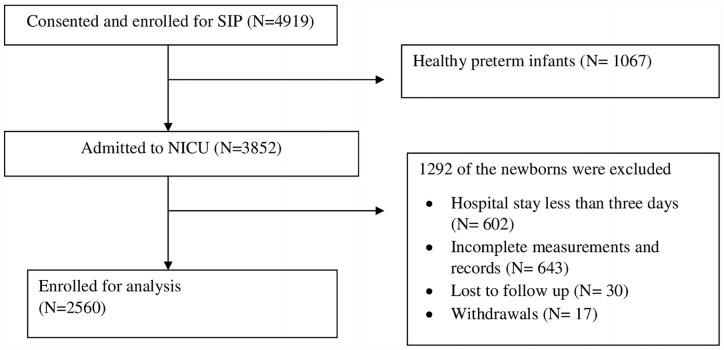
Background. In low-income countries, preterm nutrition is often inadequately addressed. The aim of the study was to assess the patterns of feeding and associated clinical outcomes of preterm neonates admitted to neonatal intensive care units in Ethiopia. Method. This was a multicenter, prospective study. Infants' clinical characteristics at birth, daily monitoring of feeding history, and weight measurements were collected. An outcome assessment was completed at 28 days. Result. For this analysis, 2560 infants (53% male) were eligible. The mean (SD) gestational age was 33.1 (2.2) weeks. During the hospital stay the proportion of infants on breast milk only, preterm formula, term formula, and mixed feeding was 58%, 27.4%, 1.6%, and 34.1%, respectively. Delay in enteral feeding was associated with increased risk of death (odds ratio [OR] = 1.92, 95% confidence interval [CI] = 1.33-2.78; P < .001) and (OR = 5.06, 95% CI = 3.23-7.87; P < .001) for 1 to 3 and 4 to 6 days of delay in enteral feeding, respectively, after adjusting for possible confounders. The length of delay in enteral feeding was associated with increased risk of hypoglycemia (OR = 1.2, 95% CI = 1.1-1.2; P = .005). The mortality rate was lower in hospitals providing preterm formula more often (P = .04). Half of the infants continued losing weight at the time of discharge. Conclusion. Delayed enteral feeding significantly increases the risk of mortality before discharge and hypoglycemia in preterm infants in resource-limited settings. Ensuring adequate nutritional support of preterm infants is highly needed.
Keywords: infant feeding; low- and middle-income countries; neonatal mortality; prematurity; preterm nutrition.
© The Author(s) 2020.
Conflict of interest statement
Declaration of Conflicting Interests: The author(s) declared no potential conflicts of interest with respect to the research, authorship, and/or publication of this article.
Figures
References
-
- Lawn JE, Blencowe H, Oza S, et al. Every newborn: progress, priorities, and potential beyond survival. Lancet. 2014;384:189-205. - PubMed
-
- Strydom K, Van Niekerk E, Dhansay MA. Factors affecting body composition in preterm infants: assessment techniques and nutritional interventions. Pediatr Neonatol. 2017;60:121-128. - PubMed
-
- Ehrenkranz RA. Nutrition, growth and clinical outcomes. World Rev Nutr Diet. 2014;110:11-26. - PubMed
LinkOut - more resources
Full Text Sources
