


Matrix-Assisted Pulsed laser Evaporation-deposited Rapamycin Thin Films Maintain Antiproliferative Activity
- PMID: 32782983
- PMCID: PMC7415860
- DOI: 10.18063/ijb.v6i1.188
Matrix-Assisted Pulsed laser Evaporation-deposited Rapamycin Thin Films Maintain Antiproliferative Activity
Erratum in
-
ERRATUM.Int J Bioprint. 2020 Sep 17;6(4):309. doi: 10.18063/ijb.v6i4.309. eCollection 2020. Int J Bioprint. 2020. PMID: 33102924 Free PMC article.
Abstract
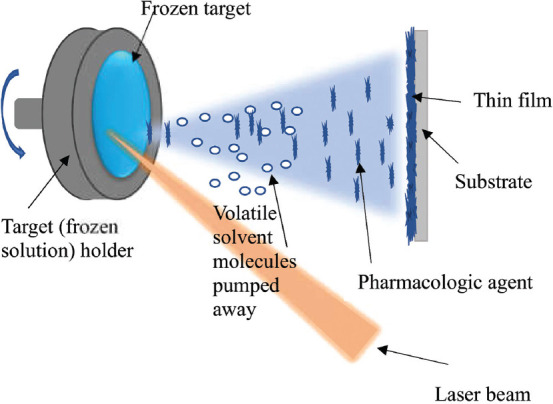
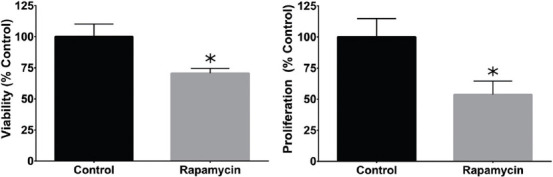
Matrix-assisted pulsed laser evaporation (MAPLE) has many benefits over conventional methods (e.g., dip-coating, spin coating, and Langmuir-Blodgett dip-coating) for manufacturing coatings containing pharmacologic agents on medical devices. In particular, the thickness of the coating that is applied to the surface of the medical device can be tightly controlled. In this study, MAPLE was used to deposit rapamycin-polyvinylpyrrolidone (rapamycin-PVP) thin films onto silicon and borosilicate optical glass substrates. Alamar Blue and PicoGreen studies were used to measure the metabolic health and DNA content of L929 mouse fibroblasts as measures of viability and proliferation, respectively. The cells on the MAPLE-deposited rapamycin-PVP surfaces exhibited 70.6% viability and 53.7% proliferation compared to a borosilicate glass control. These data indicate that the antiproliferative properties of rapamycin were maintained after MAPLE deposition.
Keywords: Drug delivery; Matrix-assisted pulsed laser evaporation; Rapamycin; Thin film.
Copyright: © 2020 Cristescu, et al.
Figures
References
-
- National Center for Biotechnology Information. PubChem Database. [Last accessed on 2019 Dec 24];Sirolimus, CID=5284616. Available from:https://www.pubchem.ncbi.nlm.nih.gov/compound/Sirolimus .
-
- Stefanini GG, Byrne RA, Windecker S, et al. State of the Art:Coronary Artery Stents Past, Present and Future. Eurointervention. 2017;13:706–16. DOI:10.4244/eij-d-17-00557. - PubMed
-
- Byrne RA, Stone GW, Ormiston J, et al. Coronary Balloon Angioplasty, Stents, and Scaffolds. Lancet. 2017;390:781–92. DOI:10.1016/s0140-6736(17)31927-x. - PubMed
-
- Yagasaki R, Nakahara T, Ushikubo H, et al. Anti-angiogenic Effects of Mammalian Target of Rapamycin Inhibitors in a Mouse Model of Oxygen-induced Retinopathy. Biol Pharm Bull. 2014;37:1838–42. DOI:10.1248/bpb.b14-00487. - PubMed
LinkOut - more resources
Full Text Sources