


Pentaplex real-time PCR for differential detection of Yersinia pestis and Y. pseudotuberculosis and application for testing fleas collected during plague epizootics
- PMID: 32783386
- PMCID: PMC7568250
- DOI: 10.1002/mbo3.1105
Pentaplex real-time PCR for differential detection of Yersinia pestis and Y. pseudotuberculosis and application for testing fleas collected during plague epizootics
Abstract
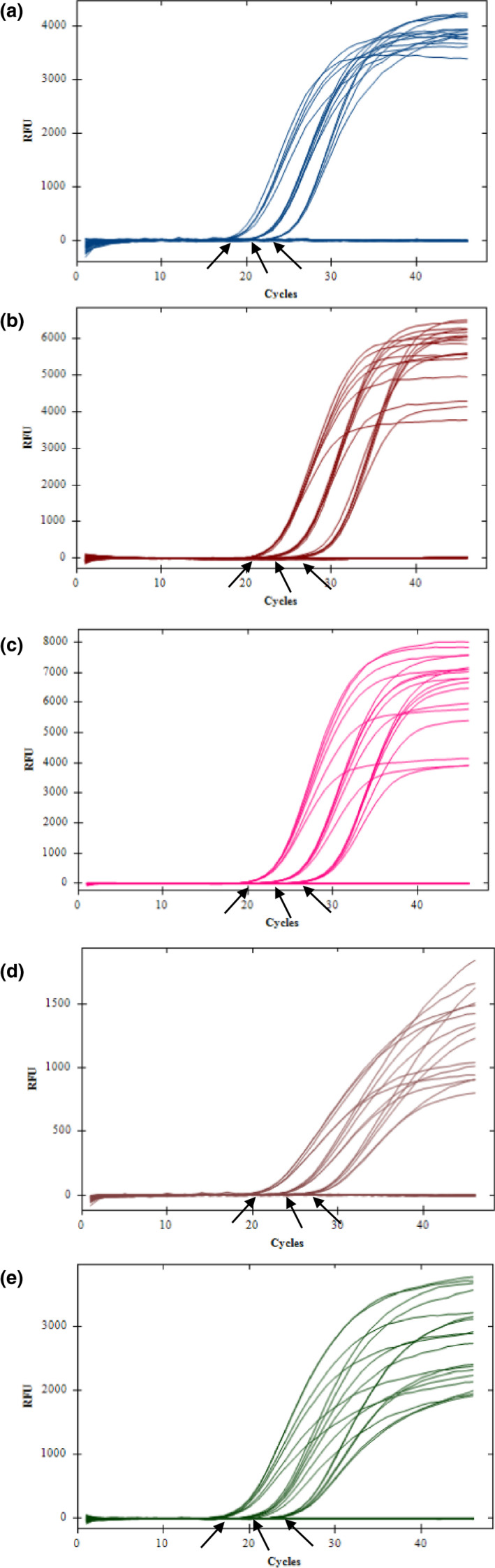
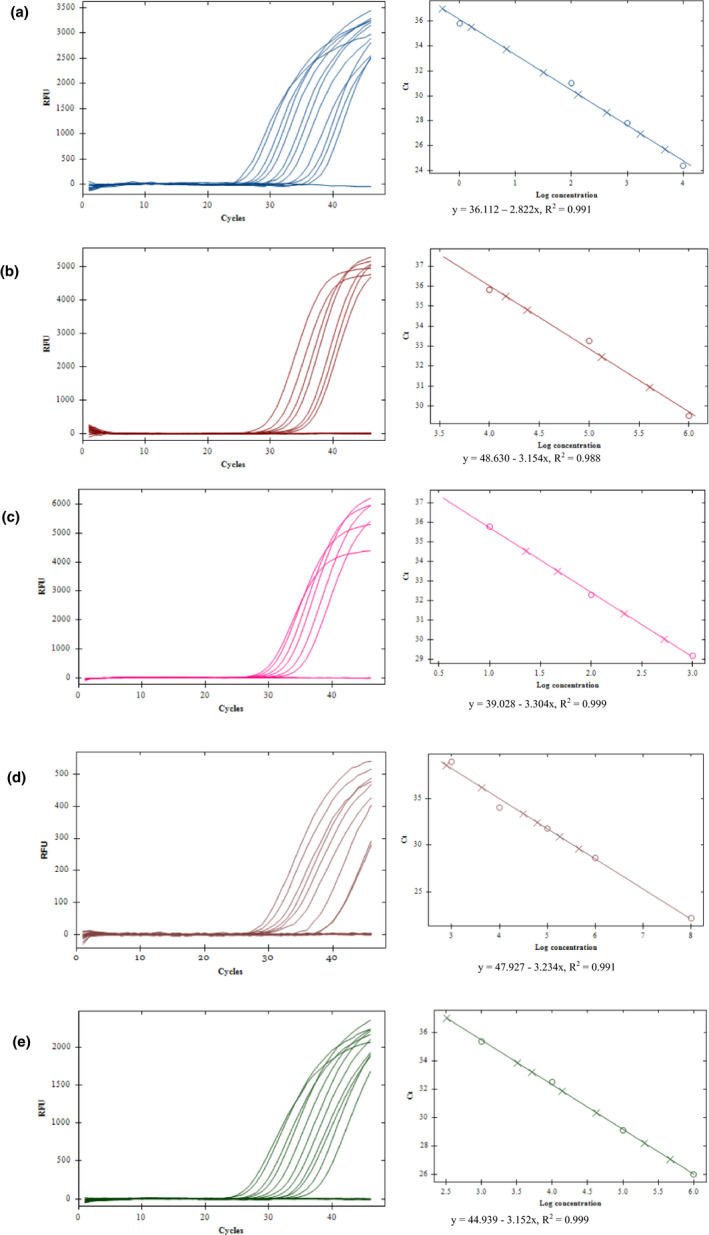
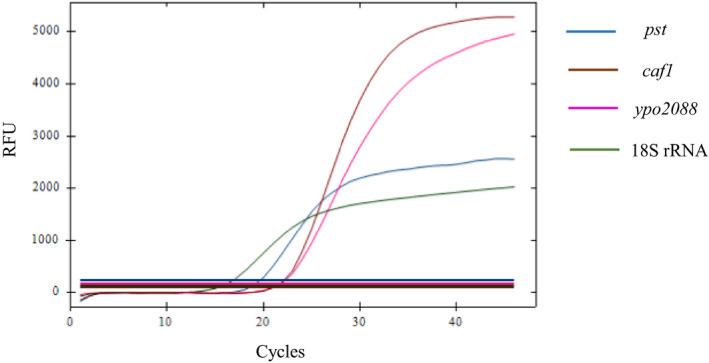
Upon acquiring two unique plasmids (pMT1 and pPCP1) and genome rearrangement during the evolution from Yersinia pseudotuberculosis, the plague causative agent Y. pestis is closely related to Y. pseudotuberculosis genetically but became highly virulent. We developed a pentaplex real-time PCR assay that not only detects both Yersinia species but also differentiates Y. pestis strains regarding their plasmid profiles. The five targets used were Y. pestis-specific ypo2088, caf1, and pst located on the chromosome, plasmids pMT1 and pPCP1, respectively; Y. pseudotuberculosis-specific chromosomal gene opgG; and 18S ribosomal RNA gene as an internal control for flea DNA. All targets showed 100% specificity and high sensitivity with limits of detection ranging from 1 fg to 100 fg, with Y. pestis-specific pst as the most sensitive target. Using the assay, Y. pestis strains were differentiated 100% by their known plasmid profiles. Testing Y. pestis and Y. pseudotuberculosis-spiked flea DNA showed there is no interference from flea DNA on the amplification of targeted genes. Finally, we applied the assay for testing 102 fleas collected from prairie dog burrows where prairie dog die-off was reported months before flea collection. All flea DNA was amplified by 18S rRNA; no Y. pseudotuberculosis was detected; one flea was positive for all Y. pestis-specific targets, confirming local Y. pestis transmission. Our results indicated the assay is sensitive and specific for the detection and differentiation of Y. pestis and Y. pseudotuberculosis. The assay can be used in field investigations for the rapid identification of the plague causative agent.
Keywords: Yersinia pestis; Yersinia pseudotuberculosis; assay development; fleas; pentaplex real-time PCR.
© 2020 The Authors. MicrobiologyOpen published by John Wiley & Sons Ltd.
Conflict of interest statement
The conclusions, findings, and opinions expressed by authors contributing to this journal do not necessarily reflect the official position of the U.S. Department of Health and Human Services, the Public Health Service, the Centers for Disease Control and Prevention, or the authors' affiliated institutions.
Figures
References
-
- Achtman, M. , Zurth, K. , Morelli, G. , Torrea, G. , Guiyoule, A. , & Carniel, E. (1999). Yersinia pestis, the cause of plague, is a recently emerged clone of Yersinia pseudotuberculosis . Proceedings of the National Academy of Sciences of the United States of America, 96, 14043–14048. - PMC - PubMed
-
- Armougom, F. , Bitam, I. , Croce, O. , Merhej, V. , Barassi, L. , Nguyen, T. T. , … Raoult, D. (2016). Genomic insights into a new Citrobacter koseri strain revealed gene exchanges with the virulence‐associated Yersinia pestis pPCP1 plasmid. Frontiers in Microbiology, 7, 340 10.3389/fmicb.2016.00340 - DOI - PMC - PubMed
-
- Bai, Y. , Osikowicz, L. M. , Kosoy, M. Y. , Eisen, R. J. , Atiku, L. A. , Mpanga, J. T. , Gage, K. (2017). Comparison of zoonotic bacterial agents in fleas collected from small mammals or host‐seeking fleas from a Ugandan region where plague is endemic. mSphere, 2, e00402‐17 10.1128/mSphere.00402-17 - DOI - PMC - PubMed
Publication types
MeSH terms
LinkOut - more resources
Full Text Sources
Medical
