


Nationwide Results of COVID-19 Contact Tracing in South Korea: Individual Participant Data From an Epidemiological Survey
- PMID: 32784189
- PMCID: PMC7470235
- DOI: 10.2196/20992
Nationwide Results of COVID-19 Contact Tracing in South Korea: Individual Participant Data From an Epidemiological Survey
Abstract
Background: Evidence regarding the effectiveness of contact tracing of COVID-19 and the related social distancing is limited and inconclusive.
Objective: This study aims to investigate the epidemiological characteristics of SARS-CoV-2 transmission in South Korea and evaluate whether a social distancing campaign is effective in mitigating the spread of COVID-19.
Methods: We used contract tracing data to investigate the epidemic characteristics of SARS-CoV-2 transmission in South Korea and evaluate whether a social distancing campaign was effective in mitigating the spread of COVID-19. We calculated the mortality rate for COVID-19 by infection type (cluster vs noncluster) and tested whether new confirmed COVID-19 trends changed after a social distancing campaign.
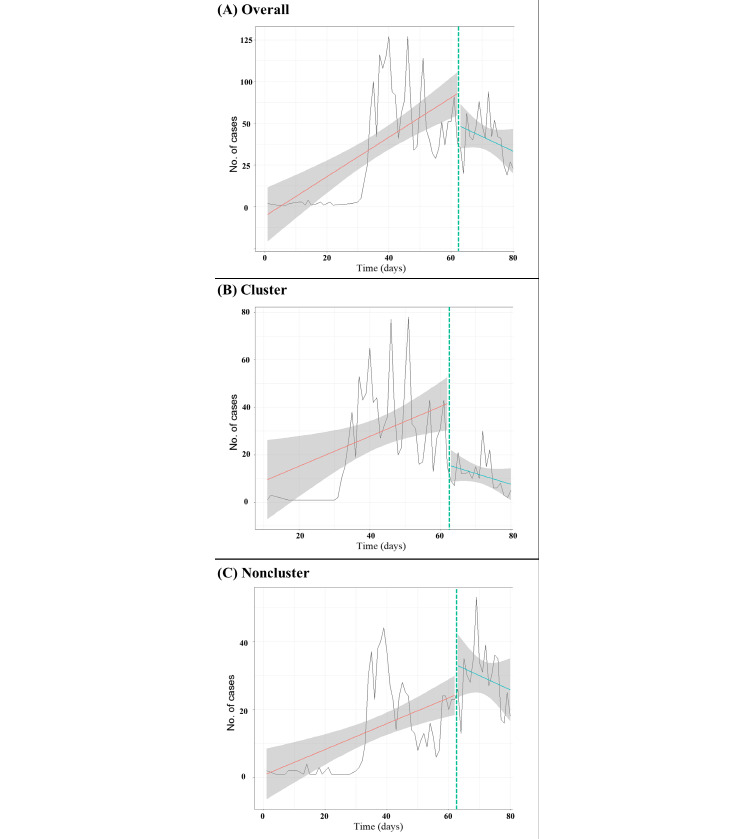
Results: There were 2537 patients with confirmed COVID-19 who completed the epidemiologic survey: 1305 (51.4%) cluster cases and 1232 (48.6%) noncluster cases. The mortality rate was significantly higher in cluster cases linked to medical facilities (11/143, 7.70% vs 5/1232, 0.41%; adjusted percentage difference 7.99%; 95% CI 5.83 to 10.14) and long-term care facilities (19/221, 8.60% vs 5/1232, 0.41%; adjusted percentage difference 7.56%; 95% CI 5.66 to 9.47) than in noncluster cases. The change in trends of newly confirmed COVID-19 cases before and after the social distancing campaign was significantly negative in the entire cohort (adjusted trend difference -2.28; 95% CI -3.88 to -0.68) and the cluster infection group (adjusted trend difference -0.96; 95% CI -1.83 to -0.09).
Conclusions: In a nationwide contact tracing study in South Korea, COVID-19 linked to medical and long-term care facilities significantly increased the risk of mortality compared to noncluster COVID-19. A social distancing campaign decreased the spread of COVID-19 in South Korea and differentially affected cluster infections of SARS-CoV-2.
Keywords: COVID-19; South Korea; contact tracing; coronavirus; epidemiology; health data; survey; transmission.
©Seung Won Lee, Woon Tak Yuh, Jee Myung Yang, Yoon-Sik Cho, In Kyung Yoo, Hyun Yong Koh, Dominic Marshall, Donghwan Oh, Eun Kyo Ha, Man Yong Han, Dong Keon Yon. Originally published in JMIR Medical Informatics (http://medinform.jmir.org), 25.08.2020.
Conflict of interest statement
Conflicts of Interest: None declared.
Figures
References
-
- Pan A, Liu L, Wang C, Guo H, Hao X, Wang Q, Huang J, He N, Yu H, Lin X, Wei S, Wu T. Association of public health interventions with the epidemiology of the COVID-19 outbreak in Wuhan, China. JAMA. 2020 Apr 10; doi: 10.1001/jama.2020.6130. http://europepmc.org/abstract/MED/32275295 - DOI - PMC - PubMed
-
- Park SE. Epidemiology, virology, and clinical features of severe acute respiratory syndrome -coronavirus-2 (SARS-CoV-2; Coronavirus Disease-19) Clin Exp Pediatr. 2020 Apr;63(4):119–124. doi: 10.3345/cep.2020.00493. http://www.e-cep.org/journal/view.php?doi=10.3345/cep.2020.00493 - DOI - PMC - PubMed
-
- Coronavirus disease 2019 (COVID-19) situation report – 78. World Health Organization. 2020. Apr 07, https://www.who.int/docs/default-source/coronaviruse/situation-reports/2....
-
- Choi S, Kim HW, Kang J, Kim DH, Cho EY. Epidemiology and clinical features of coronavirus disease 2019 in children. Clin Exp Pediatr. 2020 Apr;63(4):125–132. doi: 10.3345/cep.2020.00535. http://www.e-cep.org/journal/view.php?doi=10.3345/cep.2020.00535 - DOI - PMC - PubMed
-
- Korean Society of Infectious Diseases. Korean Society of Pediatric Infectious Diseases. Korean Society of Epidemiology. Korean Society for Antimicrobial Therapy. Korean Society for Healthcare-associated Infection Control and Prevention. Korea Centers for Disease Control and Prevention Report on the epidemiological features of coronavirus disease 2019 (COVID-19) outbreak in the Republic of Korea from January 19 to March 2, 2020. J Korean Med Sci. 2020 Mar 16;35(10):e112. doi: 10.3346/jkms.2020.35.e112. https://jkms.org/DOIx.php?id=10.3346/jkms.2020.35.e112 - DOI - PMC - PubMed
LinkOut - more resources
Full Text Sources
Miscellaneous
