Review
. 2020 Aug 8;25(16):3607.
doi: 10.3390/molecules25163607.

Zeaxanthin and Lutein: Photoprotectors, Anti-Inflammatories, and Brain Food

Affiliations
Review

Zeaxanthin and Lutein: Photoprotectors, Anti-Inflammatories, and Brain Food

Barbara Demmig-Adams et al. Molecules. .

Abstract

This review compares and contrasts the role of carotenoids across the taxa of life-with a focus on the xanthophyll zeaxanthin (and its structural isomer lutein) in plants and humans. Xanthophylls' multiple protective roles are summarized, with attention to the similarities and differences in the roles of zeaxanthin and lutein in plants versus animals, as well as the role of meso-zeaxanthin in humans. Detail is provided on the unique control of zeaxanthin function in photosynthesis, that results in its limited availability in leafy vegetables and the human diet. The question of an optimal dietary antioxidant supply is evaluated in the context of the dual roles of both oxidants and antioxidants, in all vital functions of living organisms, and the profound impact of individual and environmental context.

Keywords: chronic inflammation; macular degeneration; meso-zeaxanthin; photosynthesis; radiation; redox regulation; signaling; thermal dissipation; vision; xanthophyll cycle.


Conflict of interest statement

The authors declare no conflict of interest.

Figures
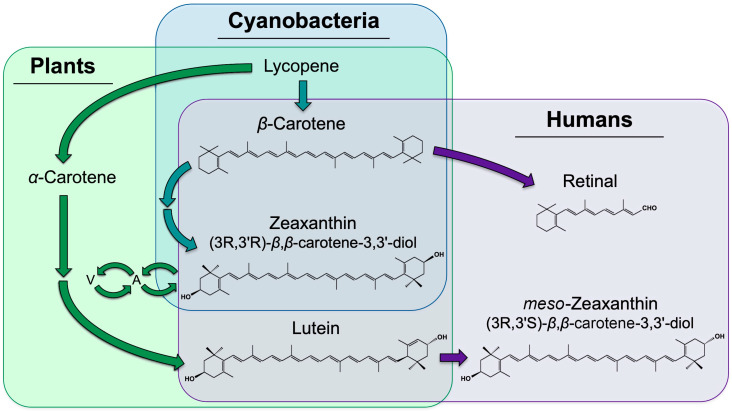
Figure 1
Figure 1
Biosynthetic pathways for the formation of zeaxanthin, lutein, and meso-zeaxanthin. Pathways existing in plants only, area shaded in green only; pathways existing in both plants and cyanobacteria, area shaded in both green and blue; pathways existing in humans, area shaded in purple only; need for dietary acquisition of β-carotene, zeaxanthin, and lutein by humans, overlapping purple and green/blue areas. A, antheraxanthin, a zeaxanthin mono-epoxide; V, violaxanthin, a zeaxanthin di-epoxide.
Figure 2
Figure 2
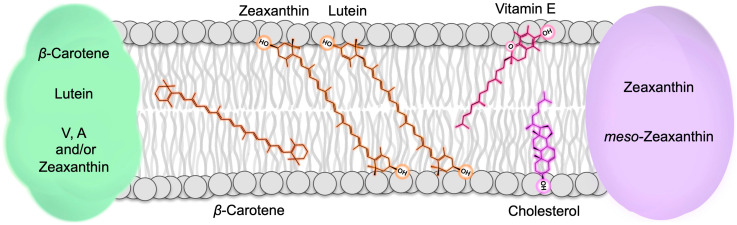
Schematic depiction of the localization of carotenoids, vitamin E (tocopherol), and cholesterol in biological membranes. Moreover, β-carotene, zeaxanthin, lutein, and tocopherols dissolve in the phospholipid biolayer of the membranes of both plants and humans/animals; cholesterol only occurs in animal membranes. In addition, binding of carotenoids to multiple components of light-collecting, chlorophyll-binding proteins in the photosynthetic membrane of plants (green oval) and of zeaxanthin and meso-zeaxanthin to a protein in the retinal membrane of humans (purple oval) is shown. A, antheraxanthin; V, violaxanthin.
Figure 3
Figure 3
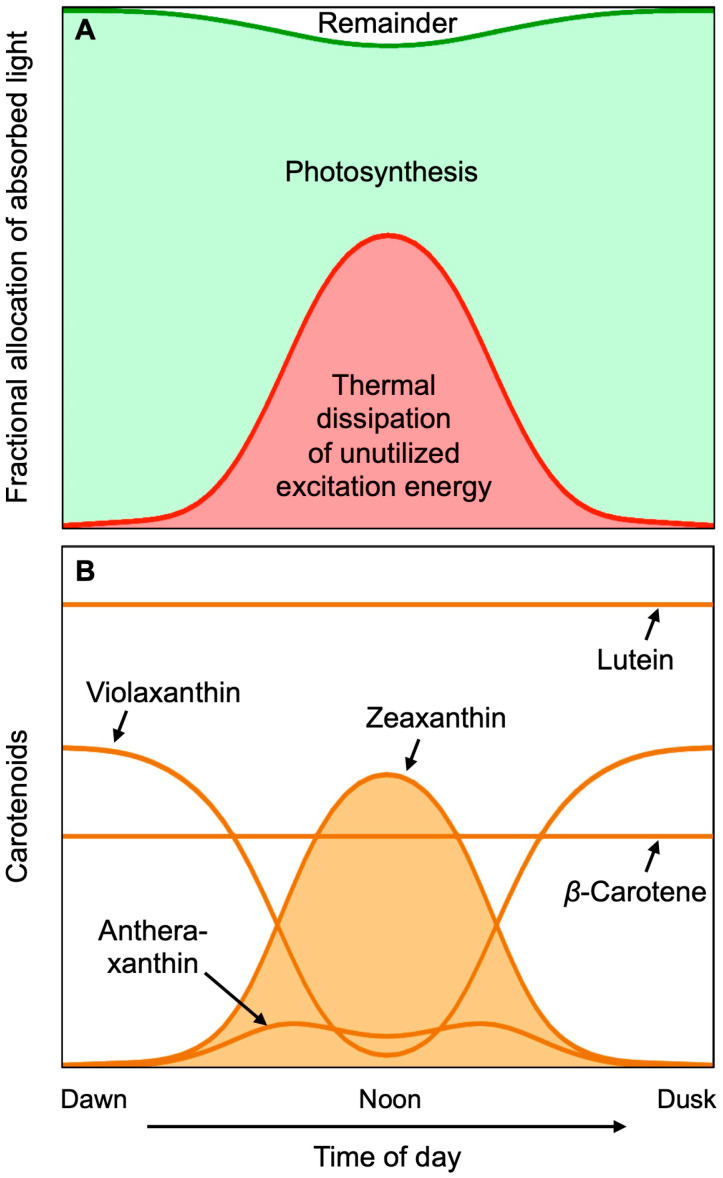
Schematic depiction of changes over the course of a clear day in (A) the fraction of light absorbed by a sun-exposed leaf that goes into photosynthesis (green), is dissipated harmlessly as heat (red), and is used by neither of the latter pathways (remainder; white). (B) shows corresponding changes in the level of the xanthophylls of the xanthophyll cycle, as well as the unchanged levels of lutein and β-carotene. Based on field data from evergreen shrubs reported in Adams et al. [18] and Demmig-Adams et al. [19]
Figure 4
Figure 4
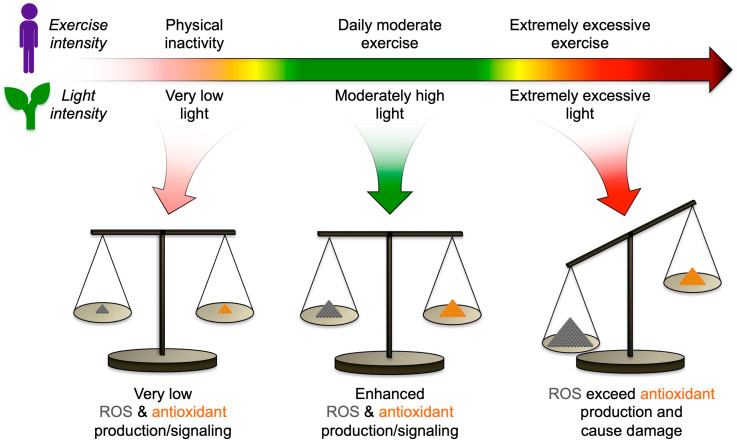
Schematic depiction of the proportion of reactive oxygen (ROS) and antioxidants produced across environmental gradients for the example of exercise intensity in humans and light intensity in plants.

References

    1. Johnson E.J., Neuringer M., Russell R.M., Schalch W., Snodderly D.M. Nutritional manipulation of primate retinas, III: Effects of lutein or zeaxanthin supplementation on adipose tissue and retina of xanthophyll-free monkeys. Investig. Ophthalmol. Vis. Sci. 2005;46:692–702. doi: 10.1167/iovs.02-1192. - DOI - PubMed
    1. Chung H.Y., Rasmussen H.M., Johnson E.J. Lutein bioavailability is higher from lutein-enriched eggs than from supplements and spinach in men. J. Nutr. 2004;134:1887–1893. doi: 10.1093/jn/134.8.1887. - DOI - PubMed
    1. Mortensen A., Skibsted L.H. Free radical transients in photobleaching of xanthophylls and carotenes. Free Radic. Res. 1997;26:549–563. doi: 10.3109/10715769709097826. - DOI - PubMed
    1. Havaux M., Dall’Osto L., Bassi R. Zeaxanthin has enhanced antioxidant capacity with respect to all other xanthophylls in Arabidopsis leaves and functions independent of binding to PSII antennae. Plant Physiol. 2007;145:1506–1520. doi: 10.1104/pp.107.108480. - DOI - PMC - PubMed
    1. Havaux M., García-Plazaola J.I. Beyond non-photochemical fluorescence quenching: The overlapping antioxidant functions of zeaxanthin and tocopherols. In: Demmig-Adams B., Garab G., Adams W.W. III, Govindjee, editors. Non-Photochemical Quenching and Energy Dissipation in Plants, Algae and Cyanobacteria, Advances in Photosynthesis and Respiration. Volume 40. Springer; Dordrecht, The Netherlands: 2014. pp. 583–603.

LinkOut - more resources