


Cancer Management during COVID-19 Pandemic: Is Immune Checkpoint Inhibitors-Based Immunotherapy Harmful or Beneficial?
- PMID: 32785162
- PMCID: PMC7465907
- DOI: 10.3390/cancers12082237
Cancer Management during COVID-19 Pandemic: Is Immune Checkpoint Inhibitors-Based Immunotherapy Harmful or Beneficial?
Abstract
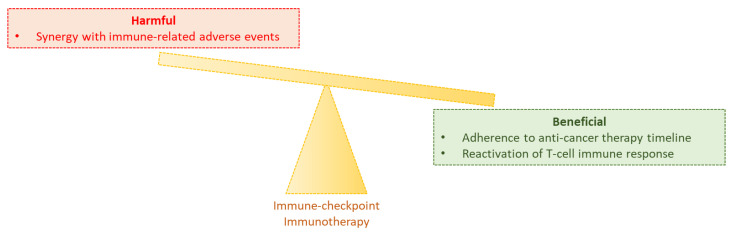
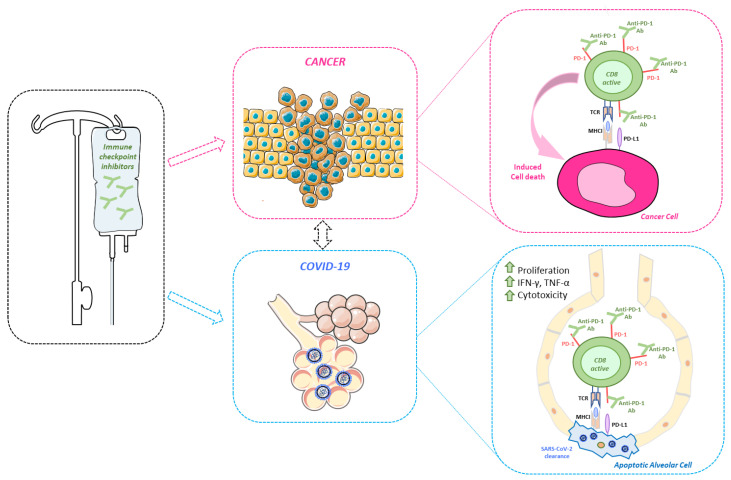
The coronavirus disease 2019 (COVID-19) is currently representing a global health threat especially for fragile individuals, such as cancer patients. It was demonstrated that cancer patients have an increased risk of developing a worse symptomatology upon severe acute respiratory syndrome associated coronavirus-2 (SARS-CoV-2) infection, often leading to hospitalization and intensive care. The consequences of this pandemic for oncology are really heavy, as the entire healthcare system got reorganized. Both oncologists and cancer patients are experiencing rescheduling of treatments and disruptions of appointments with a concurrent surge of fear and stress. In this review all the up-to-date findings, concerning the association between COVID-19 and cancer, are reported. A remaining very debated question regards the use of an innovative class of anti-cancer molecules, the immune checkpoint inhibitors (ICIs), given their modulating effects on the immune system. For that reason, administration of ICIs to cancer patients represents a question mark during this pandemic, as its correlation with COVID-19-associated risks is still under investigation. Based on the mechanisms of action of ICIs and the current evidence, we suggest that ICIs not only can be safely administered to cancer patients, but they might even be beneficial in COVID-19-positive cancer patients, by exerting an immune-stimulating action.
Keywords: Anti-PD-1 monoclonal antibody; COVID-19; SARS-CoV-2; cancer; immune-checkpoint inhibitors; immunotherapy.
Conflict of interest statement
The authors declare no conflict of interest.
Figures
References
-
- Chan J.F.-W., Yuan S., Kok K.-H., To K.K.-W., Chu H., Yang J., Xing F., Liu J., Yip C.C.-Y., Poon R.W.-S., et al. A familial cluster of pneumonia associated with the 2019 novel coronavirus indicating person-to-person transmission: A study of a family cluster. Lancet. 2020;395:514–523. doi: 10.1016/S0140-6736(20)30154-9. - DOI - PMC - PubMed
Publication types
LinkOut - more resources
Full Text Sources
Miscellaneous
