Case Reports
. 2020 Jan-Dec:8:2324709620950113.
doi: 10.1177/2324709620950113.

Hydroxychloroquine-Induced Toxic Myopathy Causing Diaphragmatic Weakness and Lung Collapse Requiring Prolonged Mechanical Ventilation

Affiliations
Case Reports

Hydroxychloroquine-Induced Toxic Myopathy Causing Diaphragmatic Weakness and Lung Collapse Requiring Prolonged Mechanical Ventilation

Julie Pillittere et al. J Investig Med High Impact Case Rep. 2020 Jan-Dec.

Abstract

A 42-year-old woman with juvenile idiopathic arthritis was treated with anakinra, corticosteroids, and hydroxychloroquine when she developed chronic hypoxic respiratory myopathy. She was admitted to the intensive care unit for acute hypercapnic respiratory failure and required prolonged intubation, subsequent tracheostomy, and long-term ventilatory support due to multiple failed spontaneous breathing trials after discontinuation of anakinra and steroids. Muscle biopsy revealed type II fiber atrophy with the accumulation of autophagosomes and vacuoles presenting as curvilinear bodies, elevated MHC class I antigen expression, and infiltration by CD68+ macrophages and CD8+ T cells. Type II fiber atrophy was attributed to corticosteroid use and curvilinear bodies due to blockade of autophagy by hydroxychloroquine. After hydroxychloroquine was discontinued, the patient recovered to her prehospitalization baseline.

Keywords: atrophy; autophagy; corticosteroids; curvilinear body; hydroxychloroquine; juvenile inflammatory arthritis; myopathy; necrosis; type II fiber.


Conflict of interest statement

Declaration of Conflicting Interests: The author(s) declared no potential conflicts of interest with respect to the research, authorship, and/or publication of this article.

Figures

Figure 1.
Figure 1.
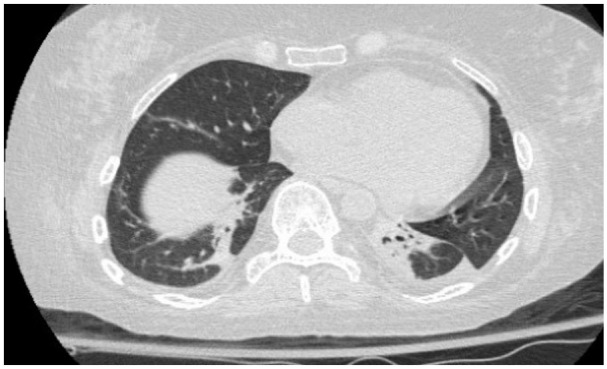
Computed tomography thorax revealing left lung opacity attributed to lung collapse due to diaphragmatic weakness.
Figure 2.
Figure 2.
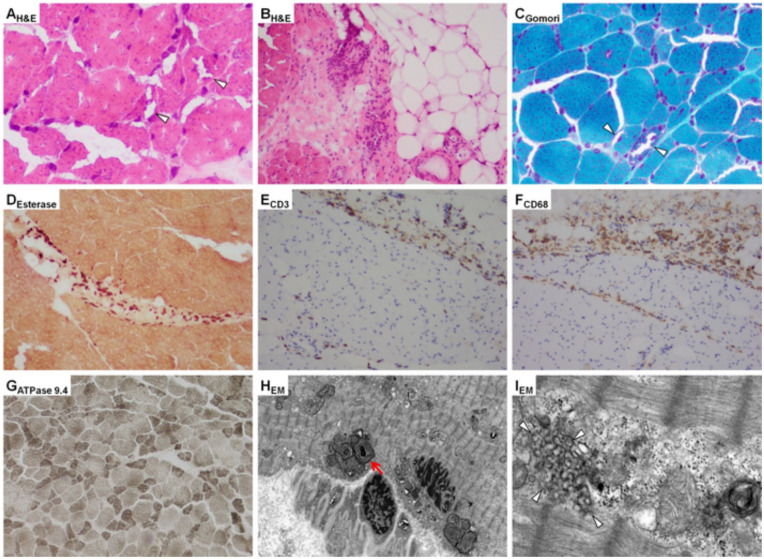
Histological analysis of right quadriceps muscle biopsy. Hematoxylin and eosin–stained images demonstrate (A) significant fiber size variation with increased granularity and vacuoles (arrow heads) and (B) perifascicular mononuclear inflammatory cells. Gomori trichrome sections demonstrate significant fiber size variation with increased granularity and vacuoles (arrow heads) (C). Perifascicular inflammatory cells highlighted by esterase (D), CD3, demonstrating infiltrating T-lymphocytes, primarily in the perifascicular compartment, with infiltration into the endomysium (E), and CD68, demonstrating histiocytes, also primarily in the perifascicular compartment (F). ATPase pH 9.4 demonstrating selective type II fiber atrophy (atrophy of darker stained fibers) (G). Electron microscopy images demonstrating abnormal autophagosomes (red arrow) (H) and curvilinear bodies corresponding to the vacuoles seen on light microscopy (arrowheads) (I).

References

    1. Chew AL, Sampson DM, Chelva E, Khan JC, Chen FK. Perifoveal interdigitation zone loss in hydroxychloroquine toxicity leads to subclinical bull’s eye lesion appearance on near-infrared reflectance imaging. Doc Ophthalmol. 2018;136:57-68. doi:10.1007/s10633-017-9615-9 - DOI - PMC - PubMed
    1. Marmor MF, Melles RB. Disparity between visual fields and optical coherence tomography in hydroxychloroquine retinopathy. Ophthalmology. 2014;121:1257-1262. doi:10.1016/j.ophtha.2013.12.002 - DOI - PubMed
    1. Stauber WT, Hedge AM, Trout JJ, Schottelius BA. Inhibition of lysosomal function in red and white skeletal muscles by chloroquine. Exp Neurol. 1981;71:295-306. doi:10.1016/0014-4886(81)90090-x - DOI - PubMed
    1. Tho JH, Blumbergs P. Hydroxychloroquine induced vacuolar myopathy mimicking acid maltase. J Clin Neurosci. 2010;17:1637. doi:10.1016/S0022-510X(09)70541-6 - DOI
    1. Cai C, Anthony DC, Pytel P. A pattern-based approach to the interpretation of skeletal muscle biopsies. Mod Pathol. 2019;32:462-483. doi:10.1038/s41379-018-0164-x - DOI - PubMed

Publication types

MeSH terms

Substances