


A systematic review evaluating the influence of incisional Negative Pressure Wound Therapy on scarring
- PMID: 32789902
- PMCID: PMC7891404
- DOI: 10.1111/wrr.12858
A systematic review evaluating the influence of incisional Negative Pressure Wound Therapy on scarring
Abstract
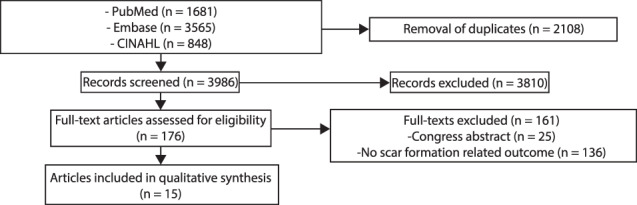
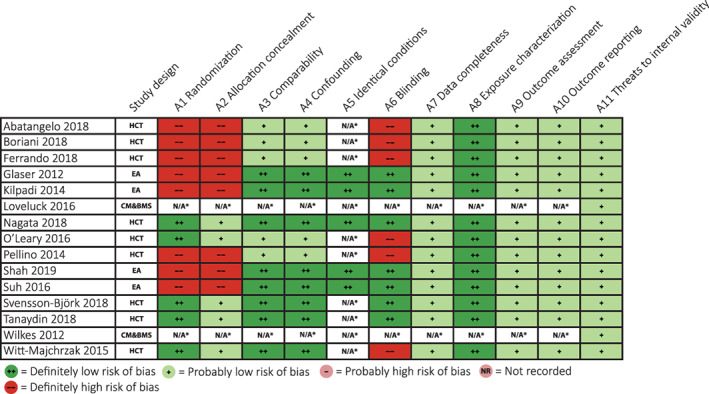
Pathological scars can result in functional impairment, disfigurement, a psychological burden, itch, and even chronic pain. We conducted a systematic review to investigate the influence of incisional Negative Pressure Wound Therapy (iNPWT) on scarring. PubMed, EMBASE and CINAHL were searched for preclinical and clinical comparative studies that investigated the influence of iNPWT on scarring-related outcomes. Individual studies were assessed using the OHAT Risk of Bias Rating Tool for Human and Animal studies. The body of evidence was rated using OHAT methodology. Six preclinical studies and nine clinical studies (377 patients) were identified. Preclinical studies suggested that iNPWT reduced lateral tension on incisions, increased wound strength, and reduced scar width upon histological assessment. Two clinical studies reported improved patient-reported scar satisfaction as measured with the PSAS (1 year after surgery), POSAS, and a VAS (both 42, 90, and 180 days after surgery). Five clinical studies reported improved observer-reported scar satisfaction as measured with the VSS, SBSES, OSAS, MSS, VAS, and POSAS (7, 15, 30, 42, 90, 180, and 365 days after surgery). Three clinical studies did not detect significant differences at any point in time (POSAS, VAS, and NRS). Because of imprecision concerns, a moderate level of evidence was identified using OHAT methodology. Preclinical as well as clinical evidence indicates a beneficial influence of iNPWT on scarring. Moderate level evidence indicates that iNPWT decreases scar width and improves patient and observer-reported scar satisfaction.
© 2020 The Authors. Wound Repair and Regeneration published by Wiley Periodicals LLC on behalf of The Wound Healing Society.
Conflict of interest statement
M.A. Boermeester reports institutional grants from J&J/Ethicon, Acelity/KCI, Allergan/LifeCell, Ipsen, Mylan, and is advisory board member of J&J/Ethicon, 3M/KCI, Bard. M.A. Boermeester is also speaker and/or instructor for 3M/KCI, Allergan/LifeCell, Bard Davol BD, Johnson&Johnson/Ethicon, Gore, and Smith & Nephew. E. Middelkoop reports institutional grants from Elastagen Pty Ltd, Micreos BV, Cutiss AG for research outside of the submitted work. O. Lapid is a speaker for Smith & Nephew. P.R. Zwanenburg is a speaker for GD Medical Pharma BV and Hospithera NV. The other authors do not declare any conflicts of interest. Please note that 3M, KCI, Smith & Nephew, GD Medical Pharma, and Hospithera NV are companies involved in the production or distribution of iNPWT technology.
Figures
References
-
- Young VL, Hutchison J. Insights into patient and clinician concerns about scar appearance: semiquantitative structured surveys. Plast Reconstr Surg. 2009;124(1):256‐265. - PubMed
-
- Bijlard E, Uiterwaal L, Kouwenberg CA, Mureau MA, Hovius SE, Huygen FJ. A systematic review on the prevalence, etiology, and pathophysiology of intrinsic pain in dermal scar tissue. Pain Physician. 2017;20(2):1‐13. - PubMed
-
- Parnell LKS. Itching for knowledge about wound and scar pruritus. Wounds. 2018;30(1):17‐36. - PubMed
-
- McOwan CG, MacDermid JC, Wilton J. Outcome measures for evaluation of scar: a literature review. J Hand Ther. 2001;14(2):77‐85. - PubMed
Publication types
MeSH terms
LinkOut - more resources
Full Text Sources
Medical
Research Materials
