


Contact Settings and Risk for Transmission in 3410 Close Contacts of Patients With COVID-19 in Guangzhou, China : A Prospective Cohort Study
- PMID: 32790510
- PMCID: PMC7506769
- DOI: 10.7326/M20-2671
Contact Settings and Risk for Transmission in 3410 Close Contacts of Patients With COVID-19 in Guangzhou, China : A Prospective Cohort Study
Abstract
Background: Risk for transmission of severe acute respiratory syndrome coronavirus 2 (SARS-CoV-2) to close contacts of infected persons has not been well estimated.
Objective: To evaluate the risk for transmission of SARS-CoV-2 to close contacts in different settings.
Design: Prospective cohort study.
Setting: Close contacts of persons infected with SARS-CoV-2 in Guangzhou, China.
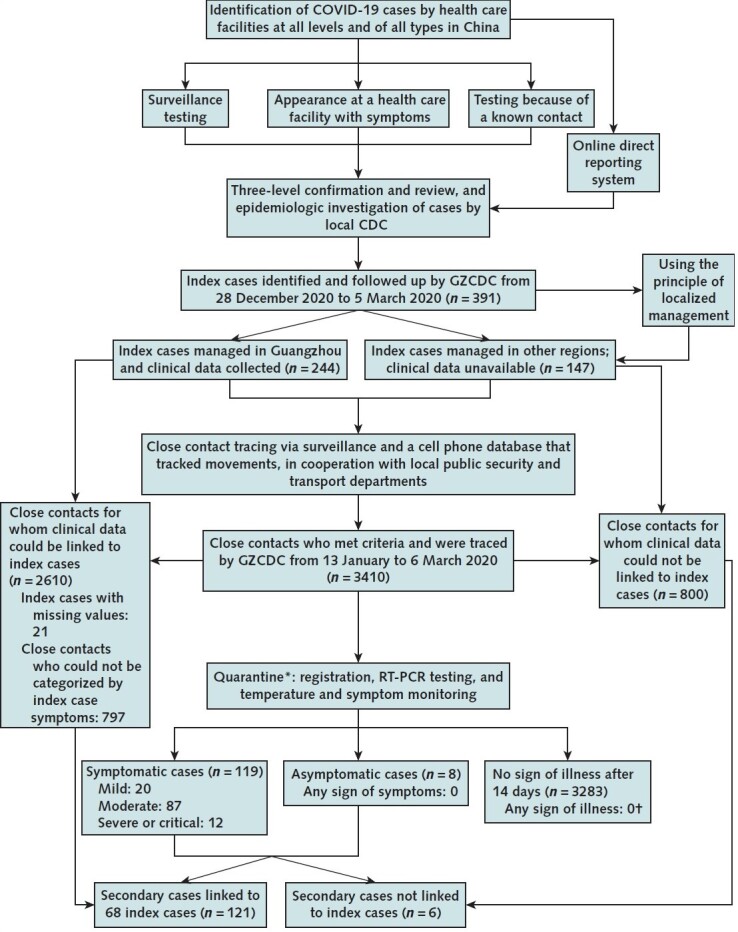
Participants: 3410 close contacts of 391 index cases were traced between 13 January and 6 March 2020. Data on the setting of the exposure, reverse transcriptase polymerase chain reaction testing, and clinical characteristics of index and secondary cases were collected.
Measurement: Coronavirus disease 2019 (COVID-19) cases were confirmed by guidelines issued by China. Secondary attack rates in different settings were calculated.
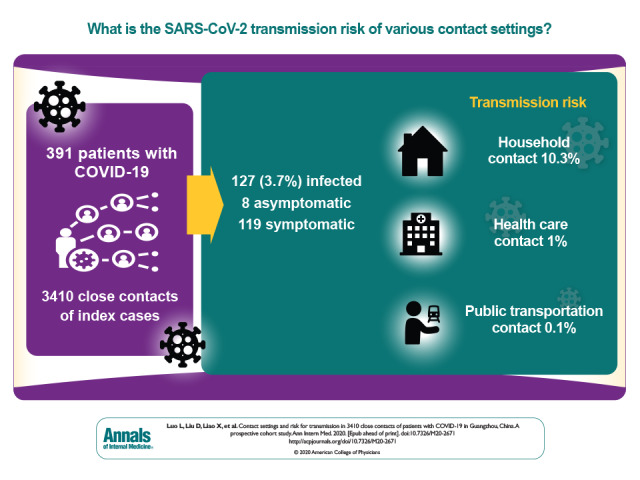
Results: Among 3410 close contacts, 127 (3.7% [95% CI, 3.1% to 4.4%]) were secondarily infected. Of these 127 persons, 8 (6.3% [CI, 2.1% to 10.5%]) were asymptomatic. Of the 119 symptomatic cases, 20 (16.8%) were defined as mild, 87 (73.1%) as moderate, and 12 (10.1%) as severe or critical. Compared with the household setting (10.3%), the secondary attack rate was lower for exposures in health care settings (1.0%; odds ratio [OR], 0.09 [CI, 0.04 to 0.20]) and on public transportation (0.1%; OR, 0.01 [CI, 0.00 to 0.08]). The secondary attack rate increased with the severity of index cases, from 0.3% (CI, 0.0% to 1.0%) for asymptomatic to 3.3% (CI, 1.8% to 4.8%) for mild, 5.6% (CI, 4.4% to 6.8%) for moderate, and 6.2% (CI, 3.2% to 9.1%) for severe or critical cases. Index cases with expectoration were associated with higher risk for secondary infection (13.6% vs. 3.0% for index cases without expectoration; OR, 4.81 [CI, 3.35 to 6.93]).
Limitation: There was potential recall bias regarding symptom onset among patients with COVID-19, and the symptoms and severity of index cases were not assessed at the time of exposure to contacts.
Conclusion: Household contact was the main setting for transmission of SARS-CoV-2, and the risk for transmission of SARS-CoV-2 among close contacts increased with the severity of index cases.
Primary funding source: Guangdong Province Higher Vocational Colleges and Schools Pearl River Scholar Funded Scheme.
Conflict of interest statement
Figures
References
-
- World Health Organization. Statement on the second meeting of the International Health Regulations (2005) Emergency Committee regarding the outbreak of novel coronavirus (2019-nCoV). 30 January 2020. Accessed at www.who.int/news-room/detail/30-01-2020-statement-on-the-second-meeting-...) on 10 March 2020.
-
- World Health Organization. Coronavirus disease 2019 (COVID-19). Situation report—127. 26 May 2020. Accessed at www.who.int/docs/default-source/coronaviruse/situation-reports/20200526-... on 27 May 2020.
Publication types
MeSH terms
LinkOut - more resources
Full Text Sources
Medical
Miscellaneous
