


Comment
doi: 10.1016/j.chom.2020.07.015.
Microbiota Can't Keep Time in Type 2 Diabetes
Affiliations
- PMID: 32791108
- PMCID: PMC7518153
- DOI: 10.1016/j.chom.2020.07.015
Item in Clipboard
Comment
Microbiota Can't Keep Time in Type 2 Diabetes
Cell Host Microbe.
.
Abstract
Gut microbes exhibit diurnal rhythmicity, and disruptions in this rhythmicity potentially impact host health. In this issue of Cell Host & Microbe, Reitmeier et al. (2020) employ timestamped gut microbiome sequencing data from human subjects coupled with machine learning to identify microbial rhythmicity patterns that predict Type 2 Diabetes incidence.
Copyright © 2020 Elsevier Inc. All rights reserved.
Figures
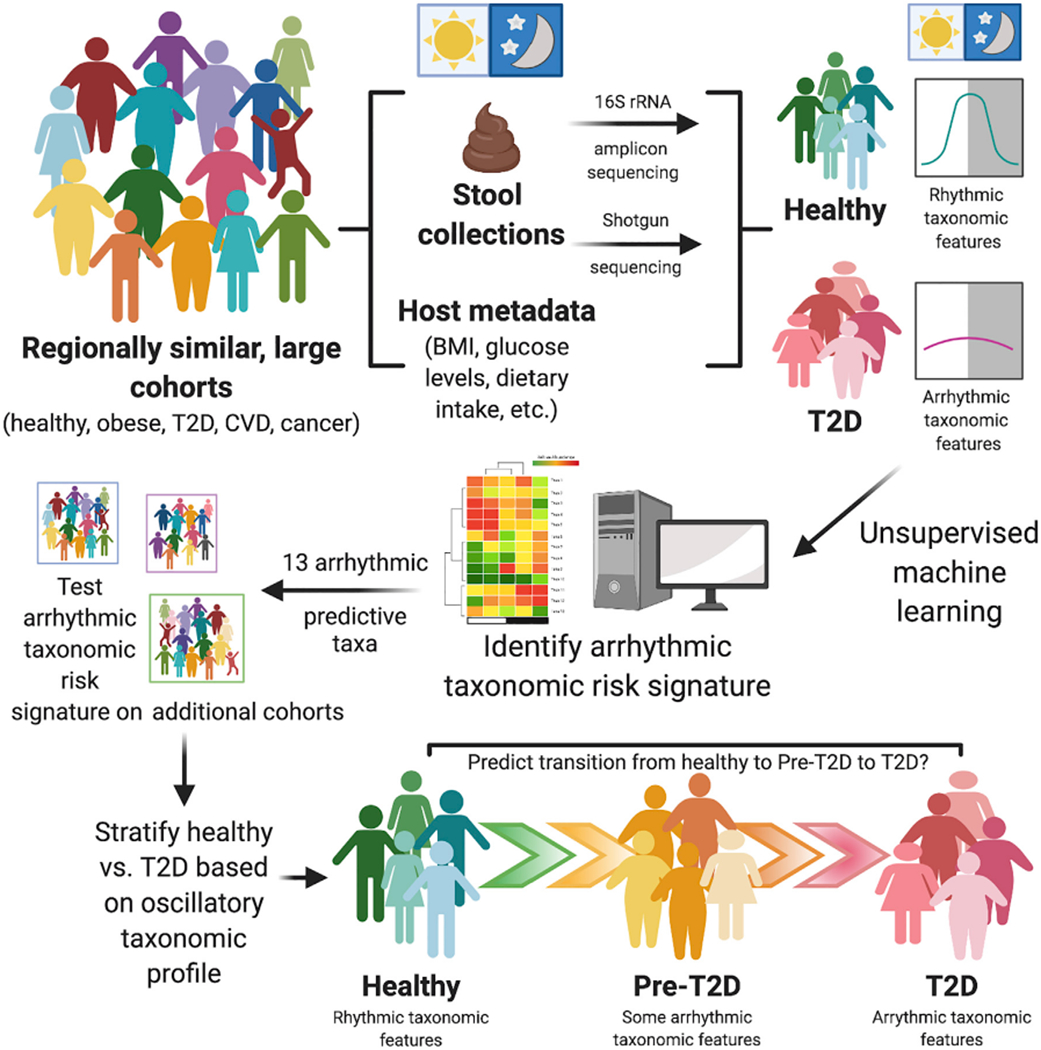
Reitmeier et al. (2020) demonstrate that gut microbiome rhythmicity can be retrospectively reconstructed using fecal collection timestamp data in single stool samples obtained from individual healthy subjects over the course of a day. A number of these microbial oscillations are absent or arrhythmic in Type 2 Diabetes (T2D) subjects. Thirteen taxa were identified as arrhythmic and predictive of T2D in the KORA cohort, which persisted in a 5-year follow-up study and was validated in other large cohorts from similar regions and may eventually allow for stratification of patients into categories of health, pre-T2D, and T2D in patient populations. While these 13 arrhythmic taxa were poor predictors of T2D in stool samples from other large cohorts outside this geographic region, this study provides a framework from which to build upon to incorporate into other timestamped datasets to aid in identifying complex diseases from gut microbiota samples in large heterogeneous cohorts.
Comment on
-
Arrhythmic Gut Microbiome Signatures Predict Risk of Type 2 Diabetes.Cell Host Microbe. 2020 Aug 12;28(2):258-272.e6. doi: 10.1016/j.chom.2020.06.004. Epub 2020 Jul 2. Cell Host Microbe. 2020. PMID: 32619440
References
-
- Kaczmarek JL, Musaad SM, and Holscher HD (2017). Time of day and eating behaviors are associated with the composition and function of the human gastrointestinal microbiota. Am. J. Clin. Nutr 106, 1220–1231. - PubMed
Publication types
MeSH terms
Grants and funding
LinkOut - more resources
Full Text Sources
Medical
