Review
. 2020 Aug 13;12(1):71.
doi: 10.1186/s13073-020-00765-y.

Strain-level epidemiology of microbial communities and the human microbiome

Affiliations
Review

Strain-level epidemiology of microbial communities and the human microbiome

Yan Yan et al. Genome Med. .

Abstract

The biological importance and varied metabolic capabilities of specific microbial strains have long been established in the scientific community. Strains have, in the past, been largely defined and characterized based on microbial isolates. However, the emergence of new technologies and techniques has enabled assessments of their ecology and phenotypes within microbial communities and the human microbiome. While it is now more obvious how pathogenic strain variants are detrimental to human health, the consequences of subtle genetic variation in the microbiome have only recently been exposed. Here, we review the operational definitions of strains (e.g., genetic and structural variants) as they can now be identified from microbial communities using different high-throughput, often culture-independent techniques. We summarize the distribution and diversity of strains across the human body and their emerging links to health maintenance, disease risk and progression, and biochemical responses to perturbations, such as diet or drugs. We list methods for identifying, quantifying, and tracking strains, utilizing high-throughput sequencing along with other molecular and "culturomics" technologies. Finally, we discuss implications of population studies in bridging experimental gaps and leading to a better understanding of the health effects of strains in the human microbiome.

Keywords: 16S; Amplicons; Metagenomics; Microbial communities; Microbial strains; Microbiome; Microbiome epidemiology.


Conflict of interest statement

The authors declare that they have no competing interests.

Figures
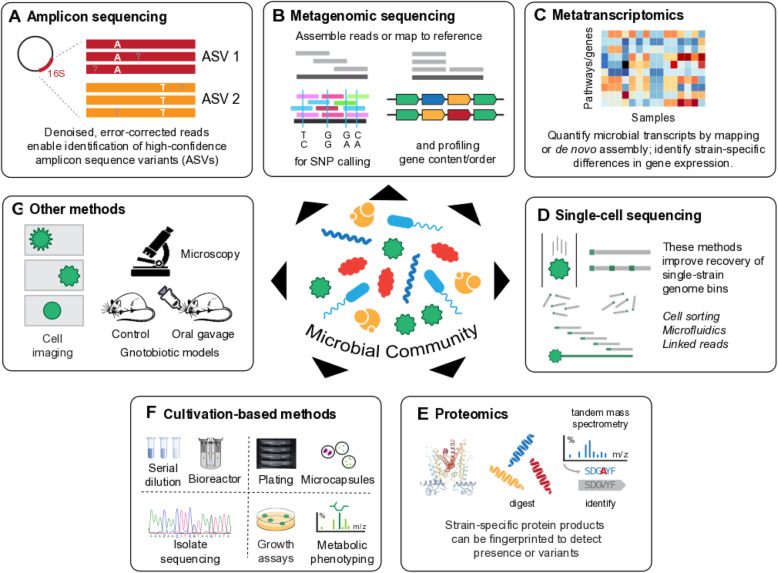
Fig. 1
Fig. 1
Strain identification approaches for microbial communities. This review summarizes a variety of high-throughput, often (but not always) culture-independent methods for strain identification within microbial communities. a Amplicon sequencing (e.g., 16S rRNA gene regions) can now be processed to near-strain-level fidelity, resulting in unique markers such as amplicon sequence variants (ASVs). b Shotgun metagenomic sequencing, either via assembly or using reference-based approaches, can identify strains broadly based on their single-nucleotide variants (SNVs) or structural variants (gene gain and loss events). c Whole-community transcriptomes can amplify the effects of gene gains or losses, or the effects of small variants that result in differential expression. d Single-cell methods can isolate individual microbial genomics directly from within communities, either via cell sorting and amplification, or through synthetic long-read/linked-read techniques. e High-throughput “culturomics” can be combined with rapid turnaround approaches such as peptide fingerprinting to strain-type isolates or microcolonies. f Relatedly, any combination of traditional isolation and high-throughput cultivation—batch, serial, or continuous—can be combined with growth, phenotypic, or molecular readouts for strain identification. g Finally, a variety of other approaches can be used with communities, ranging from flow- or high-content microscopic imaging to systems such as gnotobiotic animal model physiology and phenotyping
Fig. 2
Fig. 2
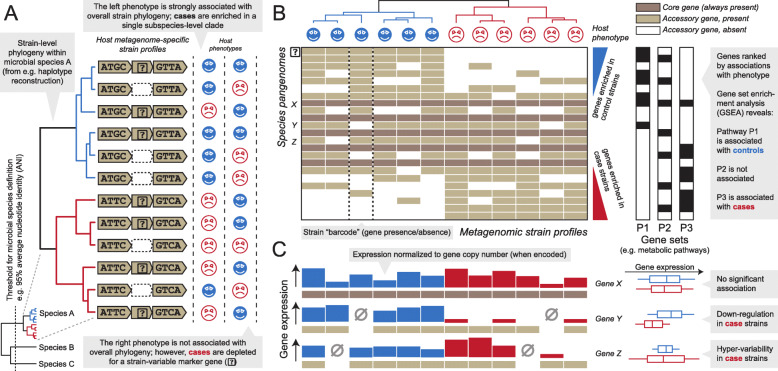
Microbial SNV, structural, and metatranscriptomic variants as features for genetic epidemiology in the human microbiome. Statistical approaches can link subspecies microbial features to human health phenotypes in several ways. a When microbial strains are identified using SNV genotypes (whether from genome bins, marker genes, core genes, etc.), any individual microbial SNV—or overall genotype—is typically of low prevalence and high variability. This means that it is extremely difficult to power significant associations with individual SNVs in reasonably sized human population studies. Instead, significant assortment of a host phenotype with strain phylogeny can be assessed, e.g., by PERMANOVA on per-species genetic distances [8] or by aggregating SNVs to genes or larger loci. b An extreme of this type of association test directly assesses the nonrandom assortment of genes’ presence or absence among microbial strain pangenomes in association with a phenotype of interest [66], since a gene loss (or gain) is essentially the “sum” of variants at every nucleotide within the gene. c Alternatively, even when no differences in genomic SNVs or structural variants are detectable at a study’s level of power, the transcriptional regulatory effects of these variants can be amplified, resulting in strain-specific differences in locus expression in association with a phenotype [156]

References

    1. Falkow S. Molecular Koch's postulates applied to bacterial pathogenicity—a personal recollection 15 years later. Nat Rev Microbiol. 2004;2:67–72. - PubMed
    1. Konstantinidis KT, Ramette A, Tiedje JM. The bacterial species definition in the genomic era. Philos Trans R Soc Lond Ser B Biol Sci. 2006;361:1929–1940. - PMC - PubMed
    1. Dijkshoorn L, Ursing BM, Ursing JB. Strain, clone and species: comments on three basic concepts of bacteriology. J Med Microbiol. 2000;49:397–401. - PubMed
    1. Zhu A, Sunagawa S, Mende DR, Bork P. Inter-individual differences in the gene content of human gut bacterial species. Genome Biol. 2015;16:82. - PMC - PubMed
    1. L. G. Wayne DJB, R. R. Colwell, P. A. D. Grimont, O. Kandler, M. I. Krichevsky, L. H. Moore, W. E. C. Moore, R. G. E. Murray, E. Stackebrandt, M. P. Starr and H. G. Truper: Report of the Ad Hoc Committee on Reconciliation of Approaches to Bacterial Systematics. 1987.

Publication types

Substances

LinkOut - more resources