The civil registration system is a potentially viable data source for reliable subnational mortality measurement in India
- PMID: 32792407
- PMCID: PMC7430426
- DOI: 10.1136/bmjgh-2020-002586
The civil registration system is a potentially viable data source for reliable subnational mortality measurement in India
Abstract
Introduction: The Indian national Civil Registration System (CRS) is the optimal data source for subnational mortality measurement, but is yet under development. As an alternative, data from the Sample Registration System (SRS), which covers less than 1% of the national population, is used. This article presents a comparison of mortality measures from the SRS and CRS in 2017, and explores the potential of the CRS to meet these subnational data needs.
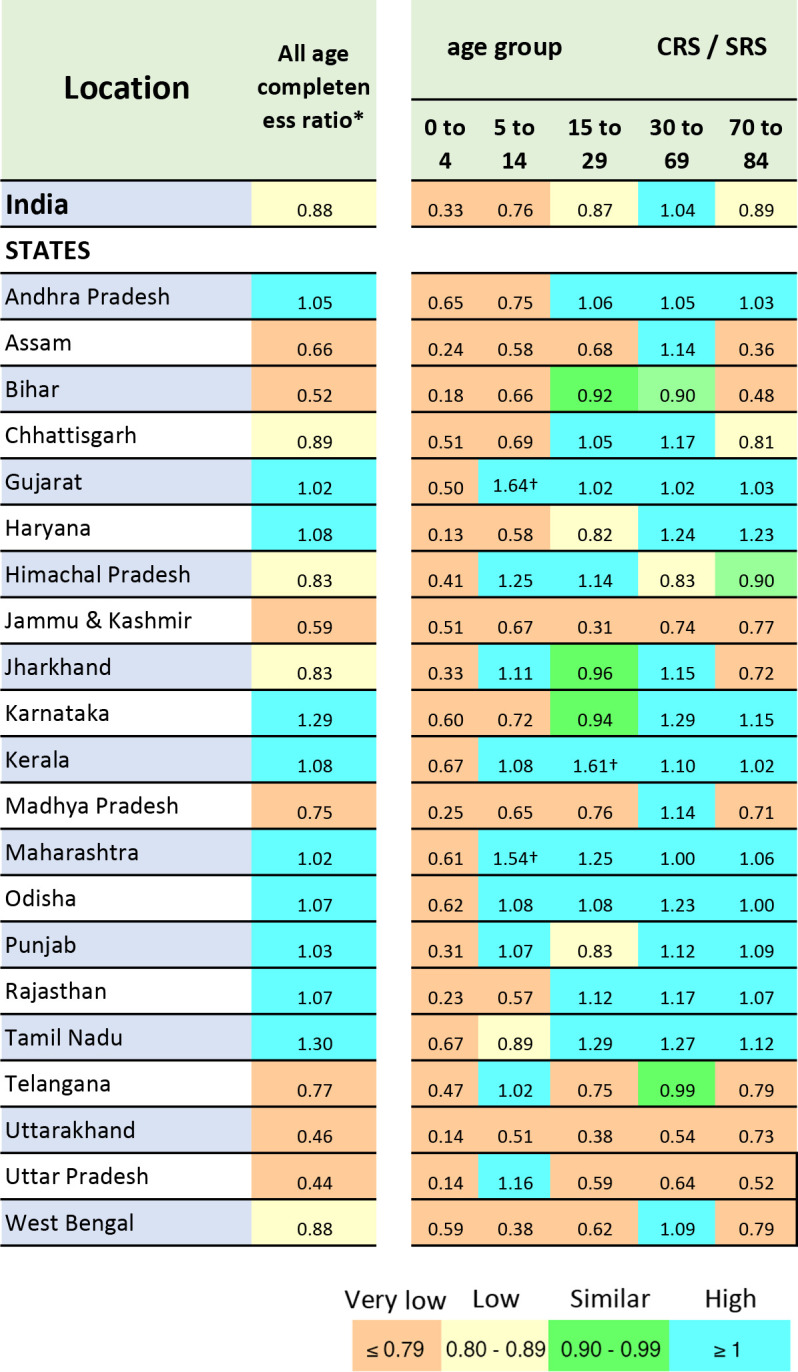
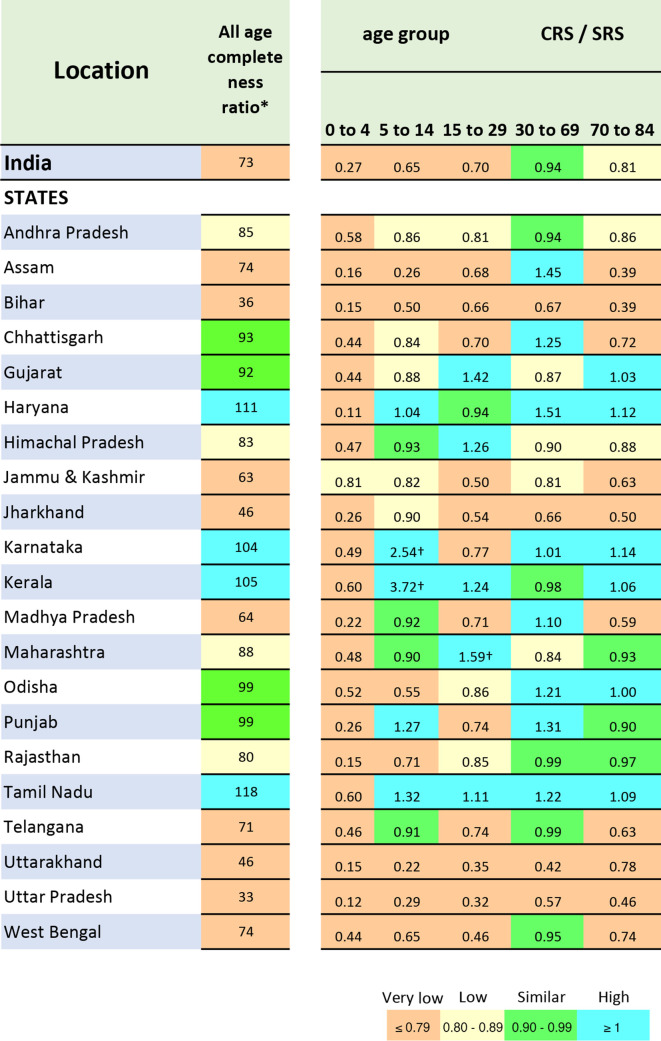
Methods: Data on population and deaths by age and sex for 2017 from each source were used to compute national-level and state-level life tables. Sex-specific ratios of death probabilities in five age categories (0-4, 5-14, 15-29, 30-69, 70-84) were used to evaluate CRS data completeness using SRS probabilities as reference values. The quality of medically certified causes of death was assessed through hospital reporting coverage and proportions of deaths registered with ill-defined causes from each state.
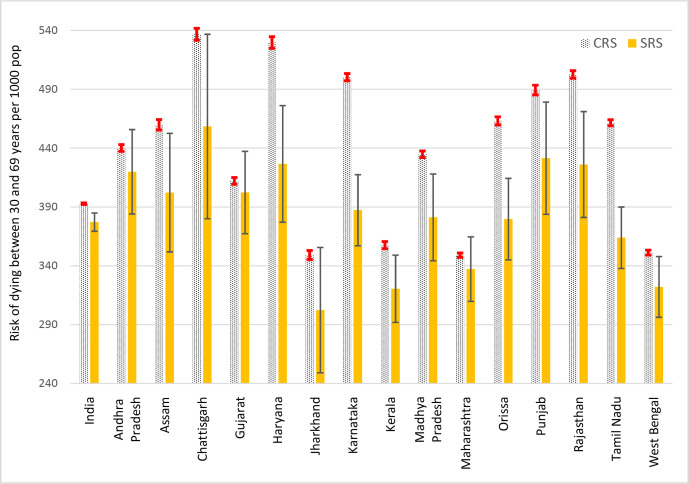
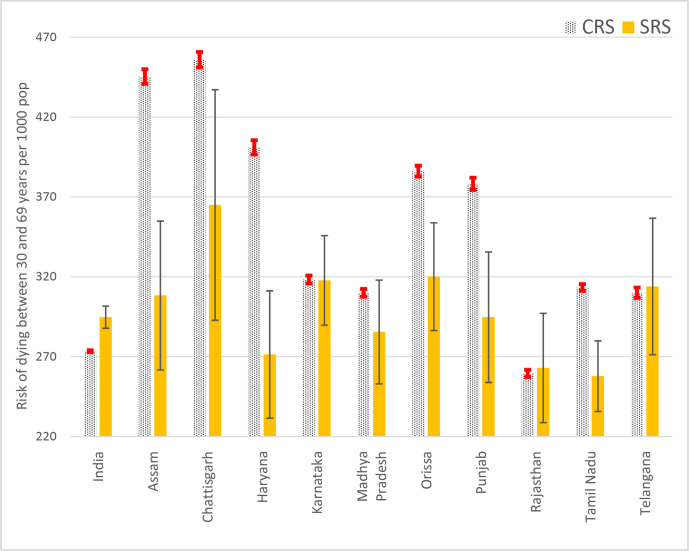
Results: The CRS operates through an extensive infrastructure with high reporting coverage, but child deaths are uniformly under-reported, as are female deaths in many states. However, at ages 30-69 years, CRS death probabilities are higher than the SRS values in 15 states for males and 10 states for females. SRS death probabilities are of limited precision for measuring mortality trends and differentials. Data on medically certified causes of death are of limited use due to low hospital reporting coverage.
Conclusions: The Indian CRS is more reliable than the SRS for measuring adult mortality in several states. Targeted initiatives to improve the recording of child and female deaths, to strengthen the reporting and quality of medically certified causes of death, and to promote use of verbal autopsy methods can establish the CRS as a reliable source of subnational mortality statistics in the near future.
Keywords: epidemiology; public health.
© Author(s) (or their employer(s)) 2020. Re-use permitted under CC BY-NC. No commercial re-use. See rights and permissions. Published by BMJ.
Conflict of interest statement
Competing interests: None declared.
Figures
References
-
- Mills SL, Abouzahr C, Kim JH, et al. Civil registration and vital statistics (CRVS) for monitoring the sustainable development goals. Washington D.C: World Bank Group, 2017. http://documents.worldbank.org/curated/en/979321495190619598/Civil-regis...
-
- Ruzicka LT, Lopez AD. The use of cause-of-death statistics for health situation assessment: national and international experiences. World Health Stat Q 1990;43:249–57. - PubMed
-
- Mahapatra P, Chalapati Rao PV. Cause of death reporting systems in India: a performance analysis. Natl Med J India 2001;14:154–62. - PubMed
-
- Office of the Registrar General and Census Commissioner of India Sample registration system new Delhi: vital statistics division, office of the registrar General of India, 2020. Available: http://censusindia.gov.in/Vital_Statistics/SRS/Sample_Registration_Syste... [Accessed 17 Mar 2020].
MeSH terms
LinkOut - more resources
Full Text Sources