. 2020 Aug 13;10(1):13753.
doi: 10.1038/s41598-020-70742-3.

Six to 12-year outcomes of magnetic sphincter augmentation for gastroesophageal reflux disease

Affiliations

Six to 12-year outcomes of magnetic sphincter augmentation for gastroesophageal reflux disease

Davide Ferrari et al. Sci Rep. .

Abstract

The magnetic sphincter augmentation (MSA) device has been proven safe and effective in controlling typical reflux symptoms and esophageal acid exposure for up to 6-year follow-up. Longer term outcomes have not been reported yet. A prospectively maintained database was reviewed to assess long-term safety and efficacy of the laparoscopic MSA procedure at a single referral center. Gastro-Esophageal Reflux Disease-Health Related Quality of Life (GERD-HRQL), use of proton-pump inhibitors (PPI), and esophageal acid exposure were compared to baseline. Favorable outcomes were defined as ≥ 50% improvement of GERD-HRQL total score and PPI discontinuation. Between March 2007 and March 2020, 335 patients met the study inclusion criteria, and 124 of them were followed from 6 to 12 years after surgery (median 9 years, IQR 2). Mean total GERD-HRQL score significantly improved from 19.9 to 4.01 (p < 0.001), and PPI were discontinued by 79% of patients. The mean total percent time with pH < 4 decreased from 9.6% at baseline to 4.1% (p < 0.001), with 89% of patients achieving pH normalization. Independent predictors of a favorable outcome were age at intervention < 40 years (OR 4.17) and GERD-HRQL score > 15 (OR 4.09). We confirm long-term safety and efficacy of MSA in terms of symptom improvement, decreased drug dependency, and reduced esophageal acid exposure.


Conflict of interest statement

The authors declare no competing interests.

Figures
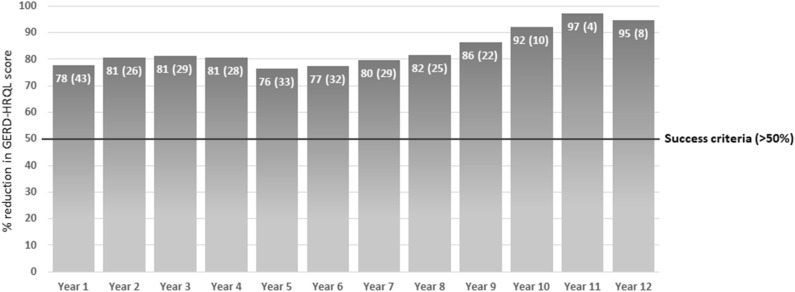
Figure 1
Figure 1
Average percent reduction (± SD) of total GERD-HRQL score per year over the follow-up.
Figure 2
Figure 2
Changes of Hill grade classification in 45 patients after magnetic sphincter augmentation.
Figure 3
Figure 3
Median % time at pH < 4 (A) and median DeMeester score (B) in sequential pH studies compared to baseline.
Figure 4
Figure 4
Kaplan–Meier estimate of explant-free probability over 6- to 12-year follow-up after magnetic sphincter augmentation (95% confidence interval indicated pointwise). [Graph created using SPSS software 23.0, URL = https://www.ibm.com/software/analytics/spss/register/].
Figure 5
Figure 5
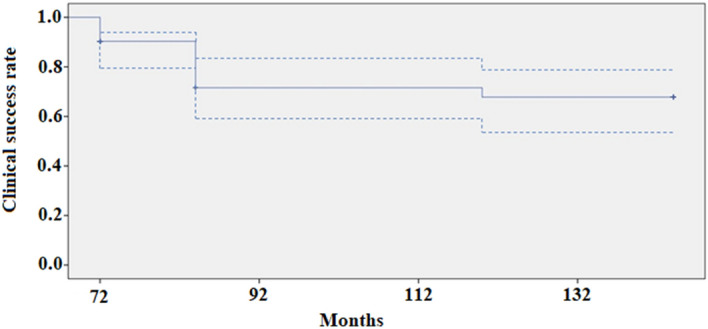
Kaplan–Meier estimate of clinical success (GERD-HRQL < 50% reduction or PPI discontinuation) over 6- to 12-year follow-up after magnetic sphincter augmentation (95% confidence interval indicated pointwise).[Graph created using SPSS software 23.0, URL = https://www.ibm.com/software/analytics/spss/register/].

References

    1. Eusebi LH, Ratnakumaran R, Yuan Y, Solaymani-Dodaran M, Bazzoli F, Ford AC. Global prevalence of, and risk factors for, gastro-oesophageal reflux symptoms: a meta-analysis. Gut. 2018;67:430–440. doi: 10.1136/gutjnl-2016-313589. - DOI - PubMed
    1. El-Serag HB, Becher A, Jones R. Systematic review: persistent reflux symptoms on proton pump inhibitor therapy in primary care and community studies. Aliment Pharmacol. Ther. 2010;32:720–737. doi: 10.1111/j.1365-2036.2010.04406.x. - DOI - PubMed
    1. Kahrilas PJ, Jonsson A, Denison H, Wernersson B, Hughes N, Howden CW. Regurgitation is less responsive to acid suppression than heartburn in patients with gastroesophageal reflux disease. Clin. Gastroenterol. Hepatol. 2012;10:612–619. doi: 10.1016/j.cgh.2012.01.022. - DOI - PubMed
    1. Watson DI, Baigrie RJ, Jamieson GG. A learning curve for laparoscopic fundoplication. Definable, avoidable, or a waste of time? Ann. Surg. 1996;224:198–203. doi: 10.1097/00000658-199608000-00013. - DOI - PMC - PubMed
    1. Pandolfino JE, Curry J, Shi G, Johel RJ, Brasseur JG, Kahrilas PJ. Restoration of normal distensive characteristics of the esophagogastric junction after fundoplication. Ann. Surg. 2005;242:43–48. doi: 10.1097/01.sla.0000167868.44211.f0. - DOI - PMC - PubMed

Publication types