. 2020 Aug 13;10(1):13761.
doi: 10.1038/s41598-020-70436-w.

Molecular evolution of coxsackievirus A24v in Cuba over 23-years, 1986-2009

Affiliations

Molecular evolution of coxsackievirus A24v in Cuba over 23-years, 1986-2009

Magilé C Fonseca et al. Sci Rep. .

Abstract

Coxsackievirus A24 variant (CVA24v) is a major causative agent of acute hemorrhagic conjunctivitis outbreaks worldwide, yet the evolutionary and transmission dynamics of the virus remain unclear. To address this, we analyzed and compared the 3C and partial VP1 gene regions of CVA24v isolates obtained from five outbreaks in Cuba between 1986 and 2009 and strains isolated worldwide. Here we show that Cuban strains were homologous to those isolated in Africa, the Americas and Asia during the same time period. Two genotypes of CVA24v (GIII and GIV) were repeatedly introduced into Cuba and they arose about two years before the epidemic was detected. The two genotypes co-evolved with a population size that is stable over time. However, nucleotide substitution rates peaked during pandemics with 4.39 × 10⁻³ and 5.80 × 10⁻³ substitutions per site per year for the 3C and VP1 region, respectively. The phylogeographic analysis identified 25 and 19 viral transmission routes based on 3C and VP1 regions, respectively. Pandemic viruses usually originated in Asia, and both China and Brazil were the major hub for the global dispersal of the virus. Together, these data provide novel insight into the epidemiological dynamics of this virus and possibly other pandemic viruses.


Conflict of interest statement

The authors declare no competing interests.

Figures

Figure 1
Figure 1
Heat map from nucleotide identity matrix of the 3C region alignment. Sequences were classified by GI-IV Genotypes described by Chu et.al.. Genotypes are indicated by the color legend on the top and in the left side in correspondence with the genotype’s clade distribution. Cuban (1997) and USA (1998) sequences are highlighted in yellow. Cuban sequences from five AHC epidemics are highlighted in red rectangles.
Figure 2
Figure 2
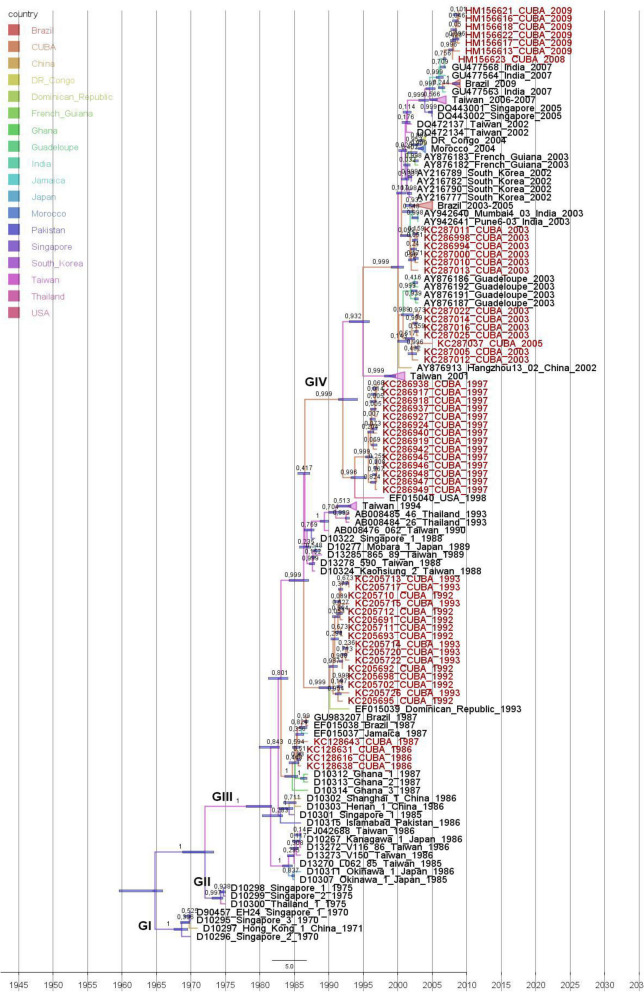
Maximum clade credibility (MCC) phylogeny tree of 3C sequences (507 nt) of Cuban (n = 54, in red) and worldwide CVA24v strains (n = 83). For each branch, the color indicates the most probable location state of their descendent nodes. Bars at nodes indicate 95% HPDs of TMRCAs. Branches forming genotypes GI-GIV are shown. The sequences are indicated by GenBank accession number, strain name, country and year of isolation.
Figure 3
Figure 3
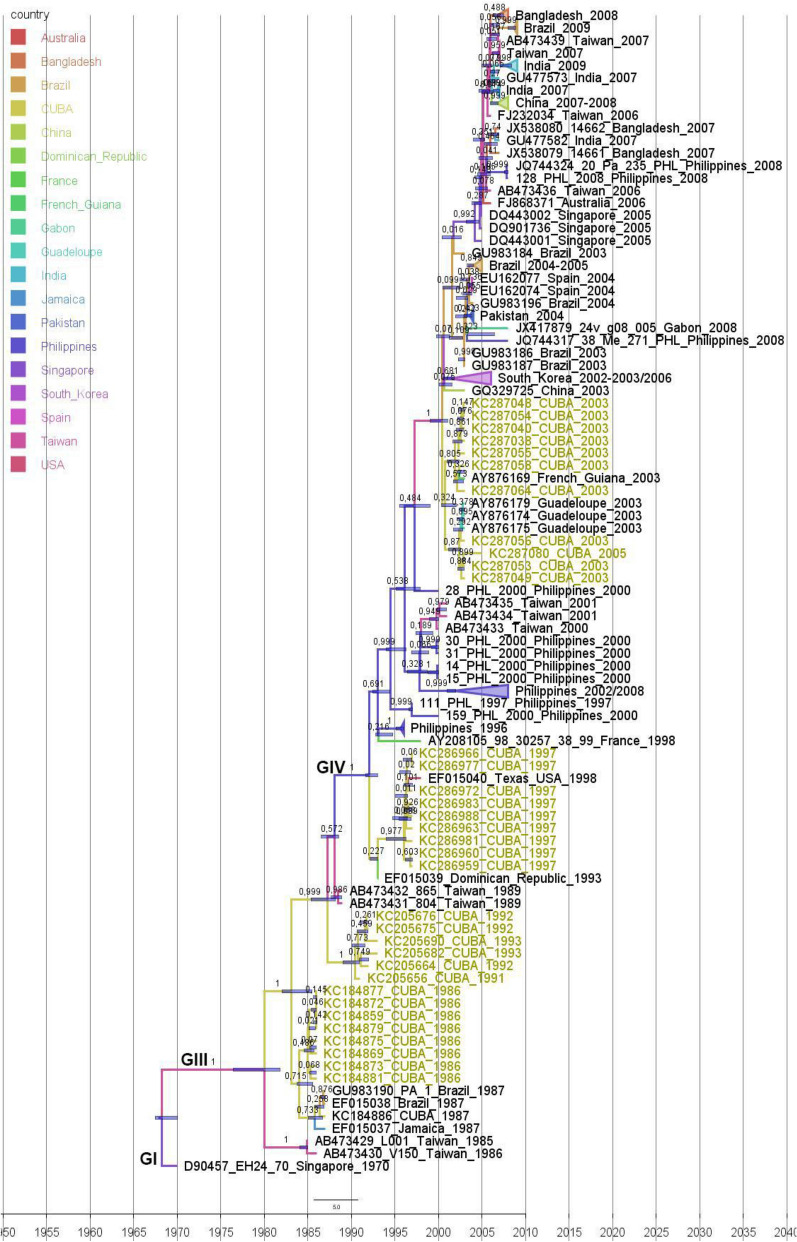
Maximum clade credibility (MCC) phylogeny of VP1 sequences (234 nt) of Cuban (n = 35 in yellow) and worldwide CVA24v strains (n = 95). For each branch, the color indicates the most probable location state of their descendent nodes Bars at nodes indicate 95% HPDs of TMRCAs. Branches forming genotypes GI-GIV are shown. The sequences are indicated by GenBank accession number, strain name, country and year of isolation.
Figure 4
Figure 4
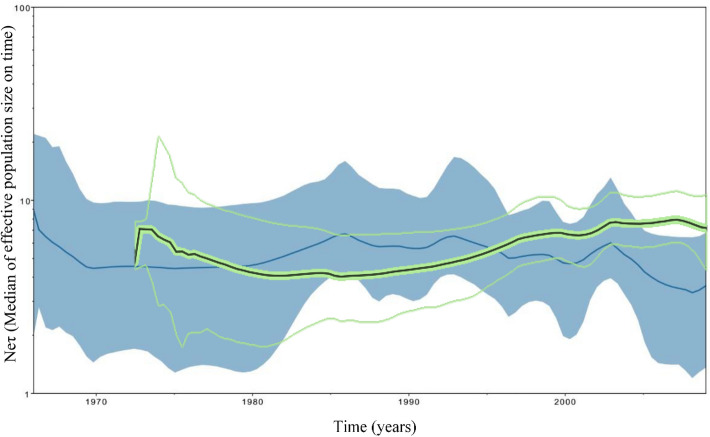
Bayesian skyride plot of Cuban and world-wide of 3C (137 sequences, 507 nt) coding region (blue) and VP1 (130 sequences, 234nt) coding region (green) of CVA24v. The x-axis is the time scale (years) and the y-axis is the logarithmic Neτ scale (Ne is the median of effective population size and τ is the generation time). The thick solid line indicates the median estimates and the shaded area indicates the 95% HPD.

References

    1. Zell R, et al. ICTV virus taxonomy profile: Picornaviridae. J. Gen. Virol. 2017;98(10):2421–2422. doi: 10.1099/jgv.0.000911. - DOI - PMC - PubMed
    1. Muslin C, Mac Kain A, Bessaud M, Blondel B, Delpeyroux F. Recombination in enteroviruses, a multi-step modular evolutionary process. Viruses. 2019;11(9):859. doi: 10.3390/v11090859. - DOI - PMC - PubMed
    1. Chang CH, Lin KH, Sheu MM, Huang WL, Wang HZ, Chen CW. The change of etiological agents and clinical signs of epidemic viral conjunctivitis over an 18-year period in southern Taiwan. Graefes Arch. Clin. Exp. Ophthalmol. 2003;241(7):554–560. doi: 10.1007/s00417-003-0680-2. - DOI - PubMed
    1. Leveque N, et al. Rapid diagnosis of acute hemorrhagic conjunctivitis due to coxsackievirus A24 variant by real-time one-step RT-PCR. J. Virol. Methods. 2007;142(1–2):89–94. doi: 10.1016/j.jviromet.2007.01.009. - DOI - PubMed
    1. Yen YC, et al. Phylodynamic characterization of an ocular-tropism coxsackievirus A24 variant. PLoS ONE. 2016;11:e0160672. doi: 10.1371/journal.pone.0160672. - DOI - PMC - PubMed

Publication types

MeSH terms